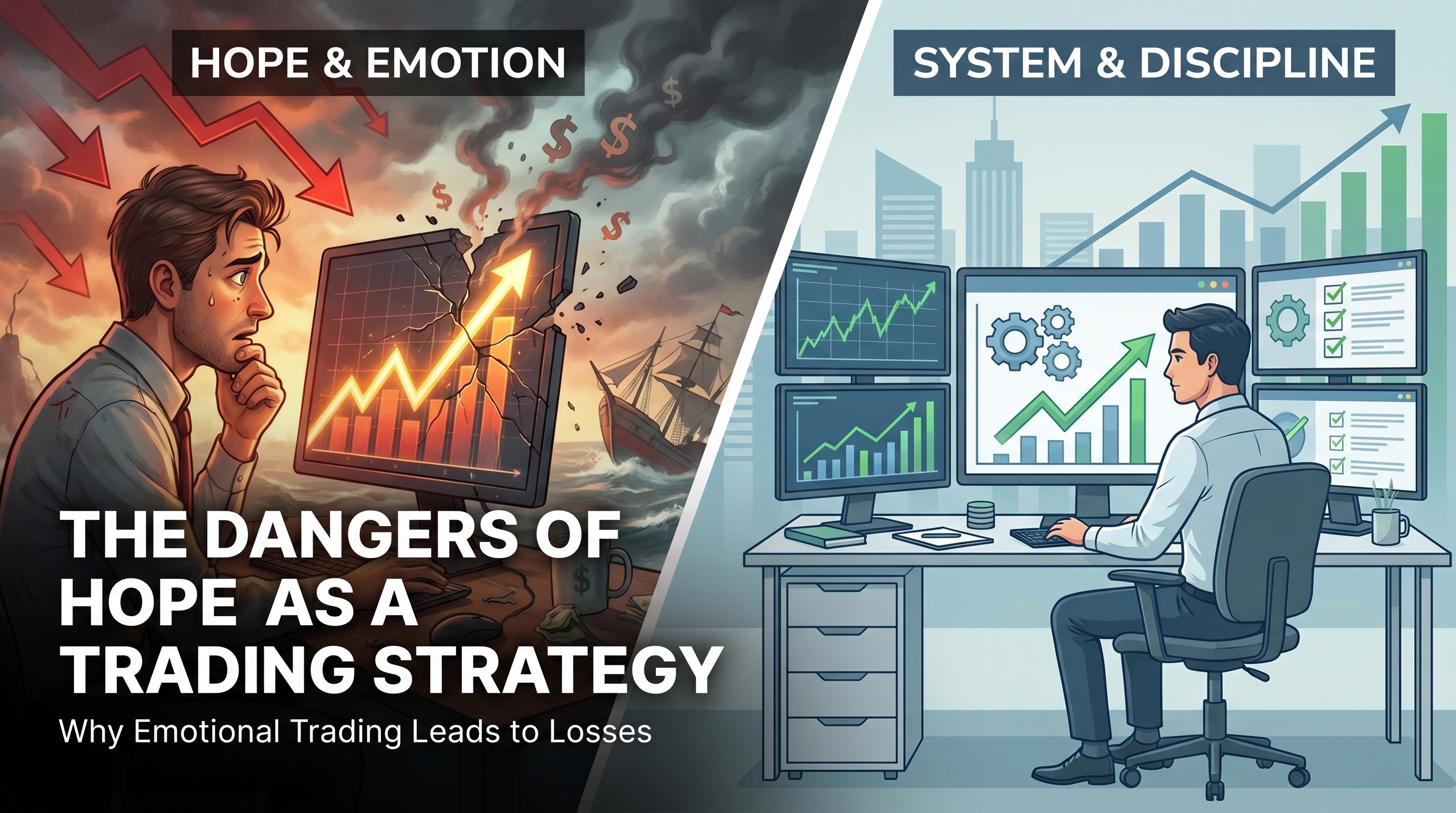
# The Dangers of Hope as a Trading Strategy: Why Emotional Trading Leads to Losses
Hope is one of the most dangerous emotions a trader can experience. While hope serves us well in many areas of life, in trading it becomes a destructive force that clouds judgment, prevents logical decision-making, and ultimately leads to significant financial losses. Understanding why hope as a trading strategy fails is crucial for developing the disciplined mindset necessary for consistent trading success.
:::warning Using hope as a trading strategy is one of the fastest ways to blow a trading account. Professional traders rely on systematic approaches, not wishful thinking. :::
Table of Contents
- [What is Hope in Trading](#what-is-hope-in-trading)
- [The Psychology Behind Hope-Based Trading](#the-psychology-behind-hope-based-trading)
- [How Hope Manifests in Trading Decisions](#how-hope-manifests-in-trading-decisions)
- [The Financial Cost of Hope-Driven Trading](#the-financial-cost-of-hope-driven-trading)
- [Replacing Hope with Systematic Trading](#replacing-hope-with-systematic-trading)
- [Building a Hope-Free Trading Mindset](#building-a-hope-free-trading-mindset)
What is Hope in Trading
Hope in trading occurs when traders make decisions based on wishful thinking rather than objective market analysis. It's the belief that a losing position will magically turn around, that a stock will recover "just because," or that the market will move in your favor without any logical basis for that expectation.
:::key-concept Hope as a trading strategy replaces analytical thinking with emotional attachment to outcomes. It's characterized by holding losing positions too long, averaging down without proper analysis, and ignoring clear exit signals. :::
Unlike calculated risk-taking based on technical or fundamental analysis, hope-driven trading lacks any systematic foundation. Traders using hope as a trading strategy often:
- Hold onto losing positions far longer than planned
- Refuse to accept stop losses
- Average down on declining stocks without proper analysis
- Ignore their trading plan when emotions take over
- Make decisions based on what they want to happen rather than what's likely to happen
:::example A trader buys a stock at $50, sets a stop loss at $45, but when the stock hits $45, they remove the stop loss hoping it will recover. The stock continues falling to $35, turning a manageable 10% loss into a devastating 30% loss. :::
The Psychology Behind Hope-Based Trading
The tendency to use hope as a trading strategy stems from several psychological biases that evolution hardwired into human behavior. These mental shortcuts that once helped our ancestors survive now work against us in financial markets.
Loss Aversion and Sunk Cost Fallacy
Loss aversion, identified by behavioral economists, explains why people feel losses twice as intensely as equivalent gains. This creates a powerful psychological resistance to realizing losses, leading traders to hold losing positions hoping they'll recover.
The sunk cost fallacy compounds this problem. Once traders have invested money in a position, they feel compelled to "see it through" rather than cut their losses, even when all evidence suggests the trade has failed.
Confirmation Bias
Traders using hope as a trading strategy often fall victim to confirmation bias, seeking information that supports their desired outcome while ignoring contradictory evidence. They focus on minor upticks in a downtrending stock while dismissing fundamental deterioration or technical breakdown.
:::warning Confirmation bias can blind traders to obvious warning signs. Always seek disconfirming evidence for your positions and maintain objectivity in your analysis. :::
Overconfidence and Illusion of Control
Many traders believe they can influence market outcomes through sheer willpower or that their past successes guarantee future wins. This overconfidence leads to oversized positions and reluctance to admit when they're wrong.
How Hope Manifests in Trading Decisions
Hope as a trading strategy appears in numerous destructive behaviors that experienced traders learn to recognize and eliminate from their approach.
Removing or Moving Stop Losses
The most common manifestation occurs when traders remove or widen stop losses as prices approach their predetermined exit points. Instead of accepting the planned loss, they hope the market will reverse in their favor.
:::example A forex trader enters EUR/USD long at 1.1000 with a stop at 1.0950. As price approaches 1.0950, instead of taking the 50-pip loss, they move the stop to 1.0900, hoping for a bounce. The pair continues falling to 1.0800, creating a 200-pip loss instead of the planned 50-pip loss. :::
Averaging Down Without Analysis
Hope-driven traders often add to losing positions, believing that buying more shares at lower prices will reduce their average cost and speed recovery. However, without proper analysis to confirm the position's viability, this strategy often multiplies losses.
Ignoring Exit Signals
Traders using hope as a trading strategy frequently ignore clear technical or fundamental signals that their thesis has failed. They hold positions despite broken support levels, negative earnings surprises, or deteriorating chart patterns.
Overtrading to Recover Losses
After suffering losses, hope-driven traders often increase their trading frequency or position sizes, hoping to quickly recover their losses. This emotional trading typically leads to additional losses and deeper drawdowns.
:::tip Never try to recover losses by increasing position sizes or trading frequency. This approach violates proper risk management and often compounds problems. :::
The Financial Cost of Hope-Driven Trading
The financial consequences of using hope as a trading strategy can be devastating, turning manageable losses into account-threatening disasters.
Amplified Losses
Hope prevents traders from cutting losses when they're small, allowing minor setbacks to become major losses. Studies show that the average loss for hope-driven trades often exceeds the average gain by significant margins, creating negative expectancy.
Opportunity Cost
Capital tied up in hope-based losing positions cannot be deployed in potentially profitable trades. This opportunity cost compounds the direct financial losses from failed positions.
Psychological Damage
Beyond financial losses, hope-driven trading creates psychological trauma that can impact future trading decisions. Large losses often lead to revenge trading, fear-based decisions, or complete abandonment of trading altogether.
:::warning Psychological capital is just as important as financial capital. Protect both by avoiding hope-based trading decisions that can damage your confidence and judgment. :::
Account Drawdowns
Traders who consistently rely on hope as a trading strategy often experience severe account drawdowns that require enormous percentage gains to recover. A 50% loss requires a 100% gain just to break even.
Replacing Hope with Systematic Trading
Successful traders replace hope as a trading strategy with systematic, rule-based approaches that remove emotional decision-making from the equation.
Develop Clear Entry and Exit Rules
Every trade should have predetermined entry criteria, stop loss levels, and profit targets before you enter the position. These rules should be based on technical analysis, fundamental research, or proven trading strategies.
:::key-concept Never enter a trade without knowing exactly when and why you'll exit. Hope has no place in a well-planned trade. :::
Implement Proper Position Sizing
Use position sizing rules that limit the impact of any single trade on your account. Many successful traders risk no more than 1-2% of their account on any single position.
Use Stop Losses Religiously
Treat stop losses as insurance policies, not suggestions. Once set based on technical or risk management criteria, honor them without exception.
Focus on Probability and Expectancy
Instead of hoping for specific outcomes, focus on trades with positive expectancy over many repetitions. Accept that individual trades will fail but trust that your systematic approach will be profitable over time.
:::example A systematic trader identifies a breakout pattern that historically succeeds 60% of the time with an average gain of 3R (three times risk) when successful. Even though 40% of trades will lose 1R, the expected value is positive: (0.6 × 3R) + (0.4 × -1R) = 1.4R per trade. :::
Maintain Detailed Trade Records
Keep comprehensive records of your trades, including entry/exit reasons, emotions felt, and lessons learned. This data helps identify when hope influences your decisions and tracks your progress in eliminating emotional trading.
Building a Hope-Free Trading Mindset
Developing a trading mindset that doesn't rely on hope as a trading strategy requires conscious effort and consistent practice.
Accept That Losses Are Part of Trading
Understand that losses are an inevitable part of trading, not personal failures. Professional traders expect and plan for losses as a cost of doing business.
:::tip Frame losses as tuition paid to learn about market behavior rather than failures. This mindset shift helps remove the emotional sting that leads to hope-based decisions. :::
Practice Mindfulness and Emotional Awareness
Develop awareness of your emotional state while trading. Recognize when hope, fear, or greed begin influencing your decisions and step away from the markets until you can think clearly.
Use Mechanical Trading Rules
Implement trading rules that are mechanical enough to follow regardless of emotional state. If your system says exit, exit immediately without debate or negotiation.
Focus on Process Over Outcomes
Judge your trading performance based on how well you follow your process, not on individual trade outcomes. A perfectly executed losing trade is better than a hoped-for winner that violates your rules.
Regular Trading Review Sessions
Schedule regular review sessions to analyze your trades objectively. Look for instances where hope influenced your decisions and develop specific rules to prevent similar situations.
:::key-concept Treat trading as a business with defined processes, not a gambling activity based on hope and luck. Businesses succeed through systematic execution, not wishful thinking. :::
Develop Alternative Scenarios
Before entering any trade, consider what you'll do if the market moves against you. Having predetermined plans for negative scenarios reduces the likelihood of falling back on hope when things go wrong.
Use Technology to Enforce Discipline
Leverage technology such as bracket orders, automatic stop losses, and position sizing calculators to enforce your rules mechanically. This removes the temptation to override logical decisions with hope-based thinking.
Conclusion
Hope as a trading strategy represents one of the most destructive approaches to financial markets. While hope serves us well in many life situations, it becomes a liability when making trading decisions that require objectivity, discipline, and systematic thinking.
The evidence is clear: traders who rely on hope consistently underperform those who use systematic, rule-based approaches. Hope prevents us from cutting losses quickly, leads to poor position sizing decisions, and clouds our judgment when we most need clarity.
Replacing hope with systematic trading methods requires conscious effort and practice. By developing clear rules, implementing proper risk management, and maintaining emotional discipline, traders can eliminate hope-based decisions and focus on approaches with positive expectancy.
Remember that successful trading is about managing risk and following processes, not about hoping for favorable outcomes. Every professional trader has learned to suppress the natural human tendency to hope and instead rely on evidence-based decision making.
Ready to eliminate hope from your trading approach? Start by reviewing your recent trades and identifying instances where hope influenced your decisions. Develop specific rules to address these situations and commit to following your systematic approach regardless of short-term outcomes.