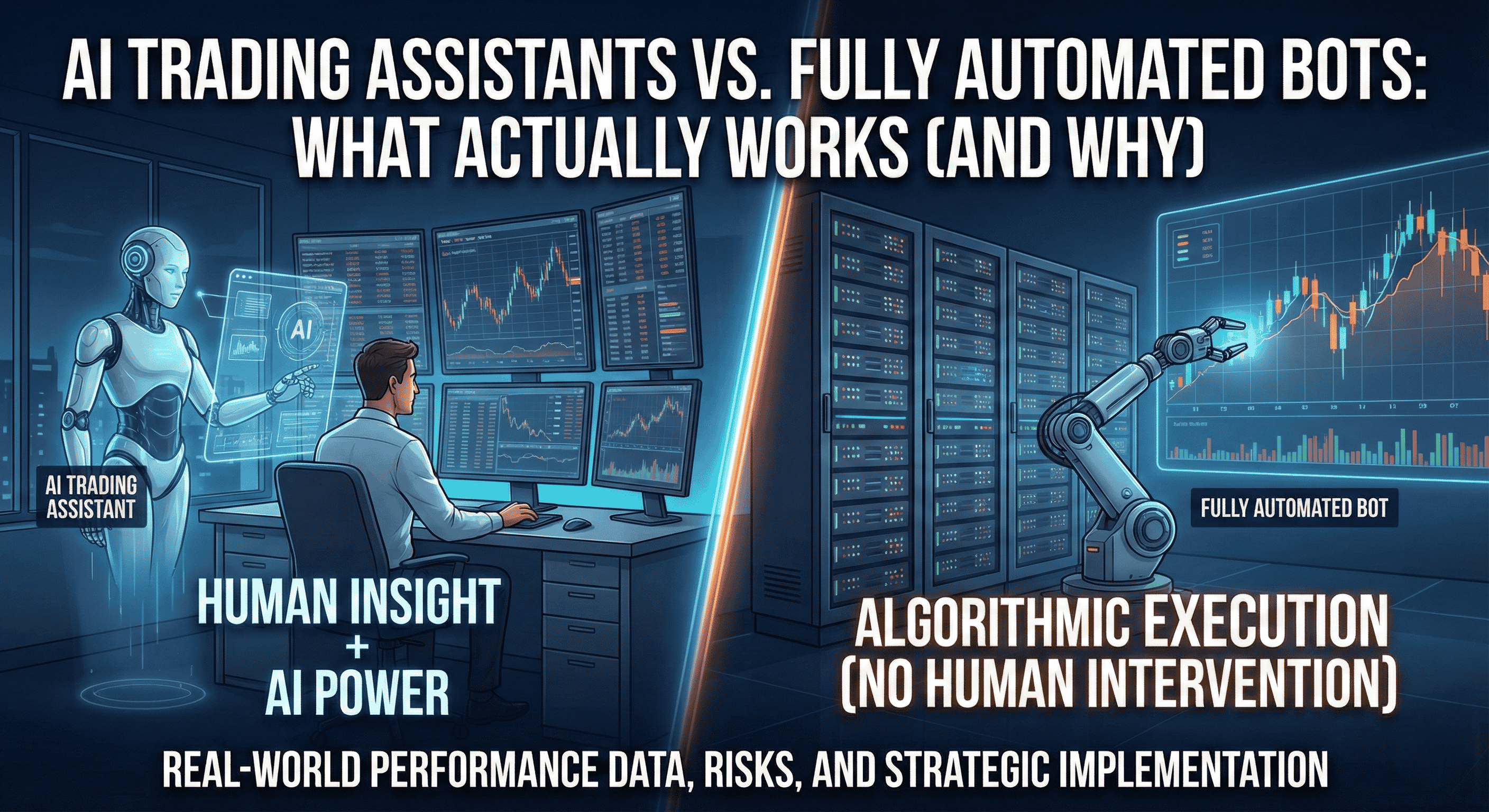
# AI Trading Assistants vs Fully Automated Bots: What Actually Works (And Why)
The world of algorithmic trading has evolved dramatically, presenting traders with two distinct approaches: AI trading assistants that support human decision-making and fully automated bots that execute trades without human intervention. Understanding the fundamental differences between these systems is crucial for any trader considering incorporating artificial intelligence into their trading strategy.
This comprehensive guide will help you understand which approach aligns with your trading goals, risk tolerance, and market conditions. We'll explore real-world performance data, examine the strengths and limitations of each system, and provide practical guidance on making the right choice for your trading journey.
Table of Contents
- [Understanding AI Trading Assistants](#understanding-ai-trading-assistants)
- [The Reality of Fully Automated Trading Bots](#the-reality-of-fully-automated-trading-bots)
- [Performance Comparison: Data vs Hype](#performance-comparison-data-vs-hype)
- [Choosing the Right Approach for Your Trading Style](#choosing-the-right-approach-for-your-trading-style)
Understanding AI Trading Assistants
AI trading assistants function as sophisticated analytical tools that enhance human decision-making rather than replacing it. These systems process vast amounts of market data, identify patterns, and provide traders with actionable insights while leaving the final trading decisions in human hands.
How AI Trading Assistants Work
AI assistants operate through several key mechanisms:
- Pattern Recognition: Advanced algorithms scan historical and real-time data to identify recurring market patterns and anomalies
- Risk Assessment: Machine learning models evaluate potential trade scenarios and calculate risk-reward ratios
- Market Context Analysis: AI systems consider multiple timeframes, correlation data, and market sentiment indicators
- Alert Generation: Sophisticated notification systems highlight high-probability trading opportunities
:::key-concept AI trading assistants amplify human intelligence rather than replacing it. They excel at processing data at scale while humans provide context, intuition, and final decision-making. :::
Advantages of AI Trading Assistants
The collaborative approach of AI assistants offers several compelling benefits:
Enhanced Analysis Speed: AI can process thousands of data points in seconds, identifying opportunities that might take humans hours to discover.
Emotion-Free Insights: While humans make the final decisions, AI provides objective analysis free from emotional bias or fatigue.
Continuous Learning: Machine learning algorithms improve over time, adapting to changing market conditions and incorporating new data patterns.
Flexibility: Traders maintain full control over position sizing, timing, and risk management while benefiting from AI-powered insights.
:::example A forex trader using an AI assistant receives an alert about unusual volume patterns in EUR/USD during Asian session overlap. The AI provides technical analysis showing potential support levels and calculates optimal position sizes. The trader evaluates the geopolitical context and decides whether to act on the signal, maintaining full control over the trading decision. :::
Limitations of AI Trading Assistants
Despite their advantages, AI assistants have notable limitations:
- Human Dependency: The system's effectiveness depends on the trader's ability to interpret and act on AI-generated insights
- Learning Curve: Traders must invest time understanding how to effectively utilize AI recommendations
- Execution Speed: Manual execution may result in missed opportunities in fast-moving markets
The Reality of Fully Automated Trading Bots
Fully automated trading bots execute trades independently based on pre-programmed algorithms and rules. These systems promise hands-free trading but come with significant considerations that traders must understand before implementation.
How Automated Trading Bots Operate
Automated bots function through rigid rule-based systems:
- Pre-defined Parameters: Bots operate within strict entry and exit criteria established during programming
- Systematic Execution: Orders are placed and managed automatically without human intervention
- Risk Management Protocols: Built-in stop-losses and position sizing rules protect against catastrophic losses
- 24/7 Operation: Bots can monitor markets and execute trades around the clock
:::warning Automated trading bots cannot adapt to unprecedented market conditions or "black swan" events that fall outside their programming parameters. This limitation can result in significant losses during extreme market volatility. :::
The Promise vs Reality of Automated Bots
While marketing materials often showcase impressive backtested results, the reality of automated bot performance presents a more complex picture:
Backtesting Limitations: Historical performance rarely translates directly to live market conditions due to factors like slippage, latency, and changing market dynamics.
Over-Optimization Risk: Bots optimized for specific historical periods may fail when market conditions change, leading to the "curve fitting" problem.
Market Adaptation Challenges: Unlike human traders who can adapt to new information, most bots continue executing the same strategies regardless of changing market conditions.
:::example During the COVID-19 market crash, many automated trading bots suffered significant losses because their algorithms were not programmed to handle the unprecedented volatility and correlation breakdowns that occurred across asset classes. :::
When Automated Bots Can Be Effective
Despite their limitations, automated bots can be effective in specific scenarios:
- High-frequency trading: For strategies requiring millisecond execution speeds
- Simple, well-defined strategies: Basic trend-following or mean-reversion strategies in stable market conditions
- Diversification tool: As part of a broader trading approach rather than a standalone solution
Performance Comparison: Data vs Hype
Understanding the real-world performance differences between AI assistants and automated bots requires examining empirical evidence rather than marketing claims.
Academic Research Findings
Research studies comparing human-AI collaboration versus fully automated systems consistently show interesting patterns:
Adaptability Metrics: Human-AI teams demonstrate superior performance in adapting to changing market conditions compared to fully automated systems.
Risk-Adjusted Returns: While automated bots may achieve higher raw returns during optimal conditions, human-AI collaboration typically produces better risk-adjusted returns over extended periods.
Drawdown Management: AI-assisted human traders generally experience smaller maximum drawdowns due to the human element's ability to recognize and respond to unusual market conditions.
Real-World Performance Factors
:::key-concept The most successful trading approaches often combine the strengths of both systems: AI's analytical power with human judgment and adaptability. :::
Several factors influence the relative performance of each approach:
Market Conditions: Automated bots may outperform during trending markets but struggle in choppy or unprecedented conditions where human judgment becomes valuable.
Strategy Complexity: Simple strategies may work well with automation, while complex strategies requiring contextual understanding benefit from human oversight.
Time Horizons: Longer-term strategies often benefit more from human-AI collaboration, while ultra-short-term strategies may require automation for speed.
The Hybrid Advantage
Many successful traders have discovered that combining both approaches yields superior results:
- AI assistants for analysis and opportunity identification
- Partial automation for routine tasks like stop-loss management
- Human oversight for final decision-making and strategy adaptation
:::tip Consider starting with AI trading assistants to develop your understanding of how artificial intelligence can enhance your trading before progressing to any automated systems. :::
Choosing the Right Approach for Your Trading Style
Selecting between AI trading assistants and automated bots depends on multiple factors specific to your trading goals, experience level, and risk tolerance.
Assessing Your Trading Profile
Before choosing an approach, honestly evaluate your trading characteristics:
Experience Level:
- Beginners benefit more from AI assistants that provide educational insights
- Experienced traders may effectively utilize either approach
- Professional traders often employ hybrid strategies
Available Time Commitment:
- Limited time may seem to favor automation, but actually requires more upfront development
- Regular time availability works well with AI assistants
- Sporadic availability may benefit from AI alerts and selective automation
Risk Tolerance:
- Conservative traders should prefer AI assistants with human oversight
- Aggressive traders might consider automated systems for specific strategies
- Risk-averse traders benefit from the control provided by AI-assisted approaches
Implementation Strategies
:::example A swing trader might use AI assistants to identify high-probability setups during market analysis sessions, then employ partial automation for stop-loss and take-profit management while maintaining manual entry decisions. :::
Starting with AI Assistants: 1. Begin with paper trading to understand AI recommendations 2. Gradually implement insights into live trading 3. Develop confidence in interpreting AI-generated signals 4. Scale position sizes as proficiency increases
Progressing to Automation: 1. Master manual trading with AI assistance first 2. Identify specific, well-defined strategies suitable for automation 3. Thoroughly backtest automated strategies 4. Start with small position sizes and gradually scale 5. Maintain regular monitoring and performance review
Cost-Benefit Analysis
Consider the total cost of ownership for each approach:
AI Trading Assistants:
- Lower upfront costs
- Subscription-based pricing models
- Immediate usability
- Lower technical requirements
Automated Trading Bots:
- Higher development or purchase costs
- Ongoing maintenance requirements
- Technical infrastructure needs
- Potential for higher returns but also higher risks
:::warning Never risk more than you can afford to lose with any automated system. Start with small amounts and gradually increase exposure only after proving consistent performance over extended periods. :::
Conclusion
The choice between AI trading assistants and fully automated bots isn't necessarily an either/or decision. The most successful traders often employ a hybrid approach that leverages the analytical power of AI while maintaining human oversight and decision-making authority.
AI trading assistants offer the optimal balance for most traders, providing sophisticated analysis and insights while preserving the flexibility and adaptability that human judgment brings to trading decisions. They allow traders to learn and improve their skills while benefiting from advanced technology.
Fully automated bots can be effective tools for specific strategies and market conditions, but they require significant expertise to implement successfully and carry inherent risks that must be carefully managed.
Regardless of which approach you choose, remember that no system – whether AI-assisted or fully automated – can guarantee profits. Success in trading ultimately depends on sound risk management, continuous learning, and the ability to adapt to changing market conditions.
Ready to explore how AI can enhance your trading performance? Start by analyzing your current trading approach and identifying areas where AI assistance could provide the most value. Begin with small implementations and gradually build your confidence and expertise in working with artificial intelligence tools.