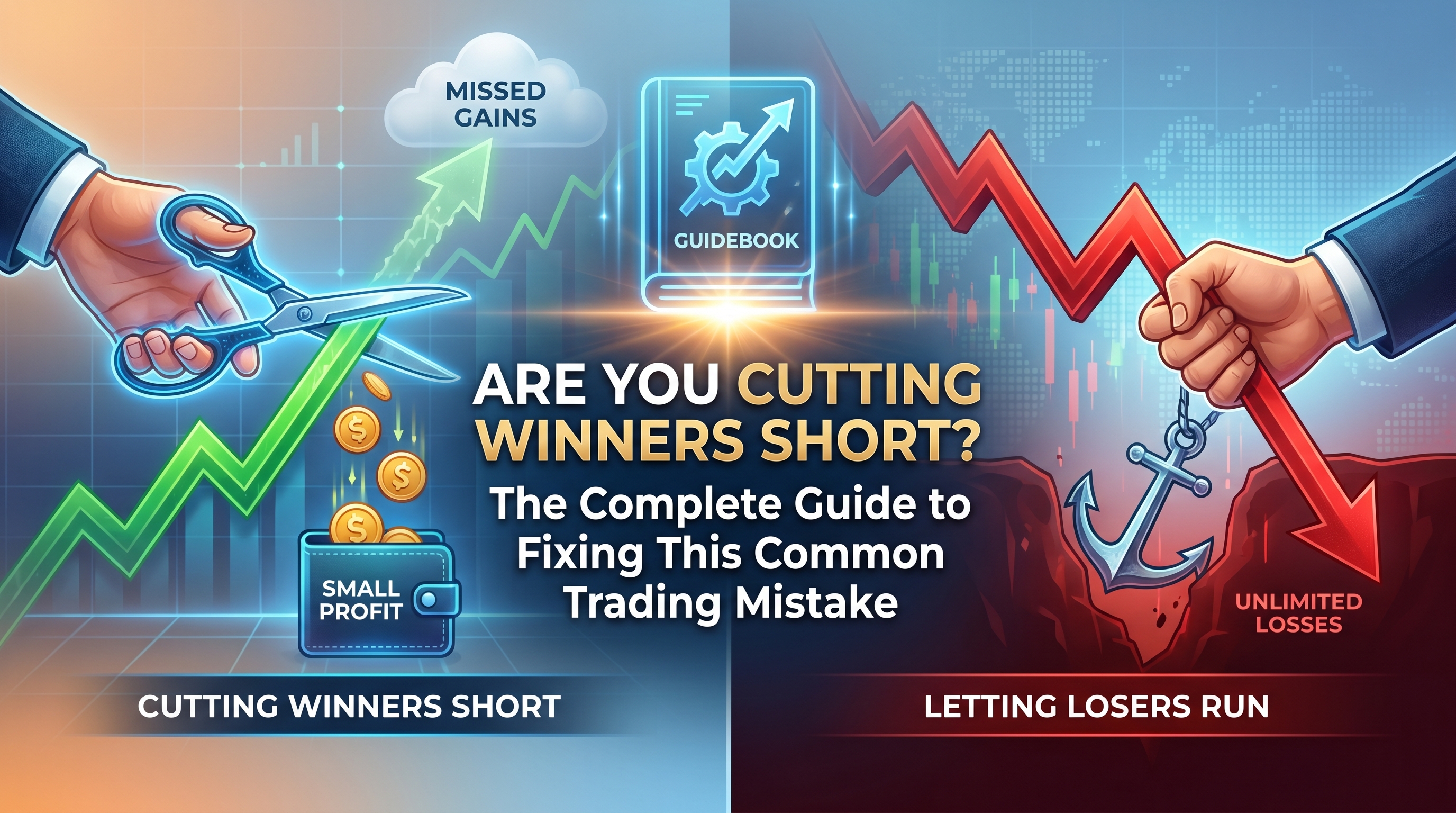
# Are You Cutting Winners Short? The Complete Guide to Fixing This Common Trading Mistake
One of the most destructive habits in trading is cutting winners short trading while letting losing positions run indefinitely. This psychological trap destroys more trading accounts than market crashes, economic downturns, or technical analysis failures combined. If you've ever found yourself taking profits too early on winning trades while hoping that losing positions will "come back," you're experiencing one of the most common and costly trading mistakes.
This guide will help you understand why this happens, recognize when you're doing it, and provide concrete strategies to break this cycle and improve your trading performance.
Table of Contents
- [Understanding the Psychology Behind Cutting Winners Short](#understanding-the-psychology-behind-cutting-winners-short)
- [The Real Cost of This Trading Mistake](#the-real-cost-of-this-trading-mistake)
- [Identifying When You're Making This Error](#identifying-when-youre-making-this-error)
- [Proven Strategies to Fix This Problem](#proven-strategies-to-fix-this-problem)
- [Building Better Trading Habits](#building-better-trading-habits)
- [Conclusion](#conclusion)
Understanding the Psychology Behind Cutting Winners Short
The tendency to cut winning trades short while letting losers run stems from deeply ingrained psychological biases that affect all traders, regardless of experience level.
:::key-concept Prospect Theory in Trading Developed by behavioral economists, prospect theory explains that people feel the pain of losses roughly twice as strongly as they feel the pleasure of equivalent gains. This asymmetry drives traders to make irrational decisions with their winning and losing positions. :::
The Fear of Giving Back Profits
When you're in a winning position, your brain starts calculating all the ways you could lose those unrealized gains. This fear becomes so overwhelming that taking a small profit feels safer than holding for larger gains. The cutting winners short trading mentality kicks in as you convince yourself that "a profit is a profit."
Loss Aversion in Losing Trades
Conversely, when facing a losing position, the psychological pain is so intense that many traders enter denial mode. They hold onto losing trades, hoping they'll return to breakeven, rather than accepting the loss and moving on to better opportunities.
The Certainty Effect
Traders prefer the certainty of a small, immediate profit over the uncertainty of a potentially larger future gain. This cognitive bias makes cutting winners short trading feel like the "smart" decision, even when it's mathematically destructive to long-term profitability.
:::example Real Trading Scenario A trader buys a stock at $50, and it rises to $55. Instead of following their plan to hold until $60, they take the $5 profit immediately, fearing the stock might reverse. Later, they watch as the stock continues to $65, missing out on $15 per share in additional profits. :::
The Real Cost of This Trading Mistake
The financial impact of cutting winners short trading while letting losers run is devastating and often underestimated by traders.
Mathematical Impact on Win Rate
Even with a 60% win rate, if your average winner is smaller than your average loser, you'll lose money over time. Here's why the math doesn't work:
- Scenario A (Cutting Winners Short):
- Win Rate: 60%
- Average Winner: $100
- Average Loser: $200
- Expected Value per Trade: (0.6 × $100) + (0.4 × -$200) = -$20
- Scenario B (Proper Risk Management):
- Win Rate: 40%
- Average Winner: $300
- Average Loser: $100
- Expected Value per Trade: (0.4 × $300) + (0.6 × -$100) = $60
Opportunity Cost
Beyond direct losses, cutting winners short trading creates massive opportunity costs. Every time you exit a winning trade early, you're potentially missing significant additional profits that could have funded multiple future trades.
:::warning The Compound Effect Cutting winners short doesn't just affect individual trades—it compounds over time. Missing larger winners means having less capital to allocate to future opportunities, creating a downward spiral in account growth. :::
Emotional Toll
The psychological damage goes beyond money. Repeatedly watching profits evaporate after early exits while holding onto losing positions creates:
- Decreased confidence in trading abilities
- Analysis paralysis on future decisions
- Increased stress and anxiety around position management
- Tendency to over-trade to "make up" for missed opportunities
Identifying When You're Making This Error
Recognizing that you're cutting winners short trading is the first step toward fixing this problem. Here are the warning signs:
Trade Review Red Flags
Winner Management Issues:
- Consistently taking profits at the first sign of resistance
- Exiting positions before reaching predetermined targets
- Moving stops to breakeven too quickly
- Feeling anxious when unrealized profits fluctuate
Loser Management Issues:
- Removing or widening stop losses on losing trades
- "Averaging down" on losing positions
- Holding trades well beyond planned exit points
- Making excuses for why a losing trade will "come back"
:::tip Journal Analysis Review your last 20 trades and calculate your average winner versus average loser. If your average winner is smaller than your average loser, you're likely cutting winners short while letting losers run. :::
Emotional Indicators
During Winning Trades:
- Constant urge to check profits and consider closing
- Fear-based thoughts about losing current gains
- Rationalizing early exits with phrases like "better safe than sorry"
During Losing Trades:
- Hope-based thinking and denial about market reality
- Moving goal posts and changing trade rationale
- Avoiding looking at losing positions
Proven Strategies to Fix This Problem
Overcoming the tendency of cutting winners short trading requires systematic changes to your trading approach and mindset.
1. Implement Strict Position Sizing
Proper position sizing is the foundation that makes holding winners and cutting losers emotionally manageable.
:::key-concept The 1-2% Rule Risk no more than 1-2% of your trading capital on any single trade. When your risk is small relative to your account size, it becomes much easier to let winners run and cut losers quickly. :::
Position Sizing Formula:
Position Size = (Account Size × Risk Percentage) ÷ (Entry Price - Stop Loss Price)2. Use Trailing Stops Effectively
Trailing stops help you stay in winning trades while protecting accumulated profits.
Progressive Trailing Strategy: 1. Initial Stop: Set at predetermined loss level (e.g., -2%) 2. First Trail: Move to breakeven when trade is +2R (2× initial risk) 3. Subsequent Trails: Raise stop by 50% of additional gains
:::example Trailing Stop Example
:::
- Entry: $100, Initial Stop: $98 (2% risk)
- Price reaches $104: Move stop to $100 (breakeven)
- Price reaches $106: Move stop to $103 (protecting $3 profit)
- Price reaches $110: Move stop to $107 (protecting $7 profit)
3. Scale Out of Winners Systematically
Rather than cutting winners short trading entirely, scale out of positions to satisfy the psychological need for profits while keeping exposure to further upside.
Three-Stage Exit Strategy:
- Stage 1: Take 1/3 profits at first target (1.5-2R)
- Stage 2: Take 1/3 profits at second target (3-4R)
- Stage 3: Trail stop on final 1/3 for maximum upside
4. Pre-Define Trade Plans
Having a detailed plan before entering trades removes emotional decision-making during the heat of the moment.
Essential Plan Components:
- Entry criteria and price level
- Initial stop loss level
- Multiple profit targets
- Position size calculation
- Trailing stop methodology
- Maximum time in trade
:::warning Stick to Your Plan Once you're in a trade, avoid second-guessing your pre-market analysis. Emotional decisions made during active trading rarely improve outcomes. :::
5. Develop Loss Acceptance Habits
Building comfort with taking small losses is crucial for avoiding the temptation to let losers run.
Loss Acceptance Techniques:
- View stops as "business expenses" rather than failures
- Celebrate quick loss-cutting as good trading behavior
- Keep detailed records showing how cutting losses preserves capital
- Practice position sizing until losses feel manageable
Building Better Trading Habits
Transforming your approach to cutting winners short trading requires consistent practice and habit formation.
Daily Trading Routines
Pre-Market Routine: 1. Review open positions and predetermined exit levels 2. Set alerts for profit targets and stop levels 3. Mentally rehearse sticking to your plan 4. Journal your emotional state and any biases you're feeling
During Market Hours:
- Check positions only at predetermined times
- Avoid constantly monitoring profit/loss fluctuations
- Use alerts instead of watching charts continuously
- Practice mindfulness when feeling urges to exit early
Post-Market Review:
- Analyze adherence to trading plans
- Record lessons learned from each trade
- Calculate actual versus potential profits from early exits
- Identify emotional triggers that led to plan deviations
Psychological Techniques
Visualization Exercises: Regularly visualize yourself successfully holding winning trades through temporary pullbacks and cutting losers quickly without hesitation.
Positive Self-Talk: Develop mantras that reinforce good trading behavior:
- "I let my winners run and cut my losers short"
- "Small losses preserve capital for big winners"
- "I trust my analysis and stick to my plan"
:::tip The 5-Minute Rule When feeling the urge to exit a winning trade early, wait 5 minutes and ask yourself: "Am I exiting based on my plan or based on fear?" This simple pause often prevents emotional decisions. :::
Technology Aids
Automated Exits: Use bracket orders or OCO (One-Cancels-Other) orders to automatically execute your trading plan without emotional interference.
Trading Journal Software: Track your tendency to cut winners short trading using specialized software that calculates metrics like:
- Average winner vs. average loser ratios
- Percentage of trades exited before targets
- Opportunity cost from early exits
Accountability Systems
Trading Buddy System: Pair with another trader to review each other's trade management decisions and provide objective feedback.
Professional Coaching: Consider working with a trading coach who can help identify and correct cutting winners short trading patterns.
Conclusion
Cutting winners short trading while letting losers run is one of the most common and destructive trading mistakes, but it's entirely fixable with the right approach. The key lies in understanding that this isn't a character flaw—it's a natural human psychological tendency that can be overcome through systematic changes to your trading process.
The most effective solutions combine proper position sizing, predetermined trading plans, trailing stop strategies, and consistent self-monitoring. By implementing these techniques, you'll gradually build the discipline needed to let your winners run while cutting losses quickly.
Remember, changing deeply ingrained trading habits takes time and practice. Be patient with yourself as you work to overcome the cutting winners short trading mentality. Focus on progress, not perfection, and celebrate small victories along the way.
Start today by reviewing your recent trades and identifying instances where you cut winners short or let losers run. Use this analysis to create specific action plans for your next trades, and begin building the habits that will transform your trading results over time.
Ready to break the cycle of cutting winners short? Start by analyzing your last 20 trades using our trade review framework and identify specific patterns in your winner and loser management. Your future profitable self will thank you for taking action today.
Advanced Strategies for Experienced Traders
Scaling Out Techniques
Partial Position Management: Instead of an all-or-nothing approach, consider scaling out of positions in thirds:
- Take 1/3 profit at first target to secure gains
- Move stop to breakeven on remaining position
- Let 2/3 of position run toward larger targets
The "Core and Satellite" Method: Divide your position into a core holding (60-70%) and satellite portions (30-40%). Close satellites at predetermined levels while letting the core position ride longer-term trends.
:::example Scaling Out in Practice: Buy 300 shares at $50. First target at $55 - sell 100 shares (lock in profit). Second target at $60 - sell another 100 shares. Let final 100 shares run with trailing stop for maximum upside potential. :::
Advanced Stop-Loss Strategies
Volatility-Adjusted Stops: Use Average True Range (ATR) to set dynamic stops that adjust to market conditions:
- In low volatility: Tighter stops (1.5x ATR)
- In high volatility: Wider stops (2.5x ATR)
Time-Based Exits: Implement time stops for trades that aren't working:
- Day trades: Exit if no progress in first 30 minutes
- Swing trades: Exit if no movement toward target within 3-5 days
Building Mental Resilience
Visualization Techniques: Before entering trades, mentally rehearse both winning and losing scenarios. Visualize yourself calmly following your plan regardless of market movements.
The "Trade Post-Mortem" Process: After each trade, conduct a brief review: 1. Did I follow my plan? 2. What emotions did I experience? 3. What would I do differently? 4. What did I do well?
:::key-concept The Compound Effect Small improvements in trade management compound dramatically over time. A trader who increases their average winner from 1.5R to 2.0R while keeping average losses at 1R can potentially double their annual returns. :::
Creating Your Personal Trading Constitution
Develop a written "trading constitution" that includes:
Non-Negotiable Rules:
- Never risk more than X% per trade
- Always use predetermined exits
- No emotional additions to losing positions
Decision-Making Framework: Create simple checklists for common scenarios:
- When to take partial profits
- When to move stops to breakeven
- When to exit completely
Regular Review Schedule:
- Weekly: Review trade journal and identify patterns
- Monthly: Analyze R-multiple distribution
- Quarterly: Adjust strategies based on performance data
Measuring Progress
Key Performance Indicators: Track these metrics to monitor improvement:
- Win rate vs. average win/loss ratio
- Percentage of trades reaching full target
- Time to profitability after entry
- Emotional state ratings for each trade
The "Expectancy Calculation": Expectancy = (Win Rate × Average Win) - (Loss Rate × Average Loss)
:::tip Progress Tracking Tip Use a simple spreadsheet to track your R-multiples weekly. Color-code cells: green for winners held to target, yellow for early exits, red for losses that ran too long. Visual patterns become immediately obvious. :::
Common Pitfalls and How to Avoid Them
The "False Recovery" Trap
The Problem: Holding losing trades through small recoveries, hoping they'll return to profitability.
The Solution: Set maximum loss limits regardless of temporary recoveries. If a trade hits your stop level, exit immediately even if it starts bouncing back.
Over-Analysis Paralysis
The Problem: Constantly second-guessing profitable trades and looking for reasons to exit early.
The Solution: Limit chart checking to predetermined intervals. Set specific times for trade review (market open, lunch, close) and avoid constant monitoring.
The "Home Run" Mentality
The Problem: Trying to hit massive winners on every trade instead of consistently capturing good profits.
The Solution: Focus on consistent 1.5-2R winners rather than hoping for 10R trades. Consistency beats sporadic large wins.
:::warning Avoid the "Revenge Trading" Cycle After cutting a winner short or letting a loser run, resist the urge to immediately jump into another trade to "make up for it." Take a break, review what happened, and return to trading with a clear head. :::
Long-Term Success Habits
Daily Routine Development
Pre-Market Preparation:
- Review overnight news and market conditions
- Confirm your trading plan for existing positions
- Set daily loss limits and profit targets
Post-Market Analysis:
- Review all trade decisions made during the session
- Update trading journal with emotional notes
- Plan adjustments for tomorrow's trading
Continuous Learning and Adaptation
Monthly Strategy Reviews: Analyze whether market conditions require adjustments to your approach. Bull markets, bear markets, and sideways markets may require different winner/loser management techniques.
Peer Learning: Join trading communities focused on trade management and psychology. Learning from others' experiences accelerates your own development.
:::key-concept The Trading Marathon Mindset Trading is a marathon, not a sprint. Every trade is just one step in a long journey. Perfect trade management on individual trades matters less than developing consistent, profitable habits over hundreds of trades. :::
Final Thoughts: Your Path Forward
Breaking the habit of cutting winners short and letting losers run requires patience, persistence, and systematic change. The strategies outlined in this guide provide a comprehensive framework, but remember that lasting change happens gradually through consistent application.
Start small—focus on implementing one or two techniques rather than trying to change everything at once. Maybe begin with trailing stops for your next three trades, or commit to using position sizing rules consistently for one week. Small, consistent improvements compound into dramatic results over time.
Your trading journal will become your most valuable tool in this journey. Be honest about your mistakes, celebrate your progress, and use the data to guide continuous improvement. The patterns will become clear, and the solutions will follow naturally.
Most importantly, remember that every professional trader has faced this challenge. The difference between those who succeed and those who don't isn't talent or luck—it's the willingness to acknowledge the problem and systematically work to fix it.
:::tip Your Next Action Steps 1. Print out or save your trading plan where you can see it during trading hours 2. Set up your position sizing calculator and trailing stop system 3. Commit to journaling your next 10 trades with emotional notes 4. Schedule weekly reviews of your winner/loser management data
The market will be there tomorrow—focus on building the habits that will serve you for years to come. :::
Start implementing these changes today. Your future, more disciplined trading self is waiting for you to take the first step.