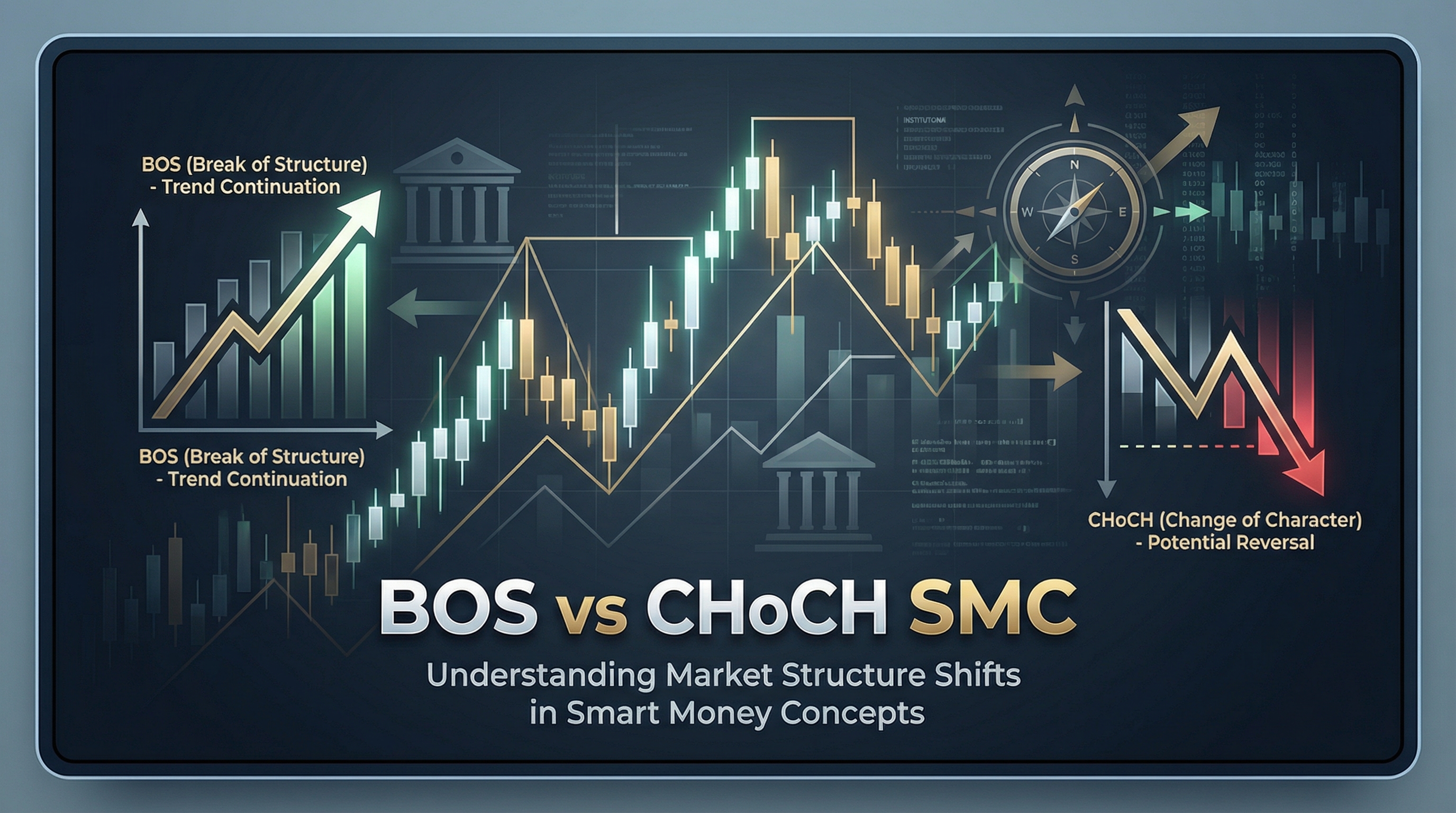
# BOS vs CHoCH SMC: Understanding Market Structure Shifts in Smart Money Concepts
Understanding market structure is fundamental to successful trading, and Smart Money Concepts (SMC) provides traders with powerful tools to identify when markets are shifting direction. Two of the most critical concepts in SMC methodology are Break of Structure (BOS) and Change of Character (CHoCH). While both indicate market movements, they serve very different purposes in identifying trend continuation versus trend reversal scenarios.
Mastering the distinction between BOS vs CHoCH SMC concepts can dramatically improve your trading accuracy by helping you align with institutional money flow rather than fighting against it. This comprehensive guide will break down these concepts, show you how to identify them on charts, and provide practical examples for implementation in your trading strategy.
Table of Contents
- [What is Market Structure in SMC](#what-is-market-structure-in-smc)
- [Understanding Break of Structure (BOS)](#understanding-break-of-structure-bos)
- [Understanding Change of Character (CHoCH)](#understanding-change-of-character-choch)
- [Key Differences Between BOS and CHoCH](#key-differences-between-bos-and-choch)
- [Practical Trading Applications](#practical-trading-applications)
- [Common Mistakes to Avoid](#common-mistakes-to-avoid)
- [Conclusion](#conclusion)
What is Market Structure in SMC
Market structure in Smart Money Concepts refers to the framework of higher highs (HH), higher lows (HL), lower highs (LH), and lower lows (LL) that form the backbone of price movement analysis. This structure helps traders understand whether the market is in an uptrend, downtrend, or transitional phase.
:::key-concept Market structure is the foundation of SMC analysis. Without understanding how to identify and mark structure, you cannot effectively use BOS vs CHoCH SMC concepts in your trading. :::
Components of Market Structure
- Higher Highs (HH): Peaks that exceed previous peaks in an uptrend
- Higher Lows (HL): Valleys that are higher than previous valleys in an uptrend
- Lower Highs (LH): Peaks that fail to exceed previous peaks in a downtrend
- Lower Lows (LL): Valleys that break below previous valleys in a downtrend
The key to successful SMC trading lies in identifying when this structure changes, which brings us to our main concepts: BOS and CHoCH.
Understanding Break of Structure (BOS)
A Break of Structure (BOS) occurs when price breaks through a significant structural level in the direction of the existing trend, confirming trend continuation. This is essentially the market's way of showing that the current trend has enough momentum to push through previous resistance or support levels.
Characteristics of BOS
1. Trend Continuation Signal: BOS confirms the existing trend is still intact 2. Structural Break: Price breaks through previous highs (in uptrend) or lows (in downtrend) 3. Institutional Confirmation: Suggests smart money is continuing to push price in the trending direction 4. Volume Confirmation: Often accompanied by increased volume
:::example In an uptrend, if price creates a new higher high by breaking above the previous peak with strong momentum, this constitutes a bullish BOS. This signals that buyers (smart money) are still in control and the uptrend is likely to continue. :::
Identifying BOS on Charts
To identify a valid BOS:
1. Mark Previous Structure: Identify the most recent swing high (in uptrend) or swing low (in downtrend) 2. Watch for the Break: Monitor price action as it approaches this level 3. Confirm with Close: Ensure price closes beyond the structural level 4. Volume Analysis: Look for increased volume during the break
:::tip A strong BOS often occurs with minimal pullback, showing institutional strength. If price struggles or shows multiple rejections at the level, it may not be a valid BOS. :::
Understanding Change of Character (CHoCH)
Change of Character (CHoCH) represents a shift in market sentiment and typically signals the potential end of the current trend. Unlike BOS, which confirms trend continuation, CHoCH suggests that the market structure is changing and a reversal may be imminent.
Characteristics of CHoCH
1. Trend Reversal Signal: Indicates potential change in market direction 2. Counter-Trend Break: Price breaks structure against the prevailing trend 3. Smart Money Shift: Suggests institutional money is beginning to position for a reversal 4. Structure Invalidation: Invalidates the previous trend's structure
:::key-concept CHoCH is your early warning system for trend changes. When you see a CHoCH, it's time to reassess your bias and prepare for potential reversal scenarios in your BOS vs CHoCH SMC analysis. :::
Types of CHoCH
Bullish CHoCH: In a downtrend, price breaks above a previous lower high, suggesting the downtrend may be weakening.
Bearish CHoCH: In an uptrend, price breaks below a previous higher low, indicating the uptrend may be losing steam.
:::example Imagine EUR/USD has been in a strong uptrend, making consistent higher highs and higher lows. Suddenly, price breaks below a recent higher low with conviction. This bearish CHoCH signals that the uptrend structure is compromised and a potential downtrend may be developing. :::
Key Differences Between BOS and CHoCH
Understanding the fundamental differences between these concepts is crucial for effective implementation of BOS vs CHoCH SMC strategies:
Directional Context
| Aspect | BOS | CHoCH | |--------|-----|-------| | Direction | With the trend | Against the trend | | Signal | Trend continuation | Potential trend reversal | | Market Bias | Maintains current bias | Challenges current bias | | Risk Level | Lower (trend following) | Higher (counter-trend) |
Trading Implications
BOS Trading Approach:
- Look for pullback entries in trend direction
- Higher probability setups
- Use for trend continuation trades
- Tighter stop losses possible
CHoCH Trading Approach:
- Wait for confirmation before entering
- Prepare for potential reversal
- Use wider stop losses
- Consider taking profits on trend trades
:::warning Never trade a CHoCH immediately. Always wait for additional confirmation such as a new opposing BOS or clear shift in market structure before entering reversal trades. :::
Practical Trading Applications
Using BOS for Entry Signals
When you identify a valid BOS in your preferred timeframe:
1. Mark the Level: Draw a line at the broken structure 2. Wait for Pullback: Look for price to retrace to the broken level 3. Look for Rejection: Watch for signs that the level now acts as support/resistance 4. Enter on Confirmation: Enter when price shows rejection and begins moving in trend direction
Using CHoCH for Exit Signals
CHoCH can serve as an excellent exit indicator:
1. Monitor Trend Trades: Keep existing trend trades until CHoCH occurs 2. Tighten Stops: Move stops to breakeven or take partial profits 3. Prepare for Reversal: Start looking for reversal setups 4. Wait for Confirmation: Don't immediately reverse; wait for structure confirmation
:::tip Combine BOS vs CHoCH SMC analysis with other confluence factors like order blocks, fair value gaps, and liquidity zones for higher probability setups. :::
Multi-Timeframe Analysis
Effective SMC trading requires analyzing multiple timeframes:
- Higher Timeframe: Identify overall trend and major structure
- Entry Timeframe: Look for BOS/CHoCH signals for precise entries
- Lower Timeframe: Fine-tune entry and exit points
:::example Daily chart shows strong uptrend with recent BOS. 4-hour chart shows pullback to broken structure. 1-hour chart shows rejection at the level with bullish order block. This confluence provides high-probability long entry. :::
Common Mistakes to Avoid
Mistake 1: Trading CHoCH Too Early
Many traders see a CHoCH and immediately try to fade the trend. This often results in losses as trends can continue much longer than expected, even after initial structure breaks.
Solution: Wait for additional confirmation such as:
- Opposite BOS formation
- Multiple CHoCH signals
- Clear shift in higher timeframe structure
Mistake 2: Ignoring Market Context
Not all BOS and CHoCH signals are created equal. Context matters significantly.
Consider:
- Overall market sentiment
- News events and fundamentals
- Session times and liquidity
- Higher timeframe structure
Mistake 3: Poor Risk Management
Some traders use the same risk parameters for both BOS and CHoCH setups, which is inappropriate given their different risk profiles.
Best Practice:
- Use smaller position sizes for CHoCH-based trades
- Wider stops for counter-trend trades
- Quicker profit-taking on reversal setups
:::warning Always backtest your BOS vs CHoCH SMC strategies on historical data before risking real money. Paper trade for at least a month to understand how these concepts behave in different market conditions. :::
Mistake 4: Overcomplicating Analysis
Some traders try to find BOS and CHoCH on every timeframe, leading to analysis paralysis.
Solution:
- Choose 2-3 main timeframes for analysis
- Focus on clear, obvious structural breaks
- Don't force signals that aren't there
Conclusion
Mastering the distinction between BOS vs CHoCH SMC concepts is essential for any trader looking to align with institutional money flow and improve their market timing. Break of Structure signals provide high-probability trend continuation opportunities, while Change of Character alerts you to potential trend shifts before they become obvious to retail traders.
Remember that BOS confirms the existing trend and offers lower-risk continuation trades, while CHoCH warns of potential reversals and requires additional confirmation before acting. The key to success lies in understanding when to use each concept and how to combine them with other SMC tools for comprehensive market analysis.
Successful implementation of these concepts requires practice, patience, and proper risk management. Don't expect to master BOS vs CHoCH SMC analysis overnight – it takes time to develop the skill to quickly identify these patterns and act on them effectively.
Ready to improve your SMC analysis skills? Start by practicing identification of BOS and CHoCH patterns on historical charts. Focus on major currency pairs or indices where institutional activity is most apparent, and always backtest your strategies before implementing them in live trading.
Advanced BOS vs CHoCH Trading Strategies
Multi-Timeframe Alignment Strategy
The most effective approach to trading BOS and CHoCH involves analyzing multiple timeframes for alignment:
Top-Down Analysis Process: 1. Higher Timeframe (Daily/4H): Identify overall market structure and bias 2. Medium Timeframe (1H): Look for BOS/CHoCH signals that align with higher timeframe bias 3. Lower Timeframe (15M/5M): Find precise entry points and market structure breaks
:::key-concept When a CHoCH appears on a higher timeframe but the lower timeframe shows a BOS in the same direction, this creates a powerful confluence for trend continuation trades with reduced risk. :::
The "False CHoCH" Filter
Not every CHoCH leads to a meaningful reversal. Use these filters to identify high-probability CHoCH signals:
Confluence Factors:
- CHoCH occurs at significant support/resistance levels
- Multiple swing failures at the same price area
- Divergence between price action and internal structure
- Volume spike accompanying the CHoCH formation
:::example On EUR/USD 1-hour chart, a CHoCH that forms after price rejection at a daily resistance level, combined with bearish divergence on RSI, provides much stronger reversal probability than an isolated CHoCH in the middle of a trend. :::
Order Flow Integration
Combine BOS/CHoCH analysis with order flow concepts for enhanced accuracy:
Liquidity Sweep Confirmation:
- BOS after liquidity sweep above/below key levels
- CHoCH following failed liquidity grabs
- Smart Money Concept order blocks aligning with structural breaks
Fair Value Gap (FVG) Integration:
- BOS respecting FVG levels as support/resistance
- CHoCH forming after FVG fill completion
- Price returning to test structural break points
Risk Management for BOS vs CHoCH Trades
Position Sizing Guidelines
Adjust your position sizes based on signal type:
BOS Trades (Trend Continuation):
- Standard position size (1-2% risk per trade)
- Stop loss below/above the broken structure
- Risk-to-reward ratio: Minimum 1:2
CHoCH Trades (Potential Reversal):
- Reduced position size (0.5-1% risk per trade)
- Wider stop loss to account for volatility
- Target quick profits: 1:1 or 1:1.5 risk-to-reward
:::tip Scale into CHoCH-based positions. Take an initial small position on the CHoCH signal, then add to the position if you get additional confirmation like an opposite BOS or support/resistance reaction. :::
Stop Loss Placement Strategies
For BOS Trades:
- Place stop 5-10 pips beyond the broken swing point
- Use the last swing low/high before the BOS as your invalidation level
- Trail stops as new swing points form in your favor
For CHoCH Trades:
- Initial stop beyond the CHoCH formation point
- Secondary stop at the next significant swing level
- Be prepared to exit quickly if the CHoCH fails to generate follow-through
Real-World Application Checklist
Before taking any BOS or CHoCH trade, verify these conditions:
Pre-Trade Checklist
- [ ] Clear identification of market structure on chosen timeframe
- [ ] Confirmation from at least one higher timeframe
- [ ] Appropriate risk-to-reward ratio (minimum 1:2 for BOS, 1:1.5 for CHoCH)
- [ ] No major news events scheduled within trade timeframe
- [ ] Adequate liquidity during planned trading session
- [ ] Position size calculated based on signal type and account risk rules
Post-Trade Analysis
- [ ] Document the outcome and lessons learned
- [ ] Note any additional confluence factors that were present
- [ ] Record how market context affected the trade result
- [ ] Update your trading statistics for BOS vs CHoCH performance
:::warning Keep detailed records of your BOS and CHoCH trades separately. This data will help you identify which setups work best for your trading style and market conditions. :::
Building Your BOS vs CHoCH Expertise
Recommended Practice Routine
Week 1-2: Pattern Recognition
- Study 50+ historical charts identifying clear BOS and CHoCH examples
- Focus on major forex pairs and stock indices
- Mark structural breaks and classify them correctly
Week 3-4: Context Analysis
- Add market context to your analysis (news, sentiment, session times)
- Practice multi-timeframe alignment techniques
- Study failed signals and understand why they didn't work
Week 5-8: Live Market Application
- Start with paper trading using real-time charts
- Implement your position sizing and risk management rules
- Keep a detailed trading journal with screenshots
Key Performance Indicators to Track
Monitor these metrics to measure your progress:
- Accuracy Rate: Percentage of correctly identified BOS vs CHoCH signals
- Win Rate: Successful trades vs total trades for each signal type
- Average Risk-to-Reward: Compare actual vs planned R:R ratios
- Time to Profitability: How quickly your trades move in your favor
Final Thoughts and Next Steps
Understanding BOS vs CHoCH in SMC represents just the beginning of your journey into institutional-style trading. These concepts form the foundation for reading market structure like the professionals, but true mastery comes from consistent practice and disciplined application.
The key differentiators that separate successful SMC traders from the rest are:
- Patience to wait for clear, high-probability setups
- Discipline to follow risk management rules consistently
- Adaptability to adjust strategies based on changing market conditions
- Continuous Learning mindset to refine and improve techniques
Remember that even institutional traders don't win on every trade. What matters is maintaining a positive expectancy over time through proper risk management and sound analysis.
:::tip Start small, think big, and stay consistent. Master the basics of BOS and CHoCH identification before moving on to more advanced SMC concepts like liquidity sweeps, institutional order flow, and premium/discount zones. :::
Ready to take your SMC skills to the next level? Begin your practice journey today by analyzing the last 3 months of price action on your favorite trading instruments. Focus on identifying clear BOS and CHoCH patterns, and gradually build your confidence through paper trading before risking real capital. The markets will always be there – invest in your education first, and the profits will follow.