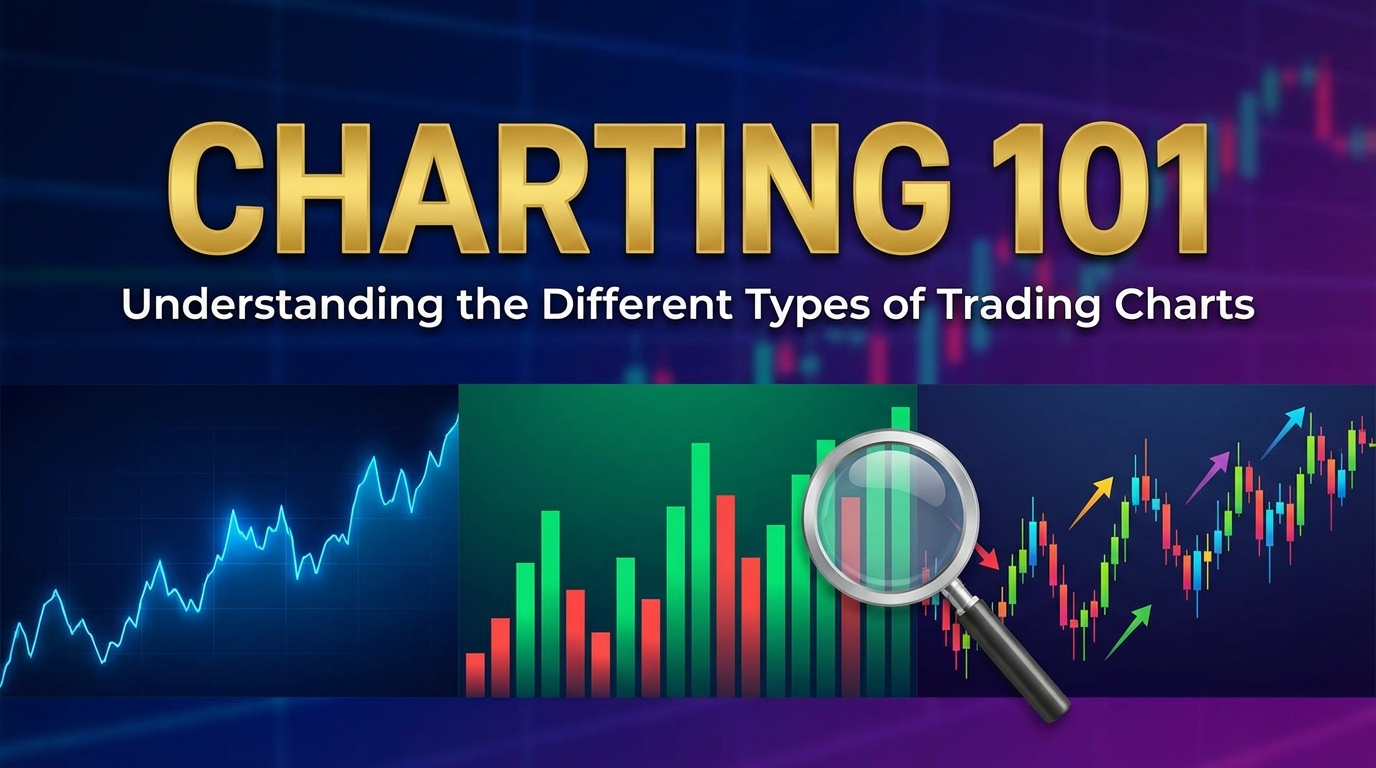
# Charting 101: Understanding the Different Types of Trading Charts
Price charts are the foundation of technical analysis and successful trading. Whether you're analyzing forex pairs, stocks, or cryptocurrency, understanding the different types of trading charts is crucial for making informed decisions. Each chart type presents market data in a unique way, offering different insights into price action and market sentiment.
Choosing the right chart type can significantly impact your ability to spot patterns, identify trends, and execute profitable trades. This comprehensive guide will explore the three primary types of trading charts: line charts, bar charts, and candlestick charts, helping you determine which format best suits your trading strategy.
Table of Contents
- [Line Charts: The Foundation](#line-charts-the-foundation)
- [Bar Charts: Adding Context](#bar-charts-adding-context)
- [Candlestick Charts: Visual Storytelling](#candlestick-charts-visual-storytelling)
- [Comparing Chart Types for Different Trading Styles](#comparing-chart-types-for-different-trading-styles)
- [Choosing the Right Chart for Your Strategy](#choosing-the-right-chart-for-your-strategy)
- [Conclusion](#conclusion)
Line Charts: The Foundation
Line charts represent the most basic form of price visualization in trading. They display a continuous line connecting closing prices over time, creating a smooth representation of price movement without the noise of intraday fluctuations.
How Line Charts Work
Line charts plot only one data point per time period - typically the closing price. These points are then connected by a line, creating a flowing visualization that shows the general direction of price movement over time.
:::key-concept Line charts focus exclusively on closing prices, filtering out the high, low, and opening price data that other chart types display. :::
Advantages of Line Charts
- Clarity: Line charts provide the clearest view of long-term trends without distracting price noise
- Simplicity: Easy to read and interpret, making them ideal for beginners
- Pattern Recognition: Excellent for identifying major support and resistance levels
- Trend Analysis: Superior for spotting long-term trend changes and momentum shifts
When to Use Line Charts
Line charts excel in specific trading scenarios:
- Long-term Analysis: Perfect for identifying weekly or monthly trends
- Multiple Timeframe Analysis: Useful when comparing different assets or timeframes
- Initial Market Assessment: Great starting point for overall market evaluation
- Clean Technical Analysis: Ideal for drawing trendlines and identifying key levels
:::example A swing trader analyzing the S&P 500 might use a daily line chart to identify the primary trend over several months, filtering out the daily volatility that could obscure the bigger picture. :::
Limitations of Line Charts
While line charts offer clarity, they have notable drawbacks:
- Limited Information: Only show closing prices, missing crucial intraday data
- No Volume Context: Don't display trading volume or price rejection levels
- Oversimplification: May miss important reversal signals that occur during the trading session
Bar Charts: Adding Context
Bar charts, also known as OHLC (Open, High, Low, Close) charts, provide significantly more information than line charts. Each bar represents a complete picture of price action for a specific time period.
Understanding Bar Chart Structure
Each bar consists of four key components:
1. Opening Price: Marked by a small horizontal line extending to the left of the vertical bar 2. High Price: The top of the vertical bar 3. Low Price: The bottom of the vertical bar 4. Closing Price: Marked by a small horizontal line extending to the right of the vertical bar
:::key-concept Bar charts provide four times more information than line charts, showing the complete range of price movement within each time period. :::
Advantages of Bar Charts
- Complete Price Information: Shows all four critical price points for each period
- Range Visibility: Displays the full trading range, revealing volatility and price rejection
- Professional Standard: Widely used by institutional traders and technical analysts
- Pattern Recognition: Enables identification of complex price patterns and formations
Reading Bar Chart Patterns
Bar charts reveal important market information:
- Long Bars: Indicate high volatility and strong directional movement
- Short Bars: Suggest low volatility and market consolidation
- Bar Position: The relationship between open and close reveals buying or selling pressure
- Range Analysis: The high-low range shows the extent of price discovery
:::example A day trader examining a 15-minute bar chart of EUR/USD might notice several long bars with closes near the highs, indicating strong buying pressure and a potential continuation of the uptrend. :::
When Bar Charts Excel
Bar charts are particularly useful for:
- Intraday Trading: Providing detailed information for short-term strategies
- Volatility Analysis: Measuring market volatility through bar ranges
- Professional Analysis: Meeting institutional standards for technical analysis
- Price Action Trading: Identifying specific price action patterns and setups
Candlestick Charts: Visual Storytelling
Candlestick charts originated in Japan and have become the most popular chart type among modern traders. They present the same OHLC data as bar charts but in a more visually intuitive format.
Candlestick Anatomy
Each candlestick consists of:
- Body: The rectangular area between open and close prices
- Upper Shadow (Wick): Line extending from the body to the high price
- Lower Shadow (Wick): Line extending from the body to the low price
- Color: Indicates whether price closed higher or lower than it opened
Bullish vs. Bearish Candles
Bullish Candles (typically white, green, or hollow):
- Close price is higher than open price
- Indicate buying pressure and upward momentum
- Body represents the difference between open and close
Bearish Candles (typically black, red, or filled):
- Close price is lower than open price
- Indicate selling pressure and downward momentum
- Show the extent of price decline during the period
:::key-concept Candlestick charts provide the same information as bar charts but present it in a more visually appealing and intuitive format that makes pattern recognition easier. :::
Advantages of Candlestick Charts
- Visual Clarity: Immediate visual distinction between bullish and bearish periods
- Pattern Rich: Hundreds of established candlestick patterns for analysis
- Market Psychology: Better representation of market sentiment and psychology
- Versatility: Effective across all timeframes and markets
- Quick Analysis: Faster interpretation of market conditions
Popular Candlestick Patterns
Candlestick charts enable recognition of powerful reversal and continuation patterns:
Single Candle Patterns:
- Doji: Open and close prices are nearly equal, indicating indecision
- Hammer: Small body with long lower shadow, potential bullish reversal
- Shooting Star: Small body with long upper shadow, potential bearish reversal
Multiple Candle Patterns:
- Engulfing Patterns: One candle completely engulfs the previous candle
- Morning/Evening Stars: Three-candle reversal formations
- Inside Bars: Consolidation patterns showing decreased volatility
:::example A forex trader spots a bullish engulfing pattern on the daily GBP/USD chart, where a large green candle completely engulfs the previous red candle, suggesting a potential trend reversal from bearish to bullish. :::
When Candlestick Charts Shine
Candlestick charts are ideal for:
- Pattern Trading: Identifying and trading specific candlestick formations
- Short-term Analysis: Excellent for scalping and day trading strategies
- Market Sentiment: Reading the psychological state of market participants
- Entry Timing: Precise timing for trade entries and exits
Comparing Chart Types for Different Trading Styles
Different types of trading charts serve various trading approaches and timeframes. Understanding which chart type aligns with your strategy is crucial for trading success.
Day Trading and Scalping
For short-term traders operating on minutes or hourly timeframes:
Best Choice: Candlestick Charts
- Provide immediate visual feedback on market sentiment
- Enable quick pattern recognition for rapid decision-making
- Show precise entry and exit points through wick analysis
- Reveal market psychology in real-time
:::warning While line charts provide trend clarity, they lack the granular detail necessary for short-term trading decisions. :::
Swing Trading
Swing traders holding positions for days to weeks benefit from:
Primary Choice: Candlestick Charts
- Identify multi-day patterns and formations
- Show weekly market sentiment shifts
- Enable precise entry timing within larger trends
Secondary Choice: Bar Charts
- Provide professional-level analysis
- Show complete price ranges for volatility assessment
- Support complex technical analysis techniques
Position Trading and Long-term Investing
Long-term traders focusing on months to years often prefer:
Primary Choice: Line Charts
- Filter out short-term noise
- Highlight major trend changes clearly
- Enable clean trendline analysis
- Simplify long-term pattern identification
Alternative: Weekly/Monthly Candlesticks
- Combine long-term clarity with detailed information
- Show significant reversal patterns on higher timeframes
Multi-Timeframe Analysis
Professional traders often use different chart types across timeframes:
1. Higher Timeframes: Line charts for overall trend direction 2. Intermediate Timeframes: Bar charts for detailed analysis 3. Lower Timeframes: Candlestick charts for precise entries
Choosing the Right Chart for Your Strategy
Selecting the appropriate chart type depends on several factors that align with your trading approach and objectives.
Consider Your Trading Timeframe
Short-term Traders (Minutes to Hours):
- Candlestick charts provide the detail and visual clarity needed for quick decisions
- Pattern recognition becomes crucial for timing entries and exits
- Market sentiment reading through candle colors aids in momentum trading
Medium-term Traders (Days to Weeks):
- Both candlestick and bar charts offer suitable detail levels
- Choice often comes down to personal preference and pattern familiarity
- Consider using different chart types for different analysis phases
Long-term Traders (Months to Years):
- Line charts excel at showing major trends without distraction
- Weekly or monthly candlesticks can provide additional context
- Focus on simplicity to avoid analysis paralysis
Assess Your Experience Level
Beginners:
- Start with line charts to understand basic trend concepts
- Progress to candlestick charts for their visual appeal and extensive educational resources
- Avoid bar charts initially as they can seem less intuitive
Intermediate Traders:
- Master candlestick patterns and their trading applications
- Experiment with bar charts for professional analysis techniques
- Learn to switch between chart types based on analysis needs
Advanced Traders:
- Use all three chart types strategically for different purposes
- Combine multiple chart types in comprehensive market analysis
- Develop personal preferences based on trading style and success rates
Match Charts to Analysis Goals
Trend Identification: Line charts provide the clearest trend visualization Pattern Trading: Candlestick charts offer the richest pattern library Professional Analysis: Bar charts meet institutional analysis standards Quick Decision Making: Candlestick charts enable fastest visual processing
:::tip Many successful traders use multiple chart types simultaneously, leveraging the strengths of each format for different aspects of their analysis. :::
Technical Considerations
Platform Compatibility: Ensure your trading platform supports your preferred chart types Data Quality: Verify that OHLC data is accurate for bar and candlestick charts Processing Speed: Consider platform performance with complex candlestick charts on lower timeframes Customization Options: Look for platforms that allow chart appearance customization
Building Your Chart Analysis Workflow
1. Start Broad: Use line charts to identify overall market direction 2. Add Detail: Switch to candlestick or bar charts for pattern analysis 3. Refine Timing: Use lower timeframe candlesticks for precise entries 4. Confirm Signals: Cross-reference patterns across multiple chart types
:::example A professional trader analyzing Apple stock might start with a monthly line chart to identify the long-term trend, switch to daily candlesticks to spot reversal patterns, and use 15-minute candles to time the actual entry. :::
Conclusion
Understanding the different types of trading charts is fundamental to developing effective technical analysis skills. Line charts provide clarity and simplicity for trend analysis, bar charts offer comprehensive OHLC data for professional analysis, and candlestick charts combine visual appeal with rich pattern recognition opportunities.
The key to success lies not in choosing one chart type exclusively, but in understanding when each format provides the most valuable insights. Line charts excel at revealing long-term trends, bar charts satisfy professional analysis requirements, and candlestick charts offer the best combination of information and visual clarity for most trading applications.
As you develop your trading skills, experiment with all three chart types to discover which formats align best with your trading style, timeframe preferences, and analysis objectives. Many successful traders incorporate multiple chart types into their analysis workflow, leveraging the unique strengths of each format.
Remember that chart selection is just the beginning. The real value comes from learning to read the story that price action tells through whichever chart type you choose. Focus on building pattern recognition skills, understanding market psychology, and developing the ability to make quick, accurate assessments of market conditions.
Start practicing with different types of trading charts today. Begin with the chart type that feels most intuitive to you, then gradually expand your skills to include other formats. With time and experience, you'll develop the ability to seamlessly switch between chart types based on your analysis needs, giving you a significant advantage in reading market conditions and timing your trades effectively.