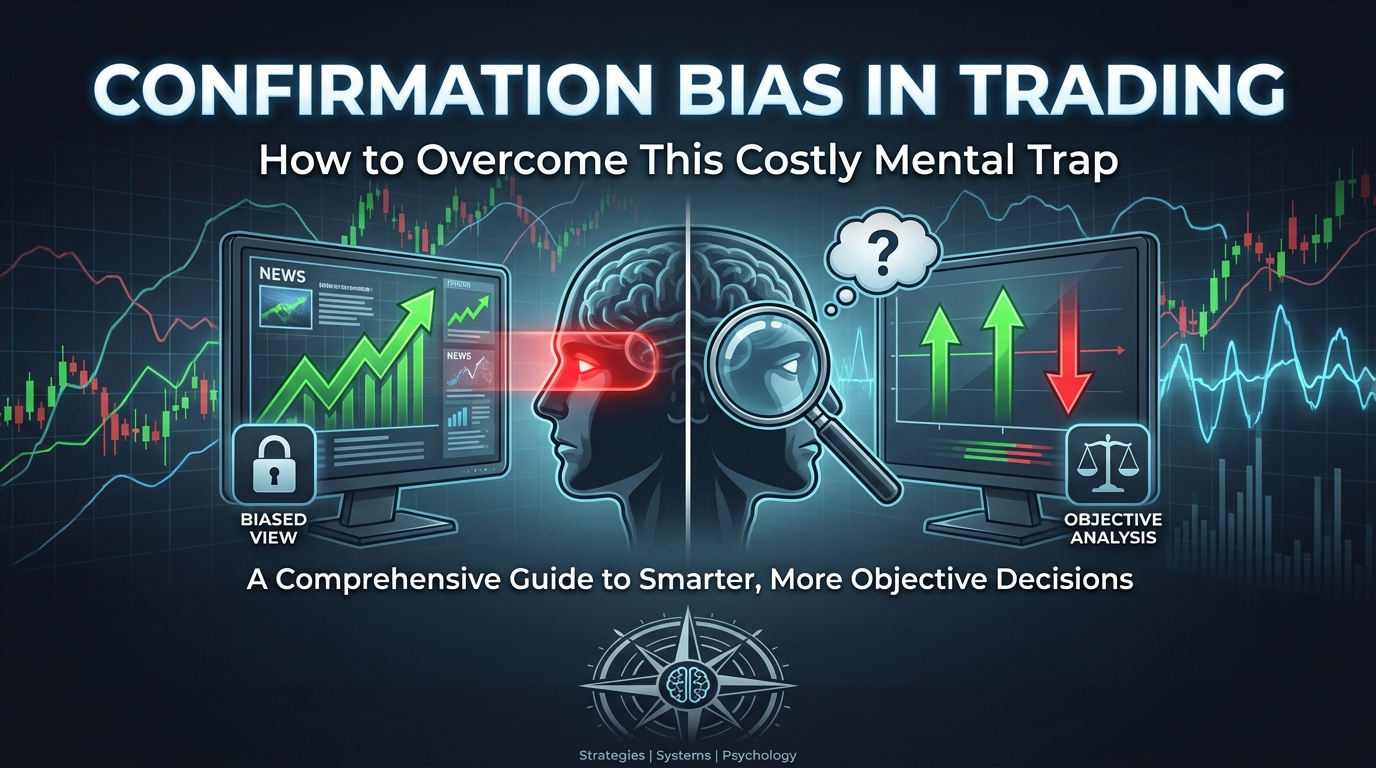
# Confirmation Bias in Trading: How to Overcome This Costly Mental Trap
Every trader has experienced it—that sinking feeling when a "sure thing" trade goes against you, despite what seemed like overwhelming evidence supporting your position. More often than not, confirmation bias in trading is the culprit behind these costly mistakes. This psychological trap causes traders to seek out information that supports their preconceived notions while ignoring contradictory evidence, leading to poor decision-making and significant losses.
Confirmation bias is one of the most destructive cognitive biases in trading, yet it's also one of the most common. Understanding how it works and implementing strategies to combat it can be the difference between consistent profitability and devastating losses. In this comprehensive guide, we'll explore how confirmation bias manifests in trading, examine real-world examples, and provide actionable strategies to help you make more objective trading decisions.
Table of Contents
- [Understanding Confirmation Bias in Trading](#understanding-confirmation-bias-in-trading)
- [How Confirmation Bias Manifests in Trading Decisions](#how-confirmation-bias-manifests-in-trading-decisions)
- [Real-World Examples of Trading Confirmation Bias](#real-world-examples-of-trading-confirmation-bias)
- [The Hidden Costs of Biased Trading](#the-hidden-costs-of-biased-trading)
- [Proven Strategies to Overcome Confirmation Bias](#proven-strategies-to-overcome-confirmation-bias)
- [Building Systems to Combat Cognitive Bias](#building-systems-to-combat-cognitive-bias)
- [Conclusion](#conclusion)
Understanding Confirmation Bias in Trading
Confirmation bias is the tendency to search for, interpret, and recall information in ways that confirm our pre-existing beliefs or hypotheses. In trading contexts, this means selectively focusing on analysis, news, or market data that supports our desired trade direction while dismissing or downplaying contradictory information.
:::key-concept Confirmation bias in trading occurs when traders unconsciously filter information to support their existing market views, leading to poor risk assessment and flawed decision-making. :::
This bias operates at both conscious and unconscious levels. Sometimes traders knowingly ignore negative signals because they're emotionally invested in a position. More dangerously, confirmation bias often works below our awareness, causing us to literally not see warning signs that contradict our expectations.
The Psychology Behind Trading Bias
Our brains are wired to seek patterns and consistency. This evolutionary trait helped our ancestors survive by quickly categorizing threats and opportunities. However, in the complex, rapidly changing world of financial markets, this mental shortcut becomes a liability.
When traders develop a market opinion—whether bullish or bearish on a particular asset—their brains begin filtering information to support that view. They unconsciously give more weight to confirming evidence and less weight to contradictory signals. This selective perception creates a false sense of confidence and leads to poor risk management.
:::warning Confirmation bias becomes more dangerous when combined with leverage, as traders may increase position sizes based on their biased confidence, amplifying potential losses. :::
How Confirmation Bias Manifests in Trading Decisions
Confirmation bias in trading appears in numerous forms, often subtle and difficult to recognize in real-time. Understanding these manifestations is crucial for developing awareness and implementing countermeasures.
Selective Information Processing
Traders affected by confirmation bias tend to:
- Cherry-pick supporting data: Focusing only on technical indicators that support their trade thesis while ignoring conflicting signals
- Overweight positive news: Giving excessive importance to news stories that confirm their market view
- Dismiss contradictory analysis: Quickly discounting expert opinions or research that challenges their position
- Interpret ambiguous signals favorably: Seeing neutral market action as confirmation of their bias
Flawed Risk Assessment
Biased traders often:
- Underestimate the probability of adverse outcomes
- Set stop losses too far away or remove them entirely when positions move against them
- Fail to properly size positions based on actual risk
- Ignore important risk factors that contradict their bullish or bearish stance
:::example A trader believes EUR/USD will rally based on European economic data. When the pair starts declining, they interpret each small bounce as "confirmation" that the uptrend is resuming, rather than recognizing it might be a normal retracement in a downtrend. They hold the losing position too long and ignore their stop loss. :::
Social Reinforcement Seeking
Modern trading often involves social elements through forums, social media, and trading communities. Confirmation bias drives traders to:
- Seek out like-minded traders who share their market views
- Join echo chambers that reinforce their biases
- Dismiss or argue with those who present contradictory analysis
- Share only information that supports their positions
Real-World Examples of Trading Confirmation Bias
Let's examine specific scenarios where confirmation bias in trading leads to poor outcomes:
Case Study 1: The Crypto Bull Market Trap
During cryptocurrency bull markets, many traders become extremely bullish on digital assets. A trader might:
1. Initial bias formation: See Bitcoin rise 50% in a month and become convinced it will continue indefinitely 2. Selective analysis: Focus only on bullish price action and positive news while ignoring bearish divergences in indicators 3. Confirmation seeking: Join crypto communities that share extreme optimism and dismiss skeptical voices as "FUD" (fear, uncertainty, doubt) 4. Risk blindness: Ignore traditional risk management because "crypto only goes up" 5. Devastating result: Hold positions through major corrections, suffering significant losses
:::warning The most dangerous aspect of confirmation bias is how it compounds during strong trends, making traders increasingly blind to reversal signals. :::
Case Study 2: The Earnings Announcement Trap
Stock traders often develop strong opinions before earnings announcements:
1. Pre-announcement bias: A trader analyzes ABC Corp and becomes convinced earnings will beat expectations 2. Selective research: They focus on positive analyst upgrades and ignore concerning industry trends 3. Technical confirmation seeking: They interpret every small uptick in the stock as "smart money" positioning for the beat 4. News filtering: On earnings day, they focus on the headline beat while ignoring concerning guidance or margin compression mentioned in the call 5. Post-earnings denial: When the stock drops despite beating estimates, they rationalize it as "temporary" or "market overreaction"
Case Study 3: The Forex Trend Following Trap
A forex trader identifies what they believe is a strong downtrend in GBP/USD:
1. Trend identification: The pair has been declining, and they short additional positions 2. Confirmation bias kicks in: Every small decline is seen as trend continuation, while bounces are dismissed as "noise" 3. Ignoring reversal signals: They miss key reversal patterns, support levels holding, or fundamental shifts 4. Averaging down: Instead of cutting losses when the trend reverses, they add to losing positions 5. Major loss: What started as a reasonable trend-following trade becomes a significant loss due to biased position management
The Hidden Costs of Biased Trading
The financial and psychological costs of confirmation bias in trading extend far beyond individual losing trades.
Direct Financial Impact
- Larger losses: Biased traders tend to hold losing positions longer and cut winning positions shorter
- Poor position sizing: Overconfidence leads to taking excessive risk
- Missed opportunities: Focusing too narrowly on one market view causes traders to miss contrary opportunities
- Increased transaction costs: Frequent position adjustments based on biased analysis increase trading costs
Long-term Performance Degradation
:::key-concept Confirmation bias doesn't just cause individual bad trades—it systematically degrades trading performance over time by preventing proper learning and adaptation. :::
Biased traders struggle to:
- Learn from mistakes because they don't properly analyze losing trades
- Adapt their strategies as market conditions change
- Develop robust risk management systems
- Build consistent profitability
Psychological Consequences
The mental toll includes:
- Increased stress and anxiety
- Loss of confidence after major losses
- Difficulty trusting their own analysis
- Tendency to blame external factors rather than improve their process
Proven Strategies to Overcome Confirmation Bias
While confirmation bias in trading is a natural human tendency, it can be mitigated through conscious effort and systematic approaches.
Strategy 1: The Devil's Advocate Approach
For every trade idea, actively seek out reasons why it might fail:
1. Write down your thesis: Clearly articulate why you want to make the trade 2. Build the counter-argument: Spend equal time developing reasons why the trade might not work 3. Weight the evidence: Objectively compare the strength of arguments on both sides 4. Adjust or abandon: If the counter-arguments are compelling, reduce position size or skip the trade entirely
:::tip Create a "pre-mortem" analysis for each trade: imagine the trade has already failed and work backward to identify what could have gone wrong. :::
Strategy 2: Systematic Information Gathering
Structure your analysis to prevent cherry-picking:
- Multiple timeframe analysis: Always check longer and shorter timeframes than your trading timeframe
- Diverse indicator types: Use trend-following, momentum, and mean-reversion indicators together
- Fundamental cross-check: Even for technical trades, check if fundamentals support or contradict your view
- Sentiment analysis: Include market sentiment indicators to identify potential contrarian opportunities
Strategy 3: The Pre-Commitment Strategy
Make key decisions before emotions and bias can interfere:
1. Define entry criteria: Establish specific conditions that must be met before entering 2. Set stop losses: Determine exit points before entering the trade 3. Plan profit targets: Decide where you'll take profits in advance 4. Write it down: Document your plan and refer to it during the trade
:::example Before buying Apple stock, a trader writes: "I will buy AAPL if it breaks above $150 with volume above average, stop loss at $145, first profit target at $155, second at $160. I will exit immediately if the broader tech sector shows weakness regardless of AAPL's price action." :::
Strategy 4: The 24-Hour Rule
For significant trading decisions, implement a waiting period:
- Sleep on major position changes
- Use this time to review your analysis objectively
- Ask yourself if you're being influenced by recent events or emotions
- Consider whether your position sizing is appropriate for the actual (not biased) probability of success
Strategy 5: Regular Bias Audits
Systematically review your trading for signs of confirmation bias:
1. Weekly trade reviews: Analyze both winning and losing trades for evidence of bias 2. Information source audit: Track where you get your trading ideas and whether you're in an echo chamber 3. Decision journal: Record your reasoning for each trade and review it later for biased thinking 4. Performance attribution: Identify whether your profits come from good analysis or luck
Building Systems to Combat Cognitive Bias
The most effective approach to overcoming confirmation bias in trading involves building systematic processes that reduce reliance on subjective judgment.
Developing Robust Trading Rules
Create clear, objective criteria for:
- Entry signals: Specific technical or fundamental conditions that must be present
- Position sizing: Mathematical formulas based on account size and stop loss distance
- Exit criteria: Pre-defined conditions for both profits and losses
- Market environment assessment: Rules for identifying when your strategy works best
:::key-concept The goal is to make trading decisions based on predefined rules rather than in-the-moment emotions or biases. :::
Technology and Tools
Leverage technology to maintain objectivity:
- Automated alerts: Set up alerts for technical levels rather than watching charts constantly
- Trading platforms with forced stops: Use platforms that automatically execute stop losses
- Backtesting software: Test your ideas on historical data before risking real money
- Position sizing calculators: Use tools that calculate appropriate position sizes mathematically
Building a Trading Community
Surround yourself with traders who will challenge your thinking:
- Join groups with diverse perspectives, not just those who share your biases
- Find a trading mentor or coach who can provide objective feedback
- Participate in forums where constructive disagreement is encouraged
- Consider working with a trading partner who can provide a second opinion on major trades
Continuous Education and Self-Awareness
Ongoing development helps maintain awareness of bias:
- Study cognitive biases: Learn about other biases that affect trading decisions
- Read trading psychology books: Understand the mental aspects of trading
- Practice mindfulness: Develop awareness of your emotional and mental state while trading
- Regular self-assessment: Honestly evaluate your trading performance and decision-making process
Creating Accountability Systems
Implement structures that hold you accountable:
- Trading journal requirements: Force yourself to document reasoning for each trade
- Regular performance reviews: Schedule monthly or quarterly assessments of your trading
- Risk management checks: Create systems that prevent you from taking excessive risk
- Objective feedback sources: Find ways to get honest feedback about your trading decisions
:::tip Consider working with a trading coach or joining a structured trading program that provides objective feedback and accountability. :::
Conclusion
Confirmation bias in trading represents one of the most significant obstacles to consistent profitability, yet it's a challenge that every trader faces. The tendency to seek information that confirms our existing beliefs while ignoring contradictory evidence is deeply ingrained in human psychology, but it can be devastating in the financial markets where objective analysis is crucial for success.
Throughout this guide, we've explored how confirmation bias manifests in various trading scenarios—from cryptocurrency bull markets to earnings announcements to forex trend following. We've seen how this bias leads to larger losses, missed opportunities, and long-term performance degradation. More importantly, we've outlined proven strategies and systematic approaches to combat this mental trap.
The key to overcoming confirmation bias lies in building structured processes that reduce reliance on subjective judgment. This includes implementing the devil's advocate approach, creating systematic information gathering methods, using pre-commitment strategies, and building robust trading rules. Technology, community support, and continuous self-awareness all play crucial roles in maintaining objectivity.
Remember that defeating confirmation bias isn't about eliminating all emotional or intuitive elements from trading—it's about ensuring that these elements are balanced with objective analysis and proper risk management. The most successful traders aren't those who never experience bias, but those who recognize it early and have systems in place to counteract its effects.
The journey to becoming a more objective trader is ongoing. Start by implementing one or two of the strategies outlined in this guide, and gradually build more comprehensive systems over time. Regular self-assessment and honest evaluation of your trading decisions will help you identify when confirmation bias is influencing your judgment.
Ready to put these concepts into practice? Begin by analyzing your recent trades for signs of confirmation bias, then choose one specific strategy from this guide to implement in your next trading session. Remember, awareness is the first step, but consistent application of bias-fighting techniques is what will ultimately transform your trading results.
Take the time to review your trading charts and decisions with fresh, objective eyes—you might be surprised by what you discover when you actively look for evidence that contradicts your assumptions rather than confirms them.