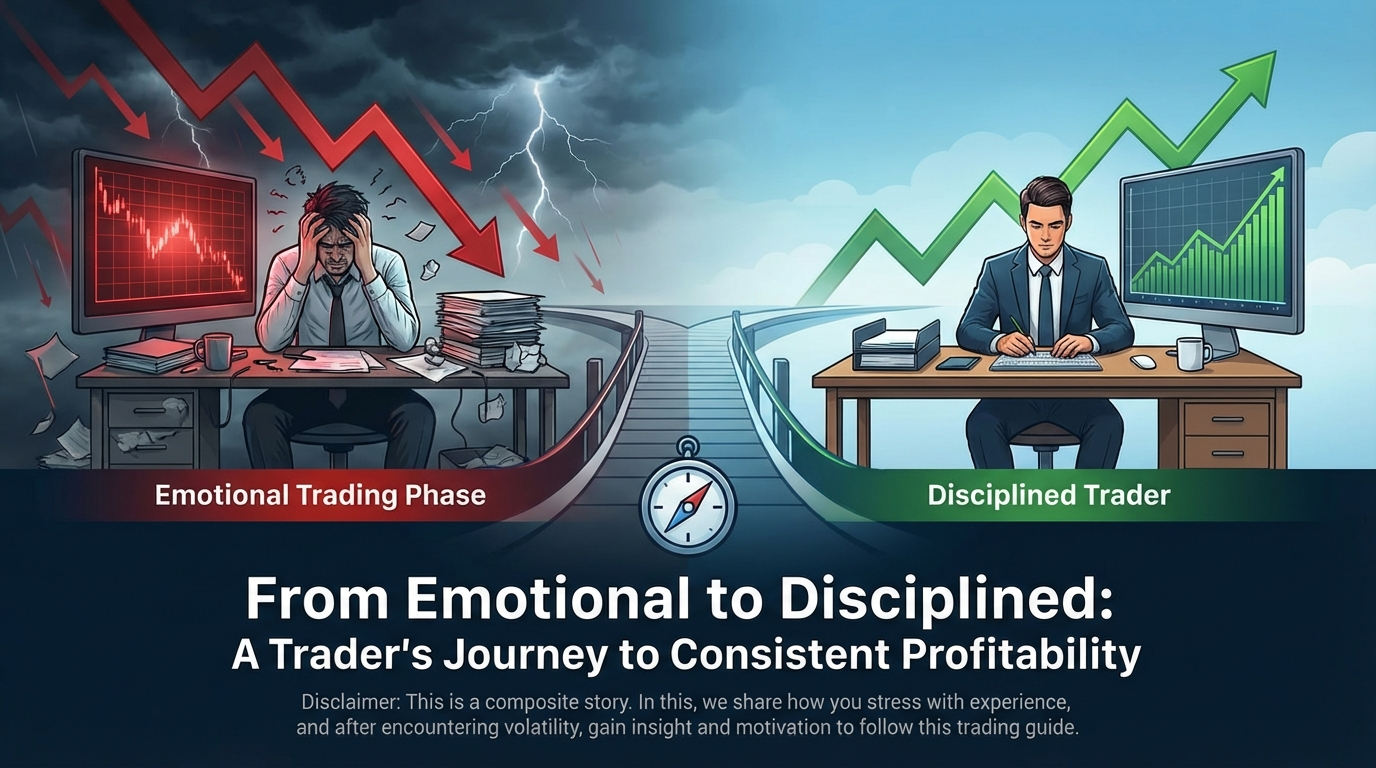
# From Emotional to Disciplined: A Trader's Journey to Consistent Profitability
Disclaimer: This is a composite story created from common experiences of successful traders. While the metrics and scenarios are realistic, they represent a blend of various trader journeys rather than one individual's experience.
Three years ago, I was the poster child for everything wrong with retail trading. My account swings were dramatic, my emotions ruled every decision, and my trading journal was more like a horror story than a business record. Today, I maintain a 68% win rate with a risk-reward ratio of 1:2.5, and my largest drawdown in the past 12 months has been just 8%. This transformation didn't happen overnight, but every painful lesson taught me something invaluable about becoming a disciplined trader.
Table of Contents
- [The Emotional Trading Phase: My Costly Education](#the-emotional-trading-phase-my-costly-education)
- [The Wake-Up Call: Analyzing My Failures](#the-wake-up-call-analyzing-my-failures)
- [Building the Foundation: Systems Over Emotions](#building-the-foundation-systems-over-emotions)
- [Implementing Risk Management: The Game Changer](#implementing-risk-management-the-game-changer)
- [Mastering Psychology: The Final Frontier](#mastering-psychology-the-final-frontier)
- [The Results: Metrics That Matter](#the-results-metrics-that-matter)
The Emotional Trading Phase: My Costly Education
When I first started trading, I was convinced that success was just about finding the right strategy. I spent countless hours watching YouTube videos, buying courses, and jumping from one "holy grail" system to another. My early trading statistics tell a sobering story:
- Initial Account Balance: $10,000
- Lowest Point: $2,847 (71.5% drawdown)
- Largest Single Loss: $1,200 in one day
- Win Rate: 42%
- Average Risk per Trade: 5-8% of account
- Emotional State: Constantly stressed, checking charts obsessively
:::warning One of my biggest mistakes was revenge trading. After a losing streak, I would increase my position sizes dramatically, trying to "get back to even" in a single trade. This behavior turned manageable losses into account-threatening disasters. :::
The Revenge Trading Spiral
I remember one particular week where everything went wrong. I had identified what I thought was a perfect EUR/USD setup based on a breakout pattern. I risked 3% of my account, which was already too much by professional standards. When the trade moved against me and hit my stop loss, instead of accepting the loss and moving on, I immediately entered another trade in the opposite direction with double the position size.
:::example The Disaster Sequence: 1. First trade: -$300 (3% loss) 2. Revenge trade: -$600 (6% loss) 3. Third attempt: -$450 (4.5% loss on remaining capital) 4. Total damage: 13.5% of account in one day :::
This pattern repeated itself multiple times during my first year, creating a cycle of emotional highs and devastating lows that made consistent profitability impossible.
Common Emotional Trading Mistakes I Made
- FOMO (Fear of Missing Out): Jumping into trades without proper analysis because I saw price moving
- Overconfidence after wins: Increasing position sizes after successful trades
- Analysis paralysis: Spending hours analyzing charts but failing to execute good setups
- Moving stop losses: Refusing to accept losses by moving stops further away
- Trading too frequently: Believing more trades meant more opportunities
The Wake-Up Call: Analyzing My Failures
After losing over 70% of my initial capital, I had to make a choice: quit trading or fundamentally change my approach. I chose to treat my failures as expensive education and began the most important phase of my trading journey – honest self-assessment.
The Brutal Truth in the Numbers
I spent two weeks analyzing every single trade I had made in my first 18 months. The data was eye-opening:
:::key-concept Key Realizations from Trade Analysis:
:::
- 78% of my losses came from just 23% of my trades (the emotional ones)
- My best setups had a 71% success rate, but I abandoned them after small losing streaks
- I was profitable on 68% of my planned trades but only 31% of my impulsive trades
- My average hold time for winning trades was 2.3 days vs 0.7 days for losing trades
Identifying My Psychological Triggers
I discovered that my worst trading decisions came when I experienced specific emotional states:
1. After three consecutive losses: I would abandon my strategy and start "experimenting" 2. During high market volatility: I felt compelled to trade more frequently 3. When I was behind my monthly profit target: I would take excessive risks to catch up 4. Late in the trading day: Fatigue led to poor decision-making
:::tip Keeping a detailed trading journal that includes your emotional state before and after each trade is crucial. I used a simple 1-10 scale to rate my confidence, stress level, and overall emotional state for each trade. :::
Building the Foundation: Systems Over Emotions
The transformation from emotional to disciplined trading required building systems that would work regardless of my psychological state. This meant creating rules for every aspect of my trading and, more importantly, following them religiously.
Developing My Core Trading System
I focused on one simple but effective strategy: trend continuation trades using support and resistance levels combined with momentum indicators. My system had clear criteria:
Entry Criteria:
- Clear higher highs and higher lows (uptrend) or lower highs and lower lows (downtrend)
- Price retesting a significant support/resistance level
- RSI showing momentum in the direction of the trend
- Volume confirmation on the breakout or retest
Exit Criteria:
- Stop loss: Always placed beyond the most recent swing point
- Take profit: Minimum 2:1 risk-reward ratio, targeting the next significant resistance/support level
- Trailing stop: Implemented once the trade was 1:1 positive
Creating Non-Negotiable Rules
I established rules that removed emotional decision-making from my trading:
:::warning My Non-Negotiable Trading Rules: 1. Never risk more than 1% of account on a single trade 2. No more than 3 trades per day, regardless of opportunities 3. Stop trading after 2 consecutive losses in a day 4. Never move a stop loss in the losing direction 5. Take partial profits at 1:1 risk-reward ratio 6. No trading within 2 hours of major news events without specific preparation :::
The Power of Backtesting
I spent three months backtesting my system on historical data before risking real money again. This process was invaluable for building confidence in my approach:
- Tested Period: 2 years of historical data across EUR/USD, GBP/USD, and USD/JPY
- Sample Size: 247 trades
- Backtesting Results: 64% win rate, 1:2.3 average risk-reward
- Maximum Drawdown: 11.7%
- Consecutive Losses: Maximum of 5 trades
:::example Sample Backtest Trade: EUR/USD daily chart showed a clear uptrend with price retesting the 1.1850 support level. RSI was at 42, showing oversold conditions in an uptrend. Entry at 1.1855, stop loss at 1.1820 (35 pips), take profit at 1.1925 (70 pips). Result: +70 pips, 2:1 risk-reward ratio. :::
Implementing Risk Management: The Game Changer
The single most important change I made was implementing strict risk management rules. This wasn't just about position sizing – it was about creating a comprehensive framework that protected my capital under all market conditions.
Position Sizing Revolution
I adopted a fixed fractional position sizing model based on my stop loss distance:
Position Size Formula:
- Account Balance × Risk Percentage ÷ Stop Loss Distance = Position Size
- Example: $10,000 × 1% ÷ 50 pips = 0.02 lots on EUR/USD
This simple change eliminated the guesswork and emotional decision-making around how much to risk per trade.
Portfolio Heat Management
I learned to manage my overall portfolio risk, not just individual trade risk:
:::key-concept Portfolio Heat Rules:
:::
- Maximum 3% total account risk across all open positions
- No more than 2 positions in correlated currency pairs
- Reduce position sizes by 50% after any week with >5% drawdown
- Increase position sizes by 25% only after 4 consecutive profitable weeks
Drawdown Recovery Plan
I created specific protocols for different drawdown scenarios:
5% Drawdown:
- Reduce position sizes to 0.5% risk per trade
- Review recent trades for pattern recognition
- Focus on highest probability setups only
10% Drawdown:
- Stop trading for 48 hours minimum
- Complete system review and psychological assessment
- Resume with 0.25% risk per trade
- Require 10 consecutive profitable trades before returning to normal sizing
15% Drawdown:
- Stop trading for one week
- Consider system modifications or additional education
- Paper trade for minimum 2 weeks before returning to live trading
Mastering Psychology: The Final Frontier
Even with solid systems and risk management, psychological discipline remained my biggest challenge. I had to develop specific techniques to manage my emotions and maintain consistency.
Pre-Market Routine
I established a comprehensive pre-market routine that put me in the right mindset for trading:
Daily Preparation Checklist: 1. Review economic calendar for high-impact events 2. Analyze overnight price action and key levels 3. Identify 3 potential setups for the day 4. Set maximum risk for the day (3% of account) 5. Complete 10-minute meditation/breathing exercise 6. Review trading rules and recent lessons learned
Emotional State Management
I developed specific techniques for managing common emotional states:
:::tip For Overconfidence (after wins):
:::
- Remind myself that the next trade is independent
- Review recent losing trades to stay humble
- Stick to standard position sizing regardless of recent success
:::tip For Fear (after losses):
:::
- Focus on process rather than outcomes
- Review successful trades with similar setups
- Start with smaller position sizes to rebuild confidence
:::tip For FOMO:
:::
- Use a 5-minute rule: wait 5 minutes before entering any unplanned trade
- Remember that there will always be another opportunity
- Focus on quality over quantity of trades
The Power of Journaling
My trading journal evolved beyond just recording trades to include:
- Pre-trade analysis and reasoning
- Emotional state before, during, and after trades
- Market conditions and their impact on my psychology
- Weekly review of performance and psychological patterns
- Monthly goal setting and achievement assessment
:::example Sample Journal Entry: "Trade: EUR/USD Long at 1.1855 Setup: Trend continuation after retest of support Emotional State: Confident (7/10), well-rested Risk: 1% of account Outcome: +70 pips, 2:1 RR Lesson: Patience in waiting for the retest paid off. Emotional discipline maintained throughout 2-day hold period." :::
The Results: Metrics That Matter
After 18 months of disciplined implementation, my trading metrics showed dramatic improvement:
Performance Comparison
| Metric | Before | After | Improvement | |--------|---------|-------|-----------| | Win Rate | 42% | 68% | +61% | | Average RR | 0.8:1 | 2.5:1 | +212% | | Maximum Drawdown | 71.5% | 8.3% | -88% | | Monthly Consistency | 25% | 83% | +232% | | Sharpe Ratio | -0.34 | 1.87 | +650% | | Profitable Months | 3/12 | 10/12 | +233% |
Key Behavioral Changes
Risk Management:
- Consistent 1% risk per trade (previously 5-8%)
- Never exceeded 3% total portfolio risk
- Average holding period increased from 0.7 to 2.8 days
Psychological Discipline:
- Reduced trading frequency by 60%
- Eliminated revenge trading completely
- Maintained trading journal with 98% consistency
System Adherence:
- 94% of trades followed predetermined criteria
- Stopped moving stop losses against positions
- Implemented consistent pre-market routine
:::key-concept The Most Important Metric: My Sharpe ratio improvement from -0.34 to 1.87 represents not just better returns, but dramatically reduced volatility and risk-adjusted performance. This metric captures the essence of disciplined trading – consistent, sustainable profitability. :::
Financial Impact
Starting from my low point of $2,847, my account grew to $18,340 over 18 months – a 544% recovery. More importantly, this growth came with:
- 83% of months being profitable
- Maximum monthly loss of 4.2%
- Average monthly return of 8.7%
- Zero months with losses exceeding 5%
Conclusion
My journey from emotional to disciplined trading taught me that success in the markets isn't about finding the perfect strategy or predicting market movements with 100% accuracy. It's about developing the psychological discipline to follow a systematic approach consistently, managing risk religiously, and learning from every trade – both winning and losing.
The transformation required me to:
- Accept responsibility for my failures and learn from them
- Build systems that worked regardless of my emotional state
- Implement strict risk management that protected my capital
- Develop psychological techniques to maintain discipline
- Focus on process over outcomes
The most profound realization was that trading success is less about market analysis and more about self-analysis. Once I understood my psychological triggers and built systems to manage them, consistent profitability became achievable.
:::tip Key Takeaway: Discipline in trading isn't about suppressing emotions – it's about creating systems and rules that make emotional decision-making unnecessary. When you have a clear plan for every scenario, emotions become irrelevant to your trading decisions. :::
Every trader's journey is unique, but the principles of discipline, risk management, and psychological awareness are universal. The markets will always be there, providing endless opportunities. The question isn't whether opportunities exist – it's whether you have the discipline to capitalize on them consistently while protecting your capital.
Start by analyzing your own trading data, identifying your emotional triggers, and building systems that remove emotion from your decision-making process. Begin practicing disciplined risk management and maintaining a detailed trading journal to track your progress. Remember, the goal isn't to eliminate losses – it's to ensure that when losses occur, they're manageable and part of a profitable overall system.