# Higher Timeframe vs Lower Timeframe Trading: Which Really Matters More?
One of the most debated topics in trading circles is the eternal question: should you focus on higher timeframes or lower timeframes for your analysis and trading decisions? This fundamental question affects everything from your entry and exit timing to your overall trading strategy and risk management approach.
The truth is, both timeframes serve critical purposes in trading, but understanding when and how to use each one can be the difference between consistent profitability and constant struggle. Many traders make the mistake of focusing exclusively on one timeframe, missing crucial information that could improve their trading performance.
In this comprehensive guide, we'll explore the strengths and weaknesses of both approaches, show you how to effectively combine them, and help you determine which timeframe emphasis works best for your trading style and goals.
Table of Contents
- [Understanding Timeframe Analysis](#understanding-timeframe-analysis)
- [The Case for Higher Timeframes](#the-case-for-higher-timeframes)
- [The Power of Lower Timeframes](#the-power-of-lower-timeframes)
- [Multi-Timeframe Analysis Strategy](#multi-timeframe-analysis-strategy)
- [Choosing Your Primary Timeframe](#choosing-your-primary-timeframe)
- [Common Timeframe Trading Mistakes](#common-timeframe-trading-mistakes)
- [Conclusion](#conclusion)
Understanding Timeframe Analysis
Before diving into the debate, it's essential to understand what we mean by higher and lower timeframes and how they impact market analysis.
:::key-concept Timeframe Hierarchy:
:::
- Higher Timeframes: Daily, Weekly, Monthly charts
- Medium Timeframes: 4-hour, 6-hour, 8-hour charts
- Lower Timeframes: 1-hour, 30-minute, 15-minute, 5-minute, 1-minute charts
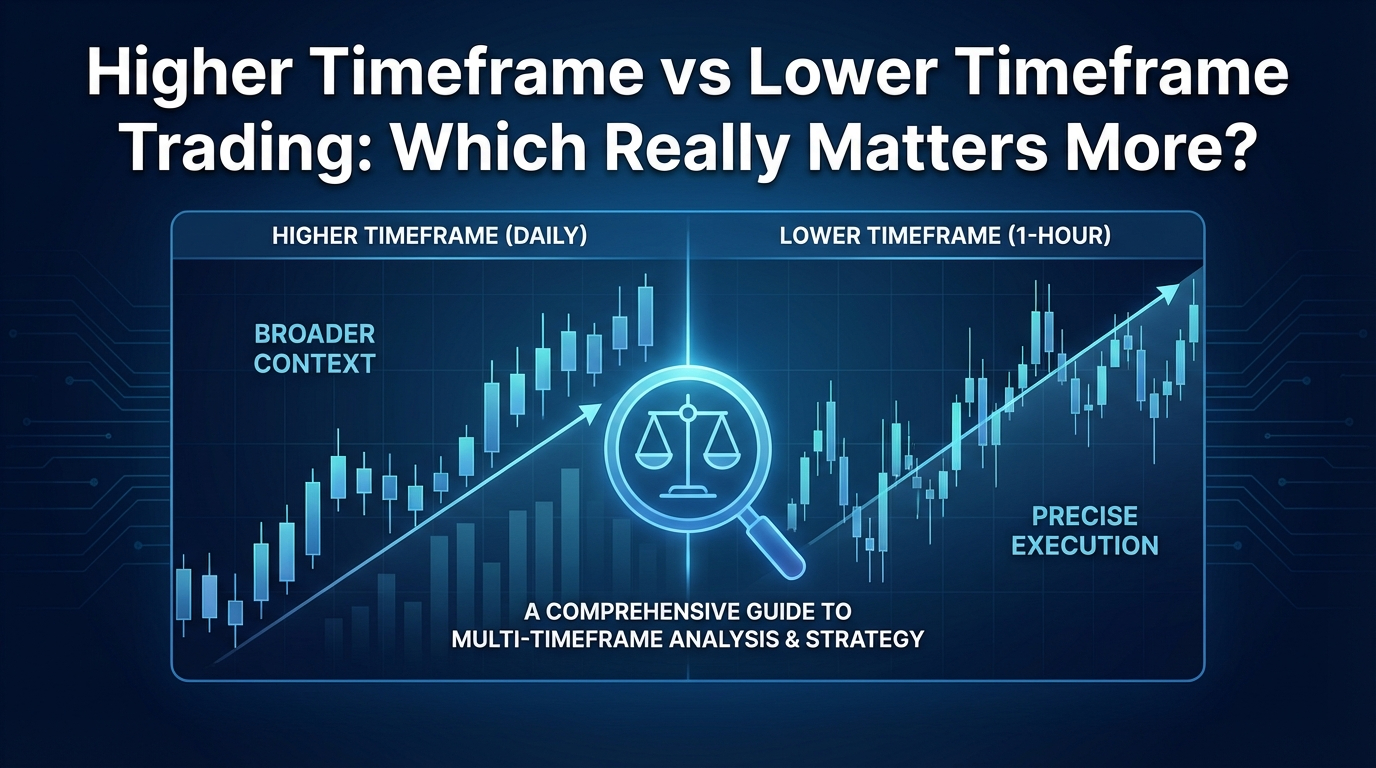
Each timeframe tells a different story about market behavior. Higher timeframes show the broader market context and long-term trends, while lower timeframes reveal short-term price movements and immediate market sentiment.
The Relationship Between Timeframes
Timeframes are interconnected in a hierarchical structure. What appears as a small pullback on a daily chart might represent a complete trend reversal on a 15-minute chart. This relationship is crucial for understanding market dynamics.
:::example Practical Example: Imagine EUR/USD is in a strong uptrend on the daily chart, but on the 1-hour chart, you see a sharp downward movement. The daily chart provides context (overall bullish bias), while the hourly chart shows a potential buying opportunity during a temporary pullback. :::
The Case for Higher Timeframes
Higher timeframes have several compelling advantages that make them invaluable for trading success.
Reduced Market Noise
One of the primary benefits of higher timeframes is the reduction of market noise. Lower timeframes are filled with false signals, whipsaws, and random price movements that can lead to overtrading and poor decision-making.
:::tip Noise Reduction Benefits:
:::
- Clearer trend identification
- More reliable support and resistance levels
- Fewer false breakouts
- Better risk-reward ratios
Stronger Technical Levels
Support and resistance levels identified on higher timeframes tend to be more significant and respected by the market. A support level that has held for weeks on a daily chart is likely to be more reliable than one formed over a few hours.
Better Risk Management
Higher timeframes naturally encourage wider stop losses and larger profit targets, leading to improved risk-reward ratios. This approach aligns with the principle that successful trading is about winning more on winning trades than you lose on losing trades.
Psychological Benefits
Trading higher timeframes can reduce stress and emotional decision-making. With fewer signals and longer holding periods, traders have more time to analyze their positions and make rational decisions.
:::warning Higher Timeframe Drawbacks:
:::
- Fewer trading opportunities
- Larger capital requirements for proper position sizing
- Longer time to confirmation of trade success or failure
- May miss short-term profit opportunities
The Power of Lower Timeframes
While higher timeframes provide context, lower timeframes offer their own unique advantages that shouldn't be overlooked.
Precise Entry and Exit Timing
Lower timeframes excel at providing precise entry and exit points. Even when your overall bias comes from a higher timeframe, using lower timeframes for execution can significantly improve your trade results.
:::example Entry Timing Example: You've identified a bullish setup on the 4-hour chart, but instead of entering immediately, you drop to the 15-minute chart to wait for a pullback to a key support level, allowing for a better entry price and tighter stop loss. :::
More Trading Opportunities
For active traders or those with smaller accounts, lower timeframes provide more frequent trading opportunities. This can be particularly beneficial for:
- Day traders who need multiple setups per day
- Traders building small accounts who need more frequent compounding opportunities
- Those learning to trade who want more practice opportunities
Quick Profit Taking
Lower timeframes allow for quick profit-taking on short-term moves, which can be particularly useful in volatile or ranging markets where longer-term trends are unclear.
Scalping Opportunities
For scalpers, lower timeframes are essential for identifying quick profit opportunities from small price movements.
:::warning Lower Timeframe Challenges:
:::
- Higher noise-to-signal ratio
- Increased transaction costs due to more frequent trading
- Greater emotional stress and decision fatigue
- Higher risk of overtrading
Multi-Timeframe Analysis Strategy
The most effective approach combines both higher and lower timeframe analysis in a structured methodology.
The Top-Down Approach
This proven strategy involves analyzing multiple timeframes in a specific sequence:
1. Start with the highest timeframe (Daily/Weekly) for overall market direction 2. Move to medium timeframes (4-hour) for trade setup identification 3. Use lower timeframes (1-hour/15-minute) for precise entry and exit timing
:::key-concept The 3-Timeframe Rule: Many successful traders use three timeframes:
:::
- Higher TF: Overall bias and major levels
- Medium TF: Trade setup and signal generation
- Lower TF: Entry timing and trade management
Practical Implementation
Here's how to implement multi-timeframe analysis effectively:
Step 1: Higher Timeframe Analysis
- Identify the overall trend direction
- Mark major support and resistance levels
- Note important chart patterns or formations
- Determine the broader market context
Step 2: Medium Timeframe Setup
- Look for trade setups that align with the higher timeframe bias
- Identify specific entry triggers (pattern breakouts, indicator signals)
- Plan initial stop loss and profit target levels
Step 3: Lower Timeframe Execution
- Wait for confirmation on the lower timeframe
- Fine-tune entry point for better risk-reward
- Manage the trade using lower timeframe signals
- Look for early exit signals if trade setup deteriorates
:::example Complete Multi-Timeframe Example:
Daily Chart: EUR/USD is in an uptrend, recently pulled back to the 50-day moving average 4-Hour Chart: Bullish engulfing pattern formed at the daily moving average support 1-Hour Chart: Wait for break above previous hour's high with strong volume for entry
Result: High-probability trade with multiple timeframe confirmation :::
Choosing Your Primary Timeframe
While multi-timeframe analysis is ideal, you still need to determine which timeframe serves as your primary focus based on several factors.
Trading Style Considerations
Day Trading:
- Primary: 5-minute to 1-hour charts
- Context: 4-hour and daily charts
- Focus on lower timeframes for multiple daily opportunities
Swing Trading:
- Primary: 4-hour to daily charts
- Context: Weekly charts
- Balance between opportunity frequency and noise reduction
Position Trading:
- Primary: Daily to weekly charts
- Context: Monthly charts
- Emphasis on higher timeframes for long-term trends
Account Size Impact
:::tip Account Size Guidelines:
:::
- Small accounts ($1,000-$10,000): May need lower timeframes for more opportunities
- Medium accounts ($10,000-$100,000): Can focus on medium timeframes effectively
- Large accounts ($100,000+): Can afford to focus primarily on higher timeframes
Available Time for Trading
Your available time significantly impacts timeframe choice:
- Limited time (part-time traders): Higher timeframes require less monitoring
- Full-time availability: Can effectively use lower timeframes
- Flexible schedule: Multi-timeframe approach works best
Risk Tolerance
Higher timeframes generally involve:
- Larger stop losses but better risk-reward ratios
- Longer time to profitability
- Less frequent but potentially larger losses
Lower timeframes typically involve:
- Smaller individual losses but more frequent losses
- Quicker feedback on trade performance
- Higher transaction costs
Common Timeframe Trading Mistakes
Understanding common mistakes can help you avoid costly errors in your timeframe selection and analysis.
Mistake 1: Timeframe Confusion
Many traders switch between timeframes randomly, looking for confirmation that supports their existing position rather than following a systematic approach.
:::warning Avoid Timeframe Shopping: Don't jump between timeframes looking for signals that confirm your bias. Stick to your predetermined timeframe hierarchy and analysis process. :::
Mistake 2: Ignoring Higher Timeframe Context
Taking trades on lower timeframes without considering higher timeframe context often leads to trading against major trends and market structure.
Mistake 3: Overcomplicating Analysis
Using too many timeframes can lead to analysis paralysis and conflicting signals. Most successful traders use 2-3 timeframes maximum.
Mistake 4: Inadequate Position Sizing
Failing to adjust position sizes based on timeframe-specific stop loss requirements can lead to taking excessive risk or inadequate profit potential.
Mistake 5: Mismatched Strategy and Timeframe
Using a scalping strategy on daily charts or a long-term trend following approach on 5-minute charts rarely works effectively.
:::tip Best Practice Checklist:
:::
- ✅ Define your primary timeframe based on trading style
- ✅ Always check higher timeframe context before trading
- ✅ Use lower timeframes only for entry/exit timing
- ✅ Adjust position sizes based on timeframe-specific stops
- ✅ Match your strategy to your chosen timeframes
Timeframe-Specific Strategies
Different timeframes require adapted strategies and approaches for optimal results.
Higher Timeframe Strategies
Trend Following:
- Use moving average crossovers on daily/weekly charts
- Focus on major support/resistance breaks
- Hold positions for weeks to months
Position Trading:
- Base decisions on fundamental analysis combined with weekly/monthly charts
- Use economic events and long-term market cycles
- Emphasize patience and position sizing
Lower Timeframe Strategies
Scalping:
- Focus on 1-5 minute charts
- Target small, quick profits (5-20 pips in forex)
- High win rate with small risk-reward ratios
Day Trading:
- Primary analysis on 15-minute to 1-hour charts
- Close all positions by end of trading day
- Focus on intraday support/resistance levels
Technology and Timeframe Analysis
Modern trading platforms and tools can significantly enhance your multi-timeframe analysis capabilities.
Multi-Monitor Setups
Using multiple monitors allows you to display different timeframes simultaneously, making it easier to spot alignment and divergences.
Alert Systems
Set up alerts on higher timeframes for major level breaks while monitoring lower timeframes for entry opportunities.
Automated Screening
Use scanners to identify setups on higher timeframes, then manually analyze lower timeframes for entry timing.
Conclusion
The question of whether higher or lower timeframes matter more doesn't have a simple answer because both serve essential but different purposes in successful trading. The key insight is that effective trading requires understanding and utilizing both timeframes appropriately.
Higher timeframes provide:
- Market context and direction
- Stronger technical levels
- Better risk-reward opportunities
- Reduced emotional stress
Lower timeframes offer:
- Precise entry and exit timing
- More frequent trading opportunities
- Quick profit-taking abilities
- Better position management
The optimal approach combines both: 1. Use higher timeframes for market bias and major levels 2. Employ medium timeframes for setup identification 3. Utilize lower timeframes for execution and management
Your primary timeframe focus should align with your trading style, account size, available time, and risk tolerance. However, regardless of your primary timeframe, always consider the broader market context from higher timeframes and use lower timeframes to improve your execution.
Remember, consistency in your approach is more important than finding the "perfect" timeframe. Develop a systematic multi-timeframe analysis process, stick to it, and refine it based on your results and experience.
Ready to improve your timeframe analysis skills? Start by identifying your natural trading style and primary timeframe preference, then practice the multi-timeframe approach on demo accounts. Focus on developing a consistent process rather than trying to catch every market move. Your trading performance will improve as you learn to let each timeframe serve its specific purpose in your overall trading strategy.