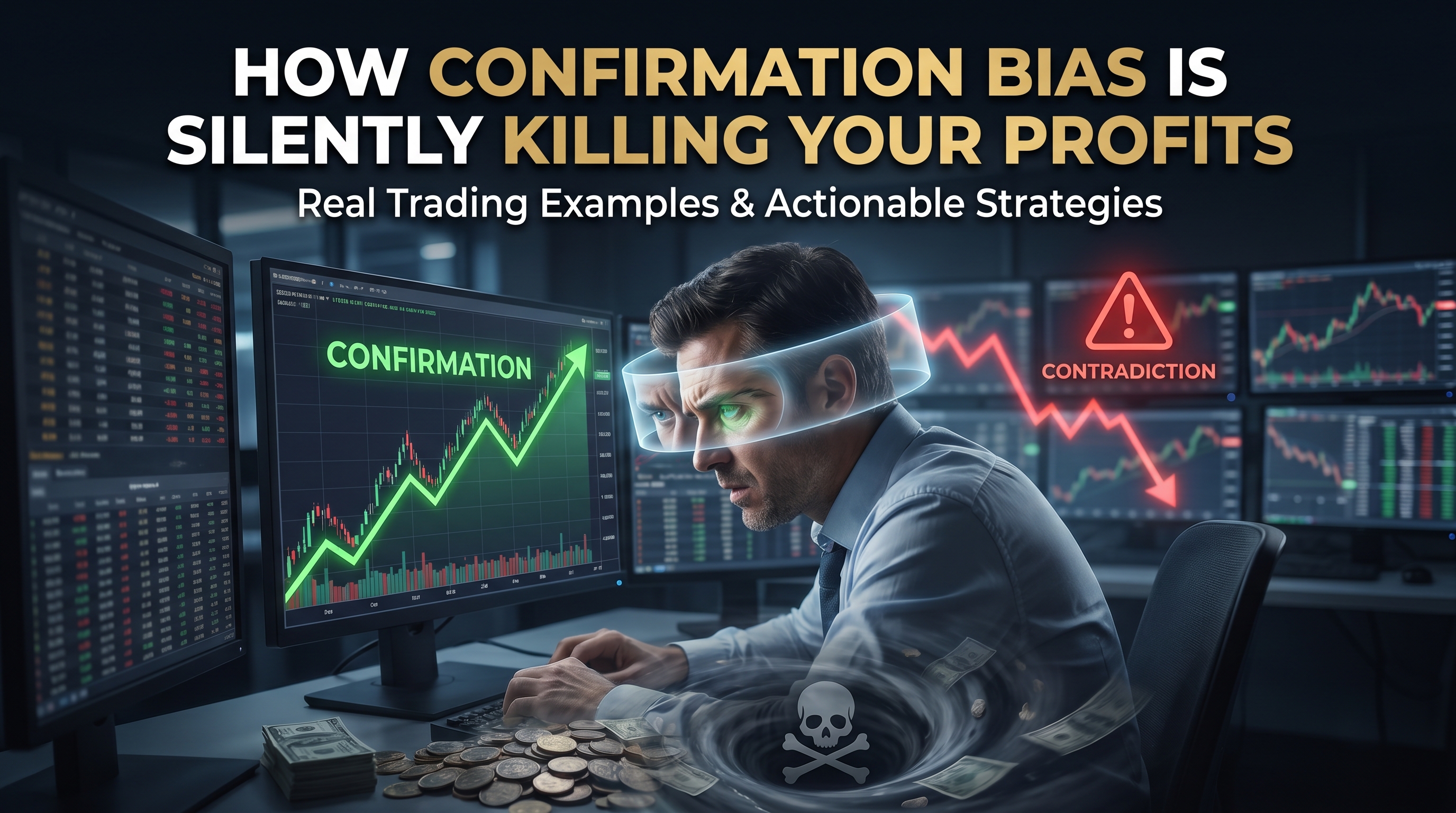
# How Confirmation Bias is Silently Killing Your Profits: Real Trading Examples
Confirmation bias is one of the most dangerous psychological traps in trading, yet most traders are completely unaware of how it's systematically destroying their profitability. This cognitive bias causes traders to seek out information that confirms their existing beliefs while ignoring contradictory evidence – a recipe for disaster in the markets.
In this comprehensive guide, we'll explore confirmation bias trading examples, examine how this psychological trap operates in real market scenarios, and provide actionable strategies to overcome it. By understanding and addressing confirmation bias, you can dramatically improve your trading performance and protect your capital from unnecessary losses.
Table of Contents
- [Understanding Confirmation Bias in Trading](#understanding-confirmation-bias-in-trading)
- [Real Confirmation Bias Trading Examples](#real-confirmation-bias-trading-examples)
- [The Hidden Costs of Confirmation Bias](#the-hidden-costs-of-confirmation-bias)
- [Identifying Confirmation Bias in Your Trading](#identifying-confirmation-bias-in-your-trading)
- [Strategies to Overcome Confirmation Bias](#strategies-to-overcome-confirmation-bias)
- [Building a Bias-Resistant Trading System](#building-a-bias-resistant-trading-system)
- [Conclusion](#conclusion)
Understanding Confirmation Bias in Trading
Confirmation bias occurs when traders selectively interpret market information to support their predetermined views about price direction. This psychological phenomenon manifests in various ways throughout the trading process, from initial market analysis to position management and exit decisions.
:::key-concept Confirmation bias in trading is the tendency to search for, interpret, and recall information that confirms pre-existing beliefs about market direction while giving disproportionately less consideration to alternative possibilities. :::
The human brain naturally seeks patterns and consistency, making confirmation bias an evolutionary survival mechanism. However, in trading, this same mechanism can lead to catastrophic losses. Markets are dynamic, unpredictable environments where being wrong is not just possible – it's inevitable. Successful traders must remain flexible and objective, qualities that confirmation bias directly undermines.
How Confirmation Bias Develops
Traders develop confirmation bias through several psychological processes:
- Selective attention: Focusing only on charts, news, or analysis that supports existing positions
- Biased interpretation: Explaining contradictory evidence in ways that still support original beliefs
- Selective recall: Remembering successful predictions while forgetting failures
- Source credibility bias: Giving more weight to analysts or sources that agree with existing views
:::warning Confirmation bias becomes stronger when traders are emotionally invested in their positions. The larger the position or the longer it's held, the more likely bias will influence decision-making. :::
Real Confirmation Bias Trading Examples
Let's examine specific confirmation bias trading examples to understand how this psychological trap operates in practice.
Example 1: The Bullish EUR/USD Trap
A trader analyzes EUR/USD and decides the pair is ready for a bullish breakout based on a ascending triangle pattern. After entering a long position at 1.1200, the trader experiences the following:
Initial Analysis: The trader sees:
- Higher lows forming over several weeks
- Strong resistance at 1.1250
- Bullish divergence on RSI
Confirmation Bias in Action:
- When price drops to 1.1180, the trader interprets it as a "healthy pullback"
- Negative economic data is dismissed as "already priced in"
- A break below the ascending trendline is seen as a "false breakdown"
- The trader adds to the position at 1.1150, convinced the analysis is correct
Reality: The pair continues falling to 1.1050, resulting in significant losses that could have been avoided with objective analysis.
:::example The trader's confirmation bias prevented recognition of changing market conditions. A bearish break of the ascending triangle should have triggered a reassessment, not additional buying. :::
Example 2: The Tech Stock Momentum Mirage
A swing trader identifies a technology stock showing strong momentum and enters a long position based on:
- Breaking above a 6-month resistance level
- Strong volume on the breakout
- Positive analyst upgrades
How Confirmation Bias Manifests:
As the stock begins to decline, the trader:
- Focuses on minor intraday recoveries as "signs of strength"
- Interprets selling pressure as "weak hands being shaken out"
- Dismisses negative earnings guidance from similar companies
- Holds the position despite breaking below the breakout level
The stock ultimately falls 25% before the trader finally exits, turning what should have been a small loss into a significant portfolio hit.
Example 3: Cryptocurrency False Dawn
During a cryptocurrency rally, a day trader becomes convinced that Bitcoin will reach new all-time highs based on institutional adoption news. After entering multiple long positions, confirmation bias leads to:
- Interpreting every small bounce as "institutional buying"
- Ignoring rising selling volume on rallies
- Dismissing regulatory concerns as "FUD" (fear, uncertainty, doubt)
- Adding to losing positions during each "dip buying opportunity"
These confirmation bias trading examples demonstrate how cognitive bias can transform potentially profitable setups into significant losses through poor risk management and objective analysis failure.
:::tip The key lesson from these examples is that successful trading requires constant reassessment of market conditions, not stubborn adherence to initial analysis. :::
The Hidden Costs of Confirmation Bias
Confirmation bias inflicts multiple forms of damage on trading performance, many of which traders don't immediately recognize:
Financial Costs
Direct Losses: The most obvious cost comes from holding losing positions too long or adding to them based on biased analysis. These decisions can transform small, manageable losses into account-threatening disasters.
Opportunity Cost: While stubbornly holding losing positions, traders miss profitable opportunities in other markets or instruments. Capital tied up in bad trades cannot be deployed in better setups.
Increased Transaction Costs: Confirmation bias often leads to overtrading as traders seek evidence to support their positions, resulting in higher spreads and commission costs.
Psychological Costs
Stress and Anxiety: Maintaining positions against mounting evidence increases psychological pressure and can lead to poor decision-making in other areas of life.
Loss of Confidence: Repeated losses due to confirmation bias can severely damage a trader's confidence, leading to hesitation on genuinely good setups.
Emotional Trading: The frustration from bias-driven losses often triggers revenge trading and other emotionally-driven behaviors.
Performance Degradation
Risk Management Breakdown: Confirmation bias frequently leads traders to violate their risk management rules, using larger position sizes or ignoring stop losses.
Analysis Paralysis: Constantly seeking confirming evidence can lead to overthinking and missed opportunities.
Reduced Learning: By dismissing contradictory information, traders miss valuable lessons that could improve future performance.
:::warning The most dangerous aspect of confirmation bias is that its costs compound over time. Each biased decision makes the next one easier to justify, creating a downward spiral that's difficult to break. :::
Identifying Confirmation Bias in Your Trading
Recognizing confirmation bias in your own trading is challenging because it operates largely at a subconscious level. However, several warning signs can help you identify when bias is influencing your decisions:
Pre-Trade Warning Signs
- Selective Research: Only seeking analysis that supports your intended trade direction
- Dismissing Contrary Evidence: Automatically rejecting or explaining away negative signals
- Overconfidence: Feeling certain about trade outcomes based on limited information
- Emotional Investment: Having strong feelings about whether a particular trade "should" work
During-Trade Red Flags
- Moving Stop Losses: Constantly adjusting stops to avoid being stopped out
- Adding to Losers: Increasing position size on losing trades to "average down"
- Ignoring Exit Signals: Dismissing technical or fundamental reasons to close positions
- Cherry-Picking Information: Focusing only on positive news while ignoring negative developments
Post-Trade Indicators
- Excuse Making: Consistently blaming losses on external factors rather than analysis errors
- Selective Memory: Remembering wins vividly while forgetting or minimizing losses
- Resistance to Change: Refusing to modify trading strategies despite poor results
:::example Keep a trading journal that specifically tracks your reasoning for trade entries, exits, and management decisions. Review this journal weekly to identify patterns of biased thinking. :::
Self-Assessment Questions
Regularly ask yourself:
1. Am I seeking information that challenges my current position? 2. What evidence would convince me I'm wrong about this trade? 3. Am I following my predetermined risk management rules? 4. How would I view this setup if I had no existing position? 5. Am I making decisions based on hope or objective analysis?
Strategies to Overcome Confirmation Bias
Overcoming confirmation bias requires deliberate effort and systematic approaches. Here are proven strategies to maintain objectivity in your trading:
Implement Devil's Advocate Analysis
For every trade setup, deliberately argue against your initial bias:
- List contrary evidence: Write down at least three reasons why your trade might fail
- Seek opposing views: Read analysis from sources that typically disagree with your perspective
- Play scenarios: Consider what would happen if you're wrong and how you'd recognize it early
Use Systematic Trade Planning
Pre-Define Everything:
- Entry criteria that must be met
- Exact stop loss levels
- Multiple take profit targets
- Maximum loss per trade
- Conditions that would invalidate the setup
:::tip Write your trade plan before entering any position and commit to following it regardless of subsequent market action or your emotional state. :::
Employ Multiple Timeframe Analysis
Analyze potential trades across different timeframes to gain broader perspective:
- Long-term trend: What's the overall market direction?
- Medium-term structure: How does your trade fit within recent price action?
- Short-term entry: What specific trigger will you use to enter?
This approach helps prevent tunnel vision and provides multiple perspectives on the same setup.
Create Bias Checkpoints
Establish regular review points to reassess your positions:
- Daily: Quick review of all open positions against original criteria
- Weekly: Deeper analysis of portfolio performance and bias indicators
- Monthly: Comprehensive review of trading journal for bias patterns
Use Position Sizing to Limit Bias Impact
Smaller position sizes reduce emotional attachment and make objective decision-making easier:
- Never risk more than 1-2% of capital on any single trade
- Use even smaller sizes when trying new strategies
- Consider reducing size when you feel overly confident about a setup
:::key-concept The goal isn't to eliminate bias entirely – that's impossible. Instead, aim to recognize bias early and limit its impact on your trading decisions. :::
Building a Bias-Resistant Trading System
Developing a systematic approach to trading is one of the most effective ways to minimize confirmation bias. Here's how to build a robust, bias-resistant trading system:
Develop Clear Entry and Exit Rules
Your trading system should specify:
Entry Criteria:
- Specific technical patterns or setups
- Required market conditions (trend, volatility, volume)
- Confirmation signals needed before entering
- Position sizing methodology
Exit Rules:
- Stop loss placement and adjustment rules
- Take profit targets and scaling out procedures
- Time-based exits for when trades don't move as expected
- Market condition changes that require immediate exit
Implement Mechanical Signals
Where possible, use objective, mechanical signals rather than subjective interpretation:
- Moving average crossovers instead of "trend looks strong"
- RSI levels rather than "looks oversold"
- Volume thresholds instead of "good volume"
- Price levels rather than "seems like support"
Create Decision Trees
Develop flowcharts that guide decision-making in various scenarios:
Is price above 20 EMA?
├── Yes: Look for long setups
│   ├── RSI < 30? Wait for higher RSI
│   └── RSI > 30? Check volume confirmation
└── No: Look for short setups or stay flat
    ├── Recent support broken? Consider short
    └── At major support? Wait for breakdown
Automate What You Can
Use technology to remove emotional decision-making:
- Automated alerts for entry and exit signals
- Stop loss orders that execute without your intervention
- Position size calculators that determine trade size automatically
- Trading platforms with built-in risk management features
Regular System Review and Improvement
Systematically review and refine your approach:
Monthly Performance Review:
- Win rate and average win/loss ratios
- Maximum drawdown periods
- Correlation between planned and actual trades
- Identification of system weaknesses
Quarterly System Updates:
- Modify rules based on performance data
- Add new markets or timeframes gradually
- Remove or modify underperforming elements
- Backtest changes before implementation
:::warning Avoid constantly tweaking your system based on recent results. Give any changes sufficient time to prove their effectiveness before making additional modifications. :::
Paper Trading for System Validation
Before implementing system changes with real money:
1. Paper trade the modified system for at least 30 trades 2. Track performance compared to your current approach 3. Monitor your ability to follow the new rules consistently 4. Identify any new sources of bias the changes might introduce
Building Accountability
Trading Partners: Work with other traders to review each other's analysis and decisions
Mentorship: Seek guidance from experienced traders who can provide objective feedback
Professional Review: Consider periodic consultations with trading psychologists or coaches
Public Accountability: Share your trades and reasoning in trading communities (while maintaining appropriate privacy)
Conclusion
Confirmation bias represents one of the most significant threats to trading profitability, silently undermining decision-making and transforming potentially profitable setups into devastating losses. Through the confirmation bias trading examples we've examined, it's clear that this psychological trap affects traders across all markets and experience levels.
The key to overcoming confirmation bias lies in recognizing its presence and implementing systematic approaches that prioritize objectivity over emotional comfort. By developing clear trading rules, using mechanical signals where possible, and regularly reviewing your performance for signs of bias, you can dramatically improve your trading results.
Remember that eliminating confirmation bias entirely is impossible – it's a fundamental aspect of human psychology. However, by acknowledging its existence and taking proactive steps to minimize its impact, you can protect your capital and make more rational trading decisions.
The most successful traders aren't those who are right most often; they're those who can quickly recognize when they're wrong and adjust accordingly. This flexibility and objectivity, free from the constraints of confirmation bias, is what separates consistently profitable traders from those who struggle.
Start implementing these bias-reduction strategies in your trading today. Begin with small position sizes, maintain detailed trading records, and regularly challenge your market assumptions. Your future self – and your trading account – will thank you for taking these crucial steps toward more objective, profitable trading.
Ready to eliminate confirmation bias from your trading? Start by analyzing your recent trades for signs of biased thinking, then implement one new bias-reduction strategy this week. Remember, awareness is the first step toward improvement, and every small change in your approach can compound into significant long-term benefits for your trading performance.