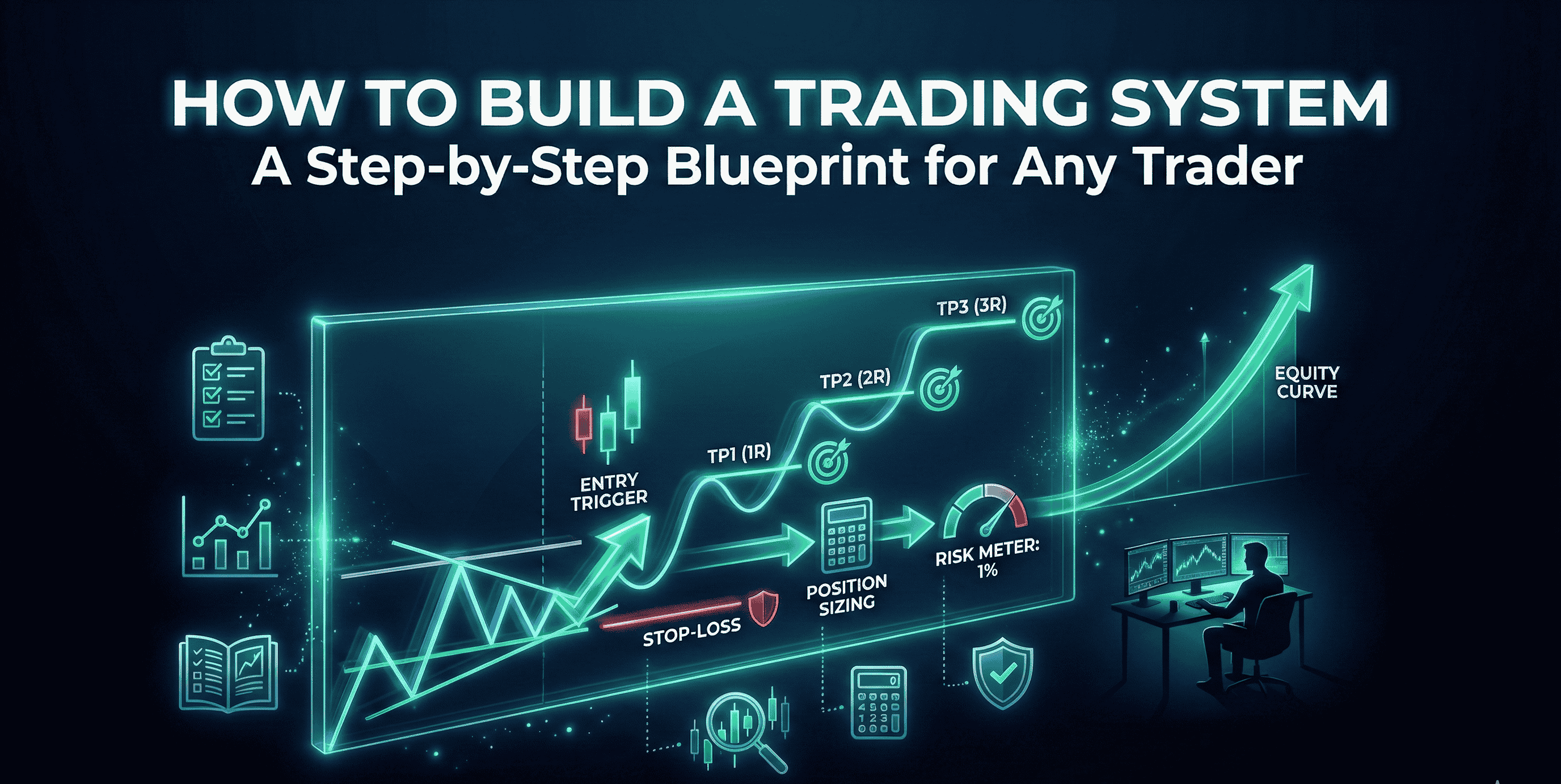
# How to Build a Trading System: A Step-by-Step Blueprint for Any Trader
Every successful trader, regardless of their market or timeframe, operates with a clear, defined approach. This approach, often referred to as a "trading system," is not merely a collection of indicators but a comprehensive framework that dictates every action, from identifying opportunities to managing risks and executing trades. Without a well-structured system, trading can devolve into impulsive decisions, driven by emotion rather than logic, leading to inconsistent results and significant losses.
Building your own trading system offers numerous benefits. It brings discipline to your trading activities, removes subjectivity, and provides a quantifiable edge over the market. It allows you to analyze your performance objectively, identify weaknesses, and continually refine your approach. This guide will provide you with a step-by-step blueprint to construct a robust trading system tailored to your unique trading style and objectives.
Table of Contents
- [The Foundation: Defining Your Trading Philosophy](#the-foundation-defining-your-trading-philosophy)
- [Phase 1: Strategy Development and Rules Creation](#phase-1-strategy-development-and-rules-creation)
- [Phase 2: Rigorous Backtesting and Optimization](#phase-2-rigorous-backtesting-and-optimization)
- [Phase 3: Risk Management and Position Sizing](#phase-3-risk-management-and-position-sizing)
- [Phase 4: Execution, Monitoring, and Review](#phase-4-execution-monitoring-and-review)
- [Conclusion: The Path to Consistent Trading](#conclusion-the-path-to-consistent-trading)
---
The Foundation: Defining Your Trading Philosophy
Before diving into specific entry and exit rules, it's crucial to establish your trading philosophy. This forms the bedrock of your entire system and influences every subsequent decision.
1. Market Selection
What markets will you trade? Each market—Forex, Stocks, Crypto, Commodities, Indices—has distinct characteristics, volatility profiles, and trading hours. Focus on markets you understand and can dedicate time to analyzing.
2. Trading Style and Timeframe
Are you a day trader, swing trader, or long-term investor? Your chosen timeframe dictates the type of charts you'll analyze and the frequency of your trades. Short-term trading requires more screen time and faster decision-making, while longer-term approaches offer more flexibility.
:::key-concept A trading system is a complete set of objective rules that define how you will trade, including entry criteria, exit criteria, and risk management parameters. It removes emotion and promotes discipline. :::
3. Capital and Risk Tolerance
Clearly define how much capital you are willing to allocate to trading and what percentage of that capital you are prepared to risk on any single trade or over a series of losing trades. This will heavily influence your position sizing and overall strategy.
:::example Trader Profile Example:
:::
- Market: Forex (Major Pairs: EUR/USD, GBP/USD, USD/JPY)
- Trading Style: Swing Trading
- Timeframe: Daily and 4-hour charts
- Capital: $10,000
- Risk Tolerance: 1% of capital per trade ($100 maximum loss per trade)
Phase 1: Strategy Development and Rules Creation
This is where you define the "how" of your trading. Your strategy outlines the specific conditions under which you will enter and exit trades.
1. Entry Triggers
What specific criteria must be met for you to consider entering a trade? This could involve:
- Price Action: Candlestick patterns (e.g., engulfing bar, pin bar), chart patterns (e.g., head and shoulders, double top/bottom), support and resistance levels, trendline bounces.
- Indicators: Moving average crossovers, RSI divergences, MACD signals, specific volume patterns.
- Market Structure: Break of structure, order blocks, fair value gaps, liquidity grabs.
:::tip Start simple. Many successful strategies are built on a few clear, robust conditions rather than a complex array of overlapping indicators. Simplicity aids consistency and ease of execution. :::
2. Exit Rules: Stop Loss and Take Profit
Every trade must have predefined exit points to manage risk and lock in profits.
- Stop Loss (SL): This is your maximum acceptable loss on a trade. It should be placed at a logical technical level that would invalidate your trade idea. Crucially, never move your stop loss further away from your entry point once a trade is live.
- Take Profit (TP): This is your target profit level. It should also be based on logical technical levels, such as strong resistance zones, previous swing highs/lows, or based on a favorable risk-to-reward ratio (e.g., aiming for 2R or 3R).
:::key-concept Risk-to-Reward Ratio (R:R): This is the potential profit of a trade divided by the potential loss. A minimum R:R of 1:2 or higher is often recommended to ensure that even with a win rate below 50%, you can still be profitable. :::
3. Trade Management Rules
Once a trade is open, how will you manage it?
- Breakeven: When will you move your stop loss to your entry price to eliminate risk?
- Partial Take Profits: Will you scale out of positions at different price targets?
- Trailing Stop: Will you use a trailing stop to protect profits as the trade moves in your favor?
:::example Strategy Rules Example - Long Trade (Short for "Sell" is the inverse):
:::
- Market: GBP/JPY Daily Chart
- Trend: Price is clearly above the 50-period Exponential Moving Average (EMA), indicating an uptrend.
- Entry Trigger: Price pulls back to the 50-EMA and forms a bullish engulfing candlestick pattern directly at a previously identified support level.
- Stop Loss: Placed immediately below the low of the bullish engulfing candle or below the support level, whichever provides more cushion while remaining logical.
- Take Profit: Target the previous swing high, aiming for a minimum 1:2 Risk-to-Reward ratio.
- Trade Management: Once price moves 1R in profit, move Stop Loss to breakeven. Consider scaling out 50% of the position at 2R and trail the stop loss for the remaining position.
Phase 2: Rigorous Backtesting and Optimization
Strategy development is only useful if it proves profitable over historical data. This is where backtesting comes in.
1. Manual vs. Automated Backtesting
- Manual Backtesting: You manually scroll through historical charts, identify setups based on your rules, and record the outcomes. This is often recommended for beginners as it helps build intuition and rule adherence.
- Automated Backtesting: Using specialized software or programming languages (e.g., MQL4/5, Python with libraries like backtrader) to test your rules on historical data. This is faster and more objective for complex systems but requires coding knowledge.
2. Data Collection and Analysis
Use clean, accurate historical data. Run your strategy over a significant period (e.g., several years), across different market conditions (trending, range-bound, volatile).
Record the following for each trade:
- Date and Time of Entry/Exit
- Entry Price
- Stop Loss Price
- Take Profit Price
- Outcome (Win/Loss)
- Profit/Loss in pips/points and dollars
- Risk-to-Reward Ratio
- Notes on specific trade characteristics
3. Key Performance Metrics
Evaluate your backtest results using these metrics:
- Win Rate: Percentage of winning trades.
- Average Win/Loss: Average profit of winning trades versus average loss of losing trades.
- Profit Factor: Total gross profit divided by total gross loss. (Above 1 is profitable).
- Drawdown: The peak-to-trough decline in your trading capital. Measures risk.
- Expectancy: (Win Rate Average Win) - (Loss Rate Average Loss). A positive expectancy means your strategy is profitable over the long run.
:::warning Avoid over-optimization. This occurs when you fine-tune your strategy parameters to fit past data too perfectly, leading to poor performance on future, unseen data. Look for robustness, not perfection. :::
Phase 3: Risk Management and Position Sizing
Even the best strategy can fail without proper risk management. This phase is non-negotiable.
1. Define Your Maximum Risk Per Trade
This is the most critical rule. A common recommendation is to risk no more than 1-2% of your total trading capital on any single trade. This protects your account from being wiped out by a losing streak.
:::example Maximum Risk Per Trade Calculation:
If your trading capital is $10,000 and you risk 1% per trade, your maximum loss per trade is $100. :::
2. Calculate Position Size
Once you know your maximum risk per trade and the location of your stop loss, you can calculate the appropriate position size.
- Determine the dollar value of your stop loss (distance from entry to stop loss in pips/points * pip/point value per unit).
- Divide your maximum risk per trade by the dollar value of your stop loss.
:::key-concept Position Sizing Formula:
Position Size = (Account Risk % * Account Capital) / (Entry Price - Stop Loss Price)Remember to adjust for specific market contract sizes (lots, shares, coins). :::
:::example Position Sizing Calculation:
- Account Capital: $10,000
- Risk Per Trade: 1% = $100
- Trade Setup: Long EUR/USD
- Entry Price: 1.0750
- Stop Loss Price: 1.0720
- Stop Loss Distance: 30 pips
Assuming a standard lot (100,000 units) has a pip value of $10 for EUR/USD:
:::
- Value of 1 pip for 1 mini lot (10,000 units) = $1
- Total risk in pips for your trade = 30 pips
- $100 (Max Risk) / 30 pips = $3.33 per pip
- Since 1 mini lot is $1 per pip, you can trade approximately 3.33 mini lots, or 33,300 units of EUR/USD. (Always round down to the nearest whole lot/unit if your broker allows fractional sizes).
3. Portfolio-Level Risk
Consider the total risk exposed across all open trades. Avoid over-leveraging or having too many highly correlated trades open simultaneously, which can amplify losses.
Phase 4: Execution, Monitoring, and Review
Developing the system is one thing; executing it consistently and learning from it is another.
1. Flawless Execution
Stick to your rules without hesitation. Do not deviate, anticipate, or act on "gut feelings." If a setup meets your criteria, execute it. If it doesn't, stay out.
:::tip Before trading with real capital, practice your system in a demo account for a few weeks or months. This builds confidence and perfects your execution without financial risk. :::
2. Trade Journaling
Maintain a detailed trade journal. This is paramount for learning and improvement. For every trade, record:
- The setup (chart screenshot with entry, SL, TP marked)
- Your rationale for entry
- Actual entry, SL, TP prices
- Outcome
- Emotions felt during the trade
- Lessons learned
3. Regular Performance Review
Periodically (e.g., weekly, monthly), review your trade journal and performance metrics. Ask yourself:
- Are you adhering to your rules?
- Which setups are performing best/worst?
- Are there consistent errors in your execution or analysis?
- Are your risk management rules being followed?
:::warning Review your system, not individual trades. A single losing trade doesn't invalidate a profitable system, just as a single winning trade doesn't validate a bad one. Focus on the aggregate statistics over many trades. :::
4. System Adaptation
Markets are dynamic. Your system should be adaptable, but not constantly changed. If your performance metrics decline significantly over an extended period, it may be time to revisit your strategy rules or parameters. Use your trade journal and performance reviews to identify specific areas for improvement, then backtest any proposed changes thoroughly before implementing them.
---
Conclusion: The Path to Consistent Trading
Building a robust trading system is a continuous journey that requires discipline, patience, and a commitment to objective analysis. It is not a "set it and forget it" solution, but rather a dynamic blueprint that evolves with your understanding of the markets and your personal trading growth. By meticulously defining your philosophy, developing clear rules, rigorously backtesting, implementing strict risk management, and consistently reviewing your performance, you empower yourself to navigate the complexities of financial markets with confidence and consistency.
Embrace the process of creation and refinement. Your trading system is your unique edge, your shield against emotional decision-making, and your roadmap to achieving your trading goals. The most successful traders are those who understand that consistent effort in building and maintaining their system is far more valuable than chasing fleeting market opportunities.
---
Ready to take control of your trading? Start building your own trading system today by analyzing historical charts and identifying potential setups based on the principles discussed in this guide. Practice in a demo environment and document your trades diligently!
Remember, successful trading is not about predicting the future; it's about having a probabilistic edge and executing it flawlessly over a large sample size of trades. Your trading system is the vehicle for achieving that edge. Now go forth and build yours!
---
Appendix A: Common Trading System Components
While every trading system is unique, most incorporate some or all of the following elements:
1. Market Selection
- What markets will you trade? (e.g., stocks, forex, futures, crypto, commodities)
- Timeframes? (e.g., 5-minute charts, daily charts, weekly charts)
- Liquidity considerations? Focus on liquid markets to ensure efficient entry and exit.
2. Charting & Indicators
- What charting platform will you use? (e.g., TradingView, MetaTrader, NinjaTrader)
- What indicators are essential to your strategy? (e.g., moving averages, RSI, MACD, Bollinger Bands, volume). Avoid indicator overload; focus on those that provide clear signals relevant to your edge.
:::tip Less is often more when it comes to indicators. Over-complicating your charts can lead to analysis paralysis. :::
3. Order Types
- Market Orders: Execute immediately at the best available price.
- Limit Orders: Specify a price; the order is only filled if that price (or better) is reached. Good for precise entries/exits or for avoiding slippage.
- Stop-Loss Orders: Crucial for risk management. Automatically closes a position if a specified price is hit, limiting potential losses.
- Take-Profit Orders: Automatically closes a position when a specified profit target is reached.
4. Backtesting Tools
- Manual Backtesting: Reviewing historical charts candle by candle. Time-consuming but builds intuition.
- Automated Backtesting Software: Platforms often have built-in tools or allow for custom coding (e.g., Pine Script on TradingView, MQL on MetaTrader) to test strategies on historical data.
---
Appendix B: Further Reading & Resources
To deepen your understanding and continue your trading education, consider exploring the following:
- Books:
- "Trade Your Way to Financial Freedom" by Van K. Tharp
- "Trading in the Zone" by Mark Douglas
- "The Complete TurtleTrader" by Michael W. Covel
- "Market Wizards" series by Jack D. Schwager
- Online Courses: Look for reputable courses focusing on technical analysis, risk management, and trading psychology.
- Trading Communities: Engage with other traders (responsibly) to share insights and learn. Be wary of "get rich quick" schemes.
- TradingAnalysis.ai (of course!): Utilize our platform's advanced charting tools, backtesting capabilities, and market analysis features to help you develop and refine your strategies.
---
Final Thoughts: Embrace Continuous Learning
The journey of a successful trader is one of continuous learning and adaptation. The markets are constantly evolving, and so must your approach. Your trading system should be a living document, a reflection of your growth and understanding. Stay curious, stay disciplined, and always remember that true success in trading comes from mastering yourself as much as mastering the markets.