# How to Find Your Perfect Trading Timeframe: A Complete Guide for Every Trader
Choosing the right trading timeframe is one of the most crucial decisions every trader faces, yet it's often overlooked by beginners eager to start trading. Your timeframe determines everything from your trading strategy and risk management approach to your daily routine and stress levels. Understanding how to find your trading timeframe that aligns with your lifestyle, capital, and trading goals can be the difference between consistent profitability and constant frustration.
Many traders jump between timeframes randomly, seeking quick profits or trying to copy successful traders without considering whether their chosen timeframe suits their circumstances. This approach leads to inconsistent results, emotional trading, and eventual burnout. The key to sustainable trading success lies in finding your optimal timeframe and sticking with it long enough to develop genuine expertise.
Table of Contents
1. [Understanding Trading Timeframes](#understanding-trading-timeframes) 2. [Factors That Determine Your Perfect Timeframe](#factors-that-determine-your-perfect-timeframe) 3. [Matching Timeframes to Trading Styles](#matching-timeframes-to-trading-styles) 4. [Testing and Validating Your Timeframe Choice](#testing-and-validating-your-timeframe-choice) 5. [Common Timeframe Selection Mistakes](#common-timeframe-selection-mistakes) 6. [Conclusion](#conclusion)
Understanding Trading Timeframes
Trading timeframes represent the duration of each candlestick or bar on your chart, ranging from seconds to months. Each timeframe offers different opportunities and requires distinct approaches to analysis and execution.
:::key-concept Primary Timeframe Categories:
:::
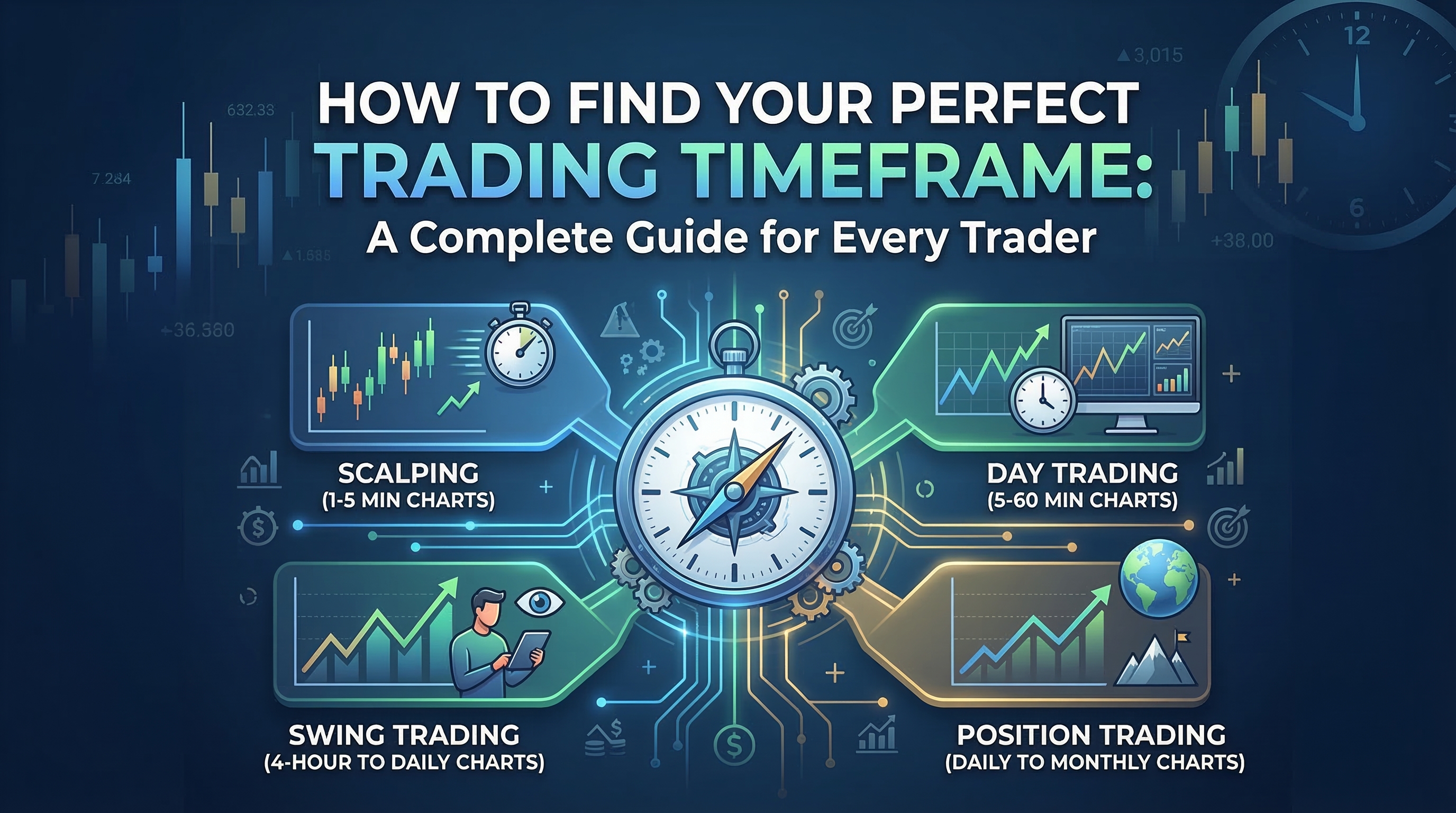
- Scalping: 1-minute to 5-minute charts
- Day Trading: 5-minute to 1-hour charts
- Swing Trading: 4-hour to daily charts
- Position Trading: Daily to monthly charts
The timeframe you choose affects several critical aspects of your trading:
Market Noise vs. Signal Clarity: Shorter timeframes contain more market noise, making it harder to identify genuine trends and patterns. Longer timeframes filter out this noise but provide fewer trading opportunities.
Frequency of Trades: Lower timeframes generate more trading signals and opportunities, while higher timeframes produce fewer but potentially more reliable setups.
Time Commitment: Shorter timeframes require constant market monitoring, while longer timeframes allow for part-time trading approaches.
:::example Real Trading Scenario: A trader using 1-minute charts might see 50+ potential setups per day but struggle with false signals. The same trader using 4-hour charts might only see 2-3 high-quality setups per week but with better risk-to-reward ratios. :::
Factors That Determine Your Perfect Timeframe
Learning how to find your trading timeframe requires honest self-assessment across multiple dimensions. Your perfect timeframe emerges from the intersection of your personal circumstances, trading capital, and market goals.
Available Time for Trading
Your schedule is the primary constraint that shapes your timeframe selection. Different timeframes demand varying levels of attention and monitoring.
Full-Time Availability: If you can dedicate 6-8 hours daily to trading, shorter timeframes become viable options. You can monitor scalping setups on 1-5 minute charts or execute multiple day trades using 15-minute to 1-hour charts.
Part-Time Trading: With 1-3 hours available daily, focus on swing trading using 4-hour to daily charts. You can analyze markets before work, set your trades, and check them during breaks.
Minimal Time Investment: If you only have 30 minutes daily, position trading on daily and weekly charts suits your schedule. You can perform analysis during weekends and make trading decisions that last weeks or months.
:::tip Time Management Strategy: Start by tracking how much time you realistically spend analyzing markets for one week. This gives you an accurate baseline for timeframe selection rather than optimistic projections. :::
Trading Capital and Position Sizing
Your account size significantly influences which timeframes work best for your situation. Smaller accounts often require different approaches than larger ones.
Small Accounts ($1,000 - $10,000): Shorter timeframes might seem attractive for quick profits, but transaction costs and emotional pressure often make longer timeframes more suitable. Swing trading allows for better risk management with smaller position sizes.
Medium Accounts ($10,000 - $100,000): This range offers flexibility across most timeframes. You can pursue day trading with proper risk management or swing trading with meaningful position sizes.
Large Accounts ($100,000+): All timeframes become viable, but longer timeframes often provide better opportunities for significant capital deployment without market impact issues.
Personality and Stress Tolerance
Your psychological makeup plays a crucial role in timeframe selection. Understanding your personality traits helps determine sustainable trading approaches.
High-Stress Tolerance: If you thrive under pressure and can make quick decisions, shorter timeframes might suit you. However, be honest about whether this stress tolerance is sustainable long-term.
Analytical and Patient: Traders who prefer thorough analysis and don't mind waiting for perfect setups often excel with longer timeframes where patience is rewarded.
Impulsive Tendencies: If you struggle with impulsive decisions, longer timeframes provide natural cooling-off periods and reduce overtrading temptation.
:::warning Psychology Warning: Many traders overestimate their stress tolerance in bull markets but struggle during volatile or losing periods. Start conservative and adjust based on real market experience, not backtesting results. :::
Matching Timeframes to Trading Styles
Once you understand the factors affecting your choice, you can match your circumstances to appropriate trading styles and timeframes. This systematic approach to how to find your trading timeframe ensures alignment between your life and your trading approach.
Scalping (1-5 Minute Charts)
Best For: Full-time traders with high stress tolerance, significant capital, and excellent execution skills.
Requirements:
- 6+ hours of focused market time
- Low-latency trading setup
- Strong emotional control
- Detailed understanding of market microstructure
Advantages: Multiple opportunities daily, quick feedback on performance, potential for consistent daily income.
Disadvantages: High stress, significant time commitment, heavy transaction costs, requires expensive technology setup.
:::example Scalping Reality Check: A scalper targeting $100 daily profit needs to win approximately 10-15 trades daily at $10-15 per trade. This requires capturing small market movements consistently while managing spreads, slippage, and commission costs. :::
Day Trading (5-60 Minute Charts)
Best For: Dedicated part-time or full-time traders who can commit 3-6 hours during market hours.
Requirements:
- Consistent daily schedule during market hours
- Minimum $25,000 account (for US equities)
- Good technical analysis skills
- Ability to cut losses quickly
Advantages: No overnight risk, regular trading opportunities, faster skill development through frequent practice.
Disadvantages: Requires market hour availability, pattern day trading rules, daily pressure to perform.
Swing Trading (4-Hour to Daily Charts)
Best For: Part-time traders, professionals with other careers, or traders seeking better work-life balance.
Requirements:
- 1-2 hours daily for analysis
- Patience to hold positions for days/weeks
- Strong technical analysis skills
- Comfort with overnight and weekend gaps
Advantages: Flexible time requirements, better risk-to-reward ratios, less screen time stress, suitable for trending markets.
Disadvantages: Overnight and weekend risks, fewer trading opportunities, requires patience for setups.
:::tip Swing Trading Sweet Spot: Most retail traders find swing trading offers the best balance between time commitment and profit potential. It allows for thorough analysis while maintaining regular job responsibilities. :::
Position Trading (Daily to Monthly Charts)
Best For: Long-term oriented traders, those with substantial capital, or traders seeking minimal time commitment.
Requirements:
- Strong fundamental analysis skills
- Patience to hold positions for months
- Larger capital base
- Understanding of macro economic factors
Advantages: Minimal time commitment, captures major market moves, lower transaction costs, reduced emotional stress.
Disadvantages: Requires larger stop losses, fewer opportunities, capital tied up longer, needs broader market knowledge.
Testing and Validating Your Timeframe Choice
Selecting a timeframe is just the beginning. You must validate your choice through systematic testing and real market experience. This process helps confirm whether your chosen timeframe truly matches your capabilities and circumstances.
Paper Trading Validation
Start with demo trading to test your timeframe choice without financial risk. This phase reveals practical challenges you might not anticipate.
Testing Duration: Trade your chosen timeframe for at least 3 months in demo mode. This period covers different market conditions and helps you understand the timeframe's characteristics.
Key Metrics to Track:
- Number of trading opportunities per week
- Average time spent analyzing markets
- Win rate and average risk-to-reward ratio
- Maximum drawdown periods
- Emotional stress levels during trading
:::example Validation Process: A trader testing 4-hour swing trading might discover they only get 2-3 quality setups monthly, requiring patience they didn't know they lacked. This insight helps them adjust expectations or consider shorter timeframes. :::
Live Trading Transition
Once demo results confirm your timeframe choice, transition to live trading with reduced position sizes. Real money adds psychological pressure that demo trading cannot simulate.
Gradual Position Sizing: Start with 25% of your intended position size and gradually increase as you demonstrate consistent performance and emotional control.
Performance Monitoring: Track the same metrics from demo trading, paying special attention to how live money affects your decision-making process.
Continuous Evaluation
Regularly assess whether your chosen timeframe continues to suit your evolving circumstances. Life changes, market conditions, and skill development may require timeframe adjustments.
Quarterly Reviews: Every three months, evaluate your trading performance, time commitment, and stress levels. Consider whether your timeframe still aligns with your goals and lifestyle.
Market Condition Adjustments: Some timeframes perform better in trending markets while others suit ranging conditions. Understanding these relationships helps you adapt your approach.
:::warning Commitment Warning: Avoid changing timeframes frequently due to temporary frustration or losses. Master one timeframe thoroughly before considering alternatives. Most successful traders become experts in a single timeframe rather than mediocre across multiple timeframes. :::
Common Timeframe Selection Mistakes
Understanding how to find your trading timeframe also means avoiding common pitfalls that lead traders to suboptimal choices. These mistakes often stem from unrealistic expectations or inadequate self-assessment.
Choosing Based on Profit Potential Alone
Many traders gravitate toward shorter timeframes believing they offer faster profits. This approach ignores the increased difficulty, stress, and time requirements of shorter-timeframe trading.
Reality Check: While scalping might generate daily profits, it requires exceptional skills, significant time investment, and carries higher stress levels. Most retail traders lack the infrastructure and expertise for consistent scalping success.
Copying Other Traders' Timeframes
Seeing successful traders use specific timeframes doesn't mean those timeframes suit your situation. Each trader's circumstances, skills, and capital differ significantly.
Individual Assessment: Focus on your unique situation rather than mimicking others. A professional trader with years of experience and substantial capital operates under completely different constraints than a beginner with a small account.
Underestimating Time Requirements
Traders often underestimate the actual time commitment required for their chosen timeframe. This leads to rushed analysis, missed opportunities, and poor execution.
:::tip Time Reality Check: Track your actual time spent on trading activities for two weeks before committing to a timeframe. Include chart analysis, trade planning, execution, and review time in your calculations. :::
Ignoring Technology Requirements
Different timeframes have varying technology needs. Scalping requires low-latency connections and professional-grade platforms, while position trading can work with basic setups.
Infrastructure Assessment: Ensure your technology setup matches your timeframe requirements before committing to a specific approach.
Changing Timeframes Due to Losses
Losing streaks tempt traders to switch timeframes, hoping for better results. This approach prevents skill development and creates a cycle of inconsistent performance.
Consistency Commitment: Stick with your chosen timeframe through both winning and losing periods. Skill development requires consistent practice within a single framework.
:::key-concept Mastery Principle: Expert traders typically spend 2-3 years mastering their chosen timeframe. Frequent changes reset this learning curve and prevent the deep understanding necessary for consistent profitability. :::
Conclusion
Finding your perfect trading timeframe is a crucial step toward sustainable trading success. It requires honest self-assessment of your available time, capital, personality, and long-term goals. The process involves understanding different timeframe characteristics, matching them to your circumstances, and validating your choice through systematic testing.
Remember that how to find your trading timeframe is not about discovering the "best" timeframe universally, but rather identifying the timeframe that aligns with your unique situation. Each timeframe offers different opportunities and challenges, and success comes from mastering one approach thoroughly rather than jumping between multiple timeframes.
Start by honestly evaluating your available time, capital, and stress tolerance. Test your chosen timeframe extensively through demo trading, then transition gradually to live trading with reduced position sizes. Avoid common mistakes like choosing based solely on profit potential or copying other traders' approaches.
Most importantly, commit to your chosen timeframe long enough to develop genuine expertise. The path to trading mastery requires patience, consistency, and dedication to continuous improvement within your chosen framework.
Ready to discover your optimal trading timeframe? Start by analyzing your current charts across different timeframes and document which setups resonate most with your trading style and available time commitment.