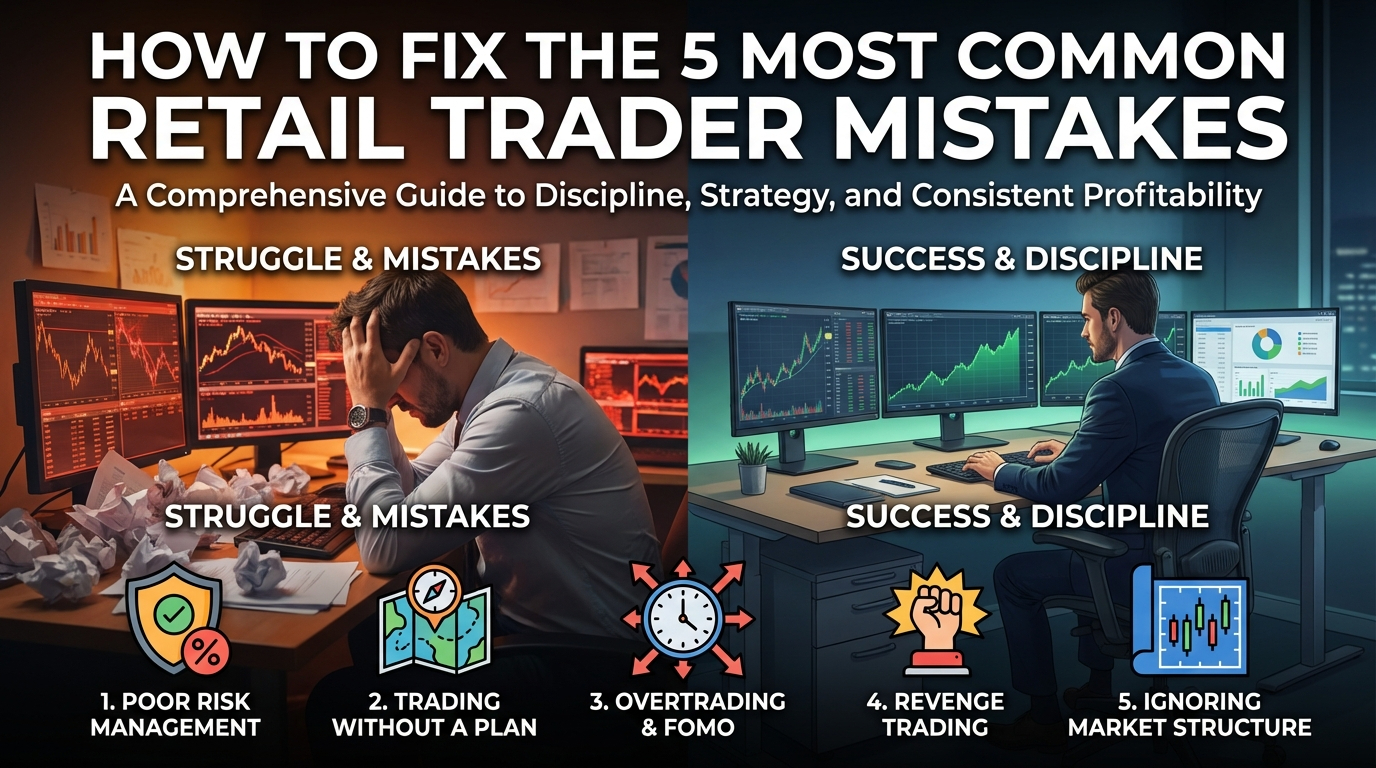
# How to Fix the 5 Most Common Retail Trader Mistakes
Every successful trader has a story of struggle, learning, and eventual breakthrough. The path to consistent profitability is littered with expensive lessons, and most retail traders repeat the same fundamental errors that drain their accounts. Understanding these common retail trader mistakes isn't just about avoiding losses—it's about building the foundation for long-term trading success.
The difference between struggling retail traders and profitable professionals often comes down to five critical areas: risk management, emotional control, trade planning, overtrading, and revenge trading. These mistakes are so prevalent that recognizing and fixing them can immediately transform your trading results.
In this comprehensive guide, we'll explore each of these common retail trader mistakes in detail, understand why traders fall into these traps, and most importantly, learn practical solutions to overcome them. Whether you're a beginner or an experienced trader looking to break through a plateau, mastering these fundamentals will set you on the path to consistent profitability.
Table of Contents
- [Mistake #1: Poor Risk Management](#mistake-1-poor-risk-management)
- [Mistake #2: Trading Without a Plan](#mistake-2-trading-without-a-plan)
- [Mistake #3: Overtrading and FOMO](#mistake-3-overtrading-and-fomo)
- [Mistake #4: Revenge Trading](#mistake-4-revenge-trading)
- [Mistake #5: Ignoring Market Structure](#mistake-5-ignoring-market-structure)
- [Building Better Trading Habits](#building-better-trading-habits)
- [Conclusion](#conclusion)
Mistake #1: Poor Risk Management
Poor risk management stands as the number one killer of trading accounts and represents one of the most destructive common retail trader mistakes. Many traders focus intensely on finding the perfect entry strategy while completely ignoring how much they're risking on each trade. This approach is like driving a sports car at high speed without brakes—disaster is inevitable.
:::warning Risking more than 1-2% of your account per trade is one of the fastest ways to blow up your trading capital. Even with a 60% win rate, poor position sizing can lead to catastrophic losses. :::
The Psychology Behind Poor Risk Management
Retail traders often fall into the trap of believing they need to risk large amounts to make meaningful profits. This mindset stems from:
- Impatience: Wanting to grow accounts quickly
- Overconfidence: Believing in the certainty of specific trades
- Lack of understanding: Not realizing how compounding works with proper risk management
- Gambling mentality: Treating trading like a casino rather than a business
The Solution: Implement Systematic Risk Management
Position Sizing Formula:
1. Determine your risk per trade: Never risk more than 1-2% of your account 2. Calculate your stop loss distance: Measure from entry to stop loss in pips/points 3. Calculate position size: (Account Balance × Risk %) ÷ Stop Loss Distance = Position Size
:::example Account Balance: $10,000 Risk per trade: 1% = $100 Stop loss: 50 pips on EUR/USD Position size: $100 ÷ 50 pips = $2 per pip = 0.2 lots :::
Risk Management Rules:
- Set your stop loss before entering any trade
- Never move your stop loss against your position
- Use position sizing calculators to eliminate math errors
- Consider correlation risk when trading multiple pairs
- Implement daily/weekly loss limits
Advanced Risk Management Techniques
The 2% Rule Variations:
- Conservative: 0.5-1% per trade for beginners
- Standard: 1-2% per trade for experienced traders
- Aggressive: 2-3% per trade only for very experienced traders
Portfolio Heat: Never have more than 6-8% of your account at risk across all open positions simultaneously.
Mistake #2: Trading Without a Plan
Trading without a plan is like navigating without a map. This common retail trader mistake leads to inconsistent results, emotional decision-making, and inability to learn from both wins and losses. Professional traders treat each trade as part of a systematic approach, while retail traders often make impulsive decisions based on momentary market movements.
:::key-concept A trading plan is your roadmap to consistent profitability. It defines your edge, risk management rules, and execution criteria before emotions can interfere with your judgment. :::
Components of a Complete Trading Plan
1. Market Analysis Framework
- Which markets you'll trade (Forex, stocks, crypto)
- Timeframes for analysis and execution
- Technical analysis methodology
- Economic calendar considerations
2. Trade Setup Criteria
- Specific entry conditions
- Confirmation signals required
- Market conditions that invalidate setups
- Minimum risk/reward ratios
3. Risk Management Rules
- Maximum risk per trade
- Position sizing methodology
- Stop loss placement rules
- Take profit strategies
4. Trading Schedule
- Market hours you'll trade
- Pre-market preparation routine
- Post-market review process
- Days off for mental health
Creating Your Trading Plan Step-by-Step
Step 1: Define Your Trading Style
- Scalping: Multiple trades per day, small profits
- Day Trading: Intraday positions, no overnight risk
- Swing Trading: Multi-day positions, larger moves
- Position Trading: Long-term positions, weeks to months
Step 2: Establish Entry Criteria
:::example Swing Trading Setup Example:
:::
- Market: Major Forex pairs
- Timeframe: 4-hour charts for entries
- Setup: Price breaks above previous swing high
- Confirmation: Volume increases on breakout
- Entry: Close above breakout candle
- Stop: Below breakout low
- Target: 2:1 risk/reward minimum
Step 3: Create Trade Management Rules
- When to scale out of positions
- How to trail stop losses
- Conditions for early exits
- Maximum holding periods
The Trading Journal Integration
Your trading plan must include a systematic approach to recording and reviewing trades:
- Pre-trade analysis and rationale
- Entry and exit prices
- Risk/reward achieved
- Emotional state during trade
- Lessons learned
- Plan adherence rating
Mistake #3: Overtrading and FOMO
Overtrading represents one of the most insidious common retail trader mistakes because it disguises itself as ambition and dedication. Traders often believe that more trades equals more opportunities for profit, but the reality is that overtrading typically leads to increased costs, emotional exhaustion, and poor decision-making.
Understanding the Overtrading Trap
FOMO (Fear of Missing Out) Triggers:
- Seeing other traders' profitable posts on social media
- Missing a setup that would have been profitable
- Feeling like you need to "catch up" after losses
- Market volatility creating apparent opportunities
The Hidden Costs of Overtrading:
- Increased spread/commission costs
- Mental fatigue leading to poor decisions
- Taking lower-quality setups
- Reduced time for proper analysis
- Emotional stress and burnout
:::warning Quality over quantity is the key to successful trading. Professional traders often make fewer trades but with higher success rates and better risk/reward ratios. :::
Identifying Overtrading Behavior
Warning Signs:
- Trading outside your defined market hours
- Taking setups that don't meet your criteria
- Increasing position sizes to "make up" for missed opportunities
- Feeling anxious when not in a trade
- Making impulsive trades based on news or social media
- Trading multiple timeframes simultaneously without a clear strategy
Solutions to Combat Overtrading
1. Set Daily/Weekly Trade Limits
- Maximum number of trades per day
- Maximum risk exposure per session
- Mandatory break periods between trades
- Weekly trade quotas rather than daily pressure
2. Implement a Pre-Trade Checklist
:::example Pre-Trade Checklist: ☐ Setup matches my trading plan criteria ☐ Risk/reward ratio is at least 1:2 ☐ I have clear entry, stop, and target levels ☐ Market conditions support this setup type ☐ I'm in the right emotional state to trade ☐ This trade fits within my daily risk allocation :::
3. Create "No Trading" Rules
- No trading during major news events (unless specifically planned)
- No trading when feeling emotional (angry, frustrated, euphoric)
- No trading outside defined market sessions
- No trading when daily/weekly limits are reached
4. Develop Patience Through Practice
- Use demo accounts to practice waiting for quality setups
- Study charts to identify what constitutes a high-quality setup
- Keep a "missed opportunity" log to see how many actually would have been profitable
- Focus on process improvement rather than profit maximization
The Power of Selective Trading
Professional traders understand that markets provide opportunities regularly, and missing one setup doesn't mean missing the only chance for profit. This mindset shift from scarcity to abundance thinking helps traders:
- Wait for higher-probability setups
- Take breaks without anxiety
- Make more rational decisions
- Preserve capital for the best opportunities
- Maintain emotional equilibrium
Mistake #4: Revenge Trading
Revenge trading occurs when traders attempt to quickly recover losses by taking increasingly risky or impulsive trades. This dangerous pattern represents one of the most account-destroying common retail trader mistakes, as it combines poor risk management with emotional decision-making.
The Psychology of Revenge Trading
Emotional Triggers:
- Anger at the market for "taking" money
- Frustration with losing streaks
- Desire to "get even" quickly
- Ego damage from being wrong
- Financial pressure to recover losses
The Revenge Trading Cycle: 1. Initial loss triggers emotional response 2. Trader increases position size to recover faster 3. Second trade results in larger loss 4. Emotions intensify, leading to even riskier trades 5. Account suffers significant damage 6. Trader either blows up account or takes extended break
:::warning Revenge trading can destroy weeks or months of careful trading in a single session. The market doesn't care about your losses and cannot be "beaten" into submission. :::
Preventing Revenge Trading
1. Implement Circuit Breakers
- Daily loss limits (typically 3-5% of account)
- Consecutive loss limits (3 losing trades in a row)
- Emotional state checks before each trade
- Mandatory cooling-off periods after large losses
2. Develop Emotional Awareness
Pre-Trade Emotional Check:
- Rate your emotional state (1-10 scale)
- Identify any negative emotions present
- Ask: "Am I trading to make money or to feel better?"
- Postpone trading if emotional rating is below 7
3. Create Loss Recovery Protocols
:::example Healthy Loss Recovery Process: 1. Accept the loss as part of trading 2. Review trade for lessons learned 3. Take a 15-30 minute break 4. Analyze market for next high-probability setup 5. Return to normal position sizing 6. Focus on process, not recovery speed :::
Building Emotional Resilience
Mindset Shifts:
- View losses as business expenses, not personal attacks
- Focus on long-term edge rather than individual trades
- Understand that drawdowns are normal and temporary
- Celebrate good process execution, regardless of outcome
Practical Techniques:
- Meditation or breathing exercises between trades
- Physical exercise to release tension
- Keeping a trading journal with emotional notes
- Having accountability partners or mentors
- Setting realistic profit expectations
The Professional Approach to Losses
Professional traders understand that losses are simply part of the business. They focus on:
- Maintaining consistent risk management
- Learning from each loss
- Keeping emotions in check
- Following their trading plan regardless of recent results
- Understanding that edge plays out over many trades, not individual ones
Mistake #5: Ignoring Market Structure
Ignoring market structure is a fundamental error that prevents traders from understanding the context of price movements. This common retail trader mistake leads to taking trades against the prevailing trend, missing obvious support and resistance levels, and failing to recognize when market conditions change.
Understanding Market Structure Basics
Key Components:
- Trend Direction: Higher highs/lows (uptrend) or lower highs/lows (downtrend)
- Support and Resistance: Price levels where buying/selling pressure emerges
- Market Phases: Trending, ranging, or transitioning between phases
- Volume Analysis: Confirming or questioning price movements
- Time Context: How current price action fits within larger timeframes
:::key-concept Market structure provides the roadmap for understanding where price is likely to go next. Trading with structure rather than against it dramatically improves success rates. :::
Common Structure Recognition Errors
1. Trading Against the Trend
- Taking short trades in strong uptrends
- Buying every dip without considering trend strength
- Ignoring higher timeframe direction
- Misidentifying trend changes
2. Ignoring Key Levels
- Entering trades near obvious resistance
- Setting unrealistic profit targets beyond major levels
- Failing to identify institutional levels
- Not adjusting strategy based on support/resistance proximity
3. Misreading Market Phases
- Using trending strategies in ranging markets
- Applying range-bound tactics during strong trends
- Missing transition periods between phases
- Not adapting to changing volatility conditions
Building Structure Analysis Skills
Multi-Timeframe Analysis Process:
1. Monthly/Weekly: Identify long-term trend and major levels 2. Daily: Determine intermediate trend and key swing points 3. 4-Hour: Find tactical levels and entry zones 4. 1-Hour: Time precise entries and exits
:::example Multi-Timeframe EUR/USD Analysis:
:::
- Monthly: Uptrend since major low, approaching key resistance
- Weekly: Pullback in progress, holding above major support
- Daily: Consolidation pattern forming near resistance
- 4-Hour: Potential bullish setup if breaks above consolidation
- Entry: 1-hour timeframe for precise timing
Structure-Based Trading Strategies:
1. Trend Continuation Trades
- Enter on pullbacks to support in uptrends
- Short rallies to resistance in downtrends
- Use structure to time entries with trend
2. Range Trading
- Buy at range lows, sell at range highs
- Wait for clear range establishment
- Exit when range boundaries break
3. Breakout Trading
- Trade breaks of significant structure levels
- Wait for confirmation and follow-through
- Use structure to set logical stop losses
Advanced Structure Concepts
Smart Money Concepts Integration:
- Order blocks as institutional support/resistance
- Fair value gaps as directional bias indicators
- Liquidity sweeps as reversal signals
- Market maker buy/sell models
Volume Spread Analysis:
- Volume confirmation of structure breaks
- Effort vs. result analysis at key levels
- Supply and demand imbalances
- Professional vs. retail trader activity
Building Better Trading Habits
Overcoming these common retail trader mistakes requires more than just knowledge—it demands the development of disciplined habits that support consistent execution. Building better trading habits is like developing muscle memory; it takes time, repetition, and conscious effort until good practices become automatic.
The Habit Formation Process
The Trading Habit Loop: 1. Cue: Market conditions that trigger analysis 2. Routine: Systematic approach to trade evaluation 3. Reward: Consistent results from disciplined execution
Essential Daily Habits
Pre-Market Routine:
- Review overnight news and economic events
- Analyze key levels on major timeframes
- Identify potential setups for the session
- Set daily risk limits and trade goals
- Perform emotional state assessment
During Market Hours:
- Follow pre-trade checklist for every potential setup
- Record all trades in real-time journal
- Take scheduled breaks to maintain focus
- Monitor risk exposure across all positions
- Stick to predetermined trading hours
Post-Market Review:
- Analyze all trades taken (winners and losers)
- Identify what worked and what didn't
- Update trading statistics and metrics
- Plan for next trading session
- Practice mindfulness or relaxation techniques
Technology and Tools for Better Habits
Essential Tools:
- Position size calculators for consistent risk management
- Trading journal software for systematic record-keeping
- Economic calendars for news awareness
- Multi-timeframe chart setups for structure analysis
- Alert systems for setup notifications
Habit-Supporting Technology:
- Smartphone reminders for routine tasks
- Spreadsheet templates for trade tracking
- Screen recording software for trade reviews
- Demo accounts for practice and development
Measuring Progress and Maintaining Motivation
Key Performance Metrics:
- Plan adherence percentage
- Risk/reward ratios achieved
- Win rate by setup type
- Maximum drawdown periods
- Emotional state ratings over time
:::tip Track your progress weekly and monthly rather than daily. Daily fluctuations can be misleading, while longer-term trends reveal true improvement. :::
Staying Motivated:
- Set process goals rather than profit goals
- Celebrate small improvements in discipline
- Connect with other serious traders
- Continue education through books and courses
- Remember that consistency beats perfection
Conclusion
Overcoming these five common retail trader mistakes—poor risk management, trading without a plan, overtrading, revenge trading, and ignoring market structure—represents the difference between struggling retail traders and consistently profitable professionals. These mistakes are interconnected, often reinforcing each other in destructive cycles that can quickly destroy trading accounts.
The path to trading success isn't about finding the perfect strategy or indicator—it's about developing the discipline to execute a sound approach consistently while avoiding the emotional pitfalls that trap most retail traders. Remember that every professional trader has made these mistakes at some point in their journey. What separates them from those who quit is the willingness to learn, adapt, and persist through the challenges.
Your Next Steps:
1. Audit your current trading: Honestly assess which of these mistakes you're currently making 2. Prioritize improvements: Start with risk management, as it provides the foundation for everything else 3. Develop systems: Create checklists and routines that prevent these mistakes from occurring 4. Practice consistently: Use demo accounts to ingrain new habits without risking capital 5. Be patient: Changing ingrained habits takes time—focus on progress, not perfection
The markets will always be there, providing opportunities for those prepared to take advantage of them. By addressing these fundamental issues now, you're laying the groundwork for a sustainable and profitable trading career. Start implementing these changes today, and begin your transformation from a struggling retail trader into a disciplined, professional trader.
Remember: Trading success is built one disciplined decision at a time. Every trade where you follow your plan, manage risk properly, and control your emotions is a step toward consistent profitability. Take time now to analyze your recent trades and identify which of these common retail trader mistakes might be holding you back from achieving your trading goals.