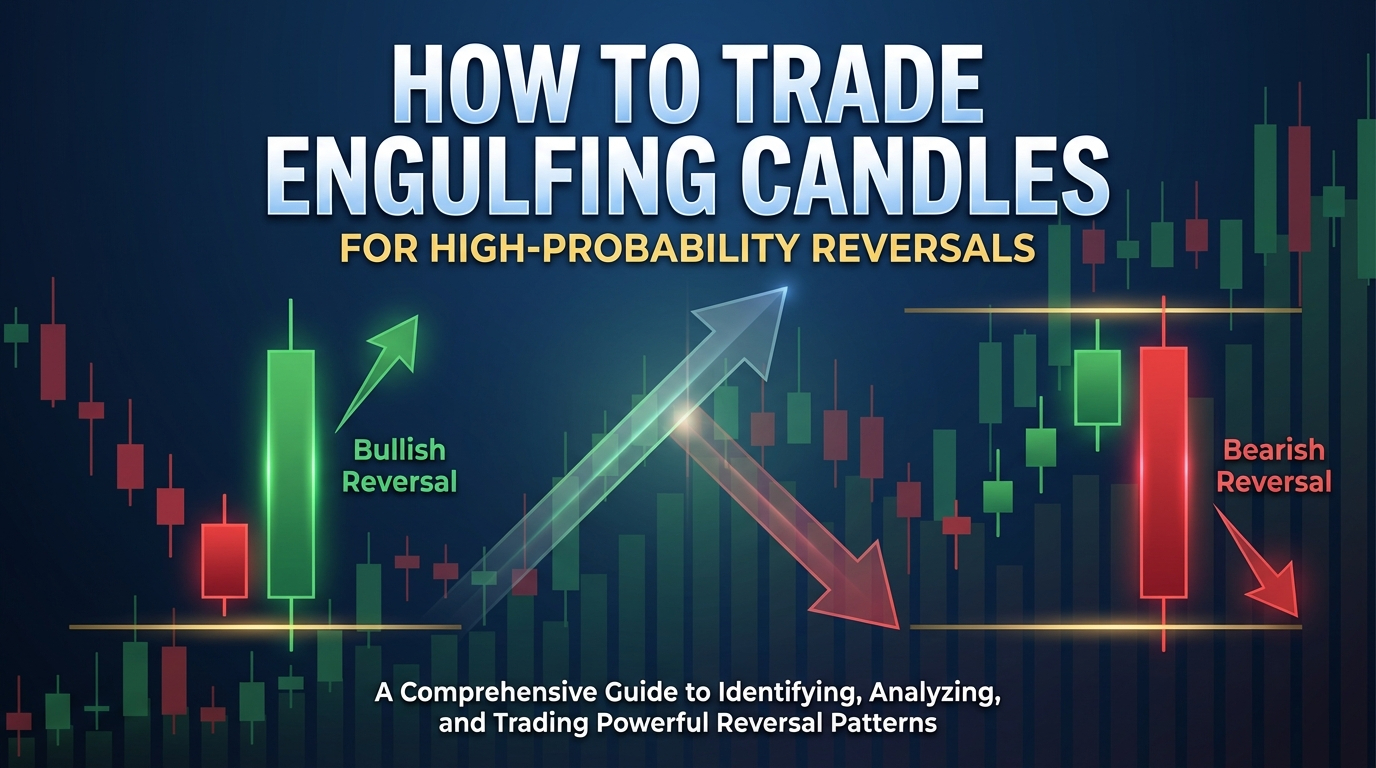
# How to Trade Engulfing Candles for High-Probability Reversals
Engulfing candles are among the most powerful and reliable reversal patterns in technical analysis. These two-candle formations signal potential trend changes and offer traders excellent opportunities to enter positions at optimal prices. Understanding how to trade engulfing candles effectively can significantly improve your trading success rate and risk-reward ratios.
This comprehensive guide will teach you everything you need to know about identifying, analyzing, and trading engulfing patterns with confidence. Whether you're a beginner looking to understand the basics or an experienced trader seeking to refine your approach, you'll discover practical strategies and techniques that work across all timeframes and markets.
Table of Contents
- [Understanding Engulfing Candle Patterns](#understanding-engulfing-candle-patterns)
- [Types of Engulfing Patterns](#types-of-engulfing-patterns)
- [How to Identify High-Quality Engulfing Setups](#how-to-identify-high-quality-engulfing-setups)
- [Trading Strategies for Engulfing Patterns](#trading-strategies-for-engulfing-patterns)
- [Risk Management and Position Sizing](#risk-management-and-position-sizing)
- [Advanced Techniques and Market Context](#advanced-techniques-and-market-context)
- [Common Mistakes to Avoid](#common-mistakes-to-avoid)
Understanding Engulfing Candle Patterns
Engulfing patterns consist of two consecutive candlesticks where the second candle's body completely "engulfs" or encompasses the first candle's body. This formation indicates a shift in market sentiment and potential reversal of the current trend.
:::key-concept An engulfing pattern requires the second candle's real body to completely cover the first candle's real body. The wicks or shadows don't need to be engulfed, only the bodies matter. :::
The psychology behind engulfing patterns is straightforward yet powerful. The first candle represents the continuation of the existing trend, while the second candle demonstrates that opposing forces have taken control with enough strength to reverse the previous move entirely.
For a valid engulfing pattern, several criteria must be met:
- Two consecutive candles in opposite colors
- The second candle's body completely covers the first candle's body
- The pattern appears after a clear trend (not in sideways markets)
- Higher volume on the engulfing candle adds confirmation
:::tip Engulfing patterns work best when they appear at significant support or resistance levels, as these areas often attract institutional buying or selling interest. :::
Types of Engulfing Patterns
Bullish Engulfing Pattern
A bullish engulfing pattern occurs when a small red (bearish) candle is followed by a larger green (bullish) candle that completely engulfs the previous candle's body. This pattern signals potential upward price movement and often marks the end of a downtrend.
:::example Imagine EUR/USD has been declining for several days. A small red candle forms, followed by a large green candle that opens below the red candle's low but closes above the red candle's high. This bullish engulfing pattern suggests buyers have overwhelmed sellers. :::
Key characteristics of bullish engulfing patterns:
- Appears after a downtrend or at support levels
- Green candle opens at or below the red candle's low
- Green candle closes above the red candle's high
- Larger volume on the green candle increases reliability
Bearish Engulfing Pattern
A bearish engulfing pattern features a small green candle followed by a larger red candle that engulfs the previous candle's body. This formation indicates potential downward price movement and often signals the end of an uptrend.
Characteristics of bearish engulfing patterns:
- Occurs after an uptrend or at resistance levels
- Red candle opens at or above the green candle's high
- Red candle closes below the green candle's low
- Higher volume on the red candle provides additional confirmation
:::warning Not all engulfing patterns lead to significant reversals. Always consider the broader market context and use additional confirmation signals before entering trades. :::
How to Identify High-Quality Engulfing Setups
Successful trading of engulfing patterns requires distinguishing between high-probability setups and lower-quality formations. Several factors separate reliable engulfing patterns from mediocre ones.
Market Structure Analysis
The most important factor when learning how to trade engulfing candles is understanding market structure. High-quality engulfing patterns typically appear at:
- Key support and resistance levels: These areas represent significant price zones where institutional traders often place large orders
- Trend line breaks: Engulfing patterns that coincide with trend line breaks offer stronger reversal signals
- Fibonacci retracement levels: The 50%, 61.8%, and 78.6% retracement levels often align with engulfing pattern formations
- Previous swing highs and lows: These levels act as natural turning points in price action
Volume Confirmation
Volume analysis adds crucial confirmation to engulfing patterns. Look for:
1. Increased volume on the engulfing candle: This suggests institutional participation and commitment to the reversal 2. Declining volume on the engulfed candle: Lower volume on the first candle indicates weakening momentum in the original direction 3. Above-average volume: Compare current volume to the 20-period average to gauge participation levels
:::tip In forex markets where volume data isn't always reliable, focus on price action and market structure instead. Look for engulfing patterns that break significant levels or create new market structure. :::
Timeframe Considerations
Engulfing patterns work across all timeframes, but their significance varies:
- Daily charts: Provide the most reliable signals for swing trading
- 4-hour charts: Excellent for intermediate-term position trades
- 1-hour charts: Suitable for day trading when combined with higher timeframe bias
- 15-minute charts: Best for scalping when aligned with longer-term trends
Context and Trend Analysis
High-probability engulfing setups require proper trend context:
1. Trend maturity: Look for engulfing patterns after extended moves when trends may be exhausting 2. Momentum divergence: RSI or MACD divergence preceding an engulfing pattern increases reversal probability 3. Market sentiment: Consider broader market conditions and news events that might support the reversal
Trading Strategies for Engulfing Patterns
Strategy 1: The Classic Engulfing Reversal
This straightforward approach focuses on trading engulfing patterns at key levels:
Entry Rules:
- Identify a clear trend (at least 3-5 consecutive candles in one direction)
- Wait for an engulfing pattern to form at support/resistance
- Enter on the close of the engulfing candle or on a pullback
- Confirm with volume if available
Stop Loss Placement:
- Place stop loss beyond the engulfing candle's extreme (high for shorts, low for longs)
- Alternative: Use the nearest significant support/resistance level
Take Profit Targets:
- First target: Previous significant swing level
- Second target: Next major support/resistance zone
- Third target: Fibonacci extension levels (127.2% or 161.8%)
:::example BTC/USD forms a bearish engulfing pattern at the $45,000 resistance level after a strong uptrend. Enter short at $44,500, place stop loss at $45,500 (above the pattern), and target $42,000 (previous support) for a 2.5:1 risk-reward ratio. :::
Strategy 2: The Confluence Engulfing Setup
This advanced strategy combines engulfing patterns with multiple technical factors:
Required Elements:
- Engulfing pattern at a key level
- Fibonacci retracement confluence (38.2%, 50%, or 61.8%)
- Moving average dynamic support/resistance
- RSI divergence or overbought/oversold conditions
Entry Timing:
- Wait for all confluence factors to align
- Enter on the engulfing candle close or slight pullback
- Use smaller position size due to higher complexity
Risk Management:
- Tighter stops due to multiple confirmations
- Scale out profits at multiple levels
- Trail stops once in profit
Strategy 3: The Breakout Engulfing Trade
Combines engulfing patterns with breakout trading:
Setup Requirements:
- Consolidation or range-bound price action
- Engulfing pattern breaks key level (support or resistance)
- Volume expansion on the breakout
- Clear directional bias
Execution: 1. Identify the range or consolidation 2. Mark key breakout levels 3. Wait for engulfing pattern to break the level 4. Enter on breakout confirmation 5. Target measured move from the range
:::warning Breakout failures are common. Always use appropriate stop losses and avoid chasing price after significant moves away from the pattern. :::
Risk Management and Position Sizing
Effective risk management is crucial when learning how to trade engulfing candles successfully. These patterns, while powerful, don't guarantee success on every trade.
Position Sizing Guidelines
Fixed Dollar Risk Method:
- Risk the same dollar amount on each trade (e.g., $100)
- Calculate position size based on stop loss distance
- Maintains consistent risk across all trades
Fixed Percentage Risk Method:
- Risk a fixed percentage of your account (typically 1-2%)
- Adjust position size based on account value
- Compound gains while protecting capital
Volatility-Based Sizing:
- Adjust position size based on market volatility (ATR)
- Smaller positions in highly volatile markets
- Larger positions in stable, trending markets
Stop Loss Strategies
1. Pattern-Based Stops: Place stops beyond the engulfing pattern's extremes 2. Structure-Based Stops: Use significant support/resistance levels 3. ATR-Based Stops: Multiple of Average True Range for dynamic stops 4. Time-Based Stops: Exit if pattern doesn't work within expected timeframe
Take Profit Management
Scale-Out Approach:
- Take 25% profit at 1:1 risk-reward
- Take 50% profit at 2:1 risk-reward
- Let remaining position run with trailing stop
Target-Based Approach:
- Set specific price targets based on technical analysis
- Use Fibonacci extensions or measured moves
- Exit completely at predetermined levels
:::tip Keep detailed records of your engulfing pattern trades. Track win rate, average profit/loss, and which market conditions produce the best results for your strategy. :::
Advanced Techniques and Market Context
Multi-Timeframe Analysis
Combining engulfing patterns across multiple timeframes increases accuracy:
Top-Down Approach: 1. Identify trend direction on daily chart 2. Find engulfing setup on 4-hour chart 3. Time entry using 1-hour chart 4. Manage trade based on daily chart targets
Confluence Trading:
- Daily chart shows bullish engulfing at major support
- 4-hour chart confirms with RSI divergence
- 1-hour chart provides precise entry timing
- All timeframes align for high-probability setup
Institutional Order Flow
Understanding institutional behavior enhances engulfing pattern trading:
Smart Money Concepts:
- Engulfing patterns often occur at liquidity zones
- Look for stop-loss hunting before reversals
- Identify order blocks that align with patterns
- Consider fair value gaps that need filling
Market Maker Behavior:
- Engulfing patterns may sweep liquidity before reversing
- Watch for failed breakouts that create engulfing setups
- Observe price reactions at round numbers and psychological levels
Seasonal and Cyclical Patterns
Certain market conditions favor engulfing pattern success:
Optimal Conditions:
- High volatility periods (earnings season, economic releases)
- Trend exhaustion after extended moves
- Major support/resistance tests
- News-driven reversals
Challenging Conditions:
- Low volatility, sideways markets
- Holiday periods with thin liquidity
- Immediately after major news events
- During strong trending phases
Common Mistakes to Avoid
Learning how to trade engulfing candles successfully requires avoiding these frequent errors:
Mistake #1: Trading Every Engulfing Pattern
Problem: Taking trades on every engulfing formation without considering context Solution: Focus on high-quality setups at significant levels with proper confluence
Mistake #2: Ignoring Market Structure
Problem: Trading patterns in isolation without considering support/resistance levels Solution: Always analyze market structure and key levels before entering trades
Mistake #3: Poor Risk Management
Problem: Risking too much capital or using inappropriate stop losses Solution: Implement consistent risk management rules and position sizing
Mistake #4: Chasing Price
Problem: Entering trades too late after significant moves away from the pattern Solution: Set specific entry criteria and stick to them, even if it means missing trades
Mistake #5: Lack of Patience
Problem: Forcing trades when market conditions aren't favorable Solution: Wait for optimal setups and be prepared to stay out of the market
:::warning Backtest your engulfing pattern strategies before risking real money. Paper trading helps identify which market conditions and timeframes work best for your approach. :::
Mistake #6: Overcomplicating Analysis
Problem: Adding too many indicators and conflicting signals Solution: Keep analysis simple and focus on price action and key levels
Mistake #7: Emotional Trading
Problem: Letting emotions override trading rules after wins or losses Solution: Develop a mechanical trading plan and stick to it regardless of recent results
Conclusion
Mastering how to trade engulfing candles requires understanding both the technical aspects of the patterns and the psychological factors that drive market behavior. These powerful reversal signals offer excellent opportunities for traders who can identify high-quality setups and manage risk effectively.
The key to success lies in focusing on confluence factors rather than trading every engulfing pattern you see. Look for formations at significant support and resistance levels, confirm with volume when possible, and always consider the broader market context. Remember that even the best patterns fail sometimes, so proper risk management and position sizing are essential.
Start by practicing pattern recognition on historical charts, then move to paper trading before risking real capital. Keep detailed records of your trades to identify which market conditions and timeframes produce the best results for your trading style.
With patience, practice, and proper risk management, engulfing candle patterns can become a valuable addition to your trading toolkit. Focus on quality over quantity, maintain discipline in your approach, and always prioritize capital preservation over profit maximization.
Ready to improve your pattern recognition skills? Start analyzing charts today and practice identifying high-quality engulfing setups in your favorite markets. Remember, consistent profitability comes from executing a well-defined strategy with proper risk management, not from finding the perfect trade setup.