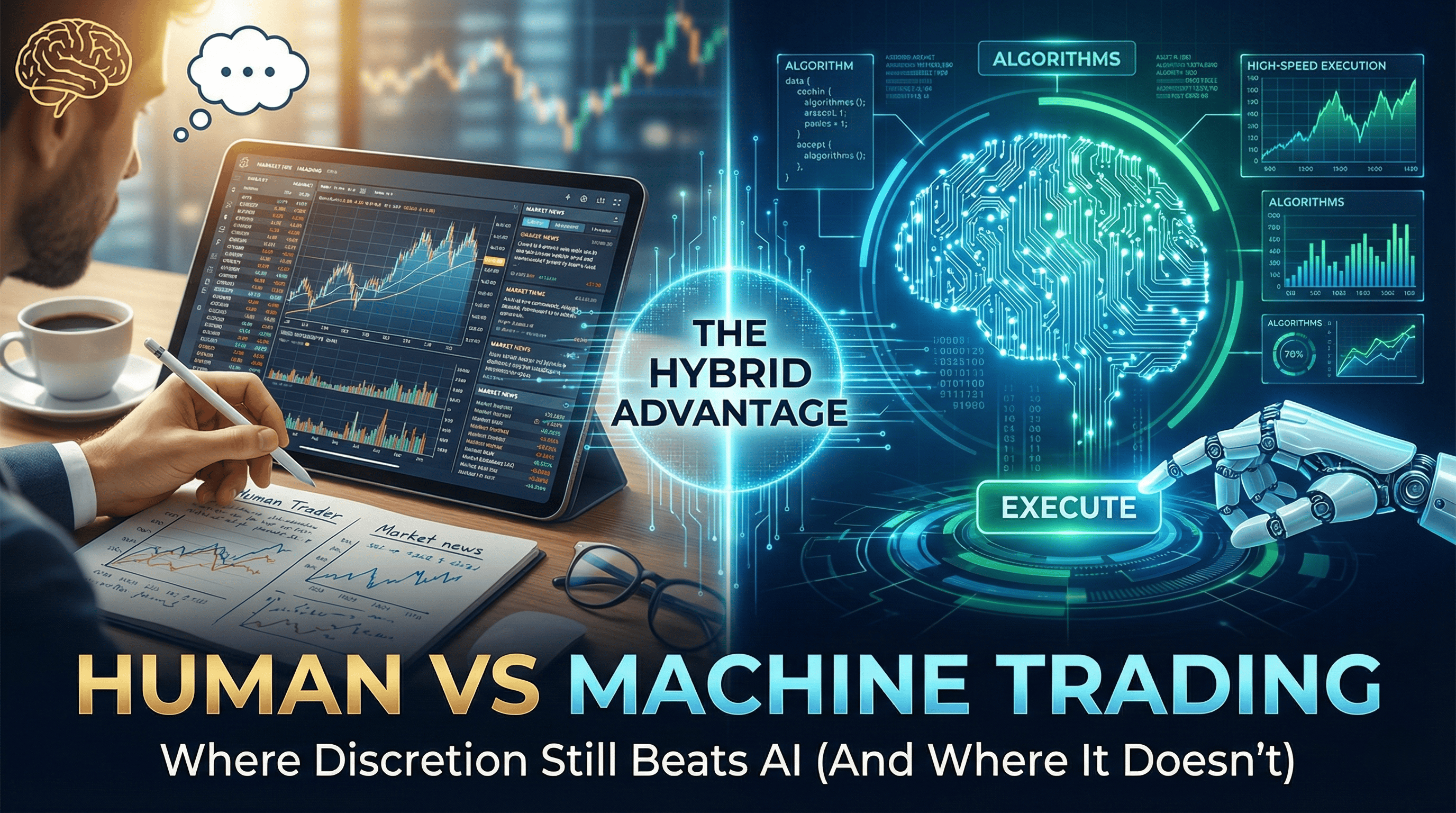
# Human vs Machine Trading: Where Discretion Still Beats AI (And Where It Doesn't)
The trading world is experiencing a technological revolution. Artificial intelligence, machine learning algorithms, and high-frequency trading systems process millions of data points per second, executing trades faster than any human could blink. Yet experienced traders continue to generate impressive returns using discretionary methods that seem almost antiquated by comparison.
This raises a fundamental question: In an age of algorithmic dominance, where does human judgment still matter? And conversely, where do machines clearly outperform human traders?
The answer isn't as straightforward as you might think. While AI excels in certain areas of trading, human discretion remains irreplaceable in others. Understanding these distinctions is crucial for modern traders who want to leverage the best of both worlds.
Table of Contents
- [The Current Trading Landscape](#the-current-trading-landscape)
- [Where Human Discretion Still Rules](#where-human-discretion-still-rules)
- [Where AI and Machines Dominate](#where-ai-and-machines-dominate)
- [The Hybrid Approach: Combining Human and Machine Intelligence](#the-hybrid-approach-combining-human-and-machine-intelligence)
- [Practical Implementation Strategies](#practical-implementation-strategies)
- [Conclusion](#conclusion)
The Current Trading Landscape
Today's financial markets present a fascinating dichotomy. On one side, we have algorithmic trading systems that account for over 80% of daily trading volume in major markets. These systems can process news events, analyze technical patterns, and execute trades within microseconds.
On the other side, discretionary traders armed with nothing more than charts, experience, and intuition continue to achieve remarkable success. Many of the world's most famous traders—from Paul Tudor Jones to Linda Raschke—still rely heavily on discretionary decision-making.
:::key-concept The coexistence of human and machine trading isn't a temporary phenomenon—it reflects fundamental differences in how each approach processes and acts on market information. :::
This coexistence isn't accidental. It reflects the complex, multi-layered nature of financial markets where different types of inefficiencies require different approaches to exploit.
Market Efficiency vs. Opportunity
Markets exist in a constant state of partial efficiency. While algorithmic trading has eliminated many obvious arbitrage opportunities, it has also created new inefficiencies that require human insight to identify and exploit.
Consider how algorithms react to earnings announcements. They can instantly parse the numerical data and execute trades based on whether results beat or miss expectations. However, they often miss the nuanced implications of management commentary, strategic shifts, or industry context that a skilled human analyst might recognize.
Where Human Discretion Still Rules
Pattern Recognition Beyond Algorithms
Humans excel at recognizing complex patterns that don't fit neatly into algorithmic models. While machines can identify standard technical patterns like triangles or head-and-shoulders formations, human traders often spot subtle variations and context-dependent patterns that algorithms miss.
:::example A human trader might notice that a particular stock tends to reverse after hitting a psychological level (like $100) when it coincides with a specific time of day and low volume conditions. This multi-dimensional pattern recognition is difficult for algorithms to code without extensive data mining that may not generalize to future market conditions. :::
Reading Market Sentiment and Psychology
Markets are driven by human emotions—fear, greed, hope, and panic. Experienced traders develop an intuitive feel for market sentiment that goes beyond what sentiment indicators can capture.
Human traders can interpret:
- The "feel" of price action during key market levels
- Unusual volume patterns that suggest institutional accumulation or distribution
- The psychological impact of news events on different market participants
- Subtle changes in market character that precede major moves
:::warning Relying purely on sentiment without objective confirmation can be dangerous. The best discretionary traders validate their intuitive reads with concrete price action and volume evidence. :::
Adapting to Unprecedented Market Conditions
When markets enter uncharted territory, historical data becomes less reliable, and algorithms trained on past patterns may fail. Human traders can adapt their approach based on first principles and logical reasoning.
The flash crashes, pandemic-induced volatility, and central bank interventions of recent years have created market conditions that don't match historical norms. Discretionary traders who understood the underlying dynamics often performed better than rigid algorithmic systems.
Complex Fundamental Analysis
While AI can process financial statements and economic data quickly, human analysts excel at understanding the qualitative aspects of fundamental analysis:
- Management quality and strategic vision
- Competitive positioning within industries
- Regulatory and political implications
- Long-term secular trends and disruptions
:::tip The most successful discretionary traders combine technical analysis skills with deep fundamental understanding, creating a comprehensive view that's difficult for algorithms to replicate. :::
Risk Management in Uncertain Environments
Human traders can make nuanced risk management decisions based on changing market conditions. They can:
- Reduce position sizes when they sense unusual market stress
- Increase risk during periods of clear trending behavior
- Exit trades early when price action doesn't match expectations
- Hold positions longer when conviction is high, even if stops would normally be hit
This dynamic approach to risk management often outperforms static algorithmic rules during periods of high uncertainty.
Where AI and Machines Dominate
Speed and Execution
The most obvious advantage of algorithmic trading is speed. Machines can:
- Process news events and react within milliseconds
- Execute complex multi-leg strategies simultaneously across multiple markets
- Take advantage of tiny arbitrage opportunities that exist for fractions of a second
- Maintain discipline by executing predefined rules without emotional interference
:::key-concept In any strategy where speed of execution is critical, algorithms have an insurmountable advantage over human traders. :::
Statistical Pattern Recognition
AI excels at finding statistical patterns in large datasets that humans would never notice. Machine learning algorithms can:
- Identify subtle correlations between seemingly unrelated variables
- Detect recurring patterns across multiple timeframes simultaneously
- Process thousands of technical indicators and fundamental metrics
- Continuously optimize strategies based on real-time performance feedback
Emotional Discipline
Perhaps the greatest weakness of human traders is emotional decision-making. Fear and greed lead to:
- Cutting profits short and letting losses run
- Revenge trading after losses
- Overconfidence after winning streaks
- Hesitation during critical moments
Algorithms never experience these emotional challenges. They execute their programmed strategies with perfect consistency, regardless of recent performance or market conditions.
:::example A human trader might exit a profitable position early due to fear of giving back gains, while an algorithm will hold the position until its predetermined exit criteria are met, often capturing significantly more profit. :::
Market Making and Liquidity Provision
Modern market making relies heavily on algorithmic systems that can:
- Continuously update bid and offer prices based on market conditions
- Manage inventory risk across multiple instruments
- Provide liquidity during volatile periods when human market makers might step away
- Process order flow and adjust prices in real-time
High-Frequency and Quantitative Strategies
Certain trading strategies are impossible for humans to execute:
- Arbitrage opportunities lasting microseconds
- Statistical arbitrage across hundreds of securities
- Options market making requiring constant delta hedging
- Systematic strategies based on complex mathematical models
The Hybrid Approach: Combining Human and Machine Intelligence
The most successful modern trading operations often combine human insight with algorithmic execution. This hybrid approach leverages the strengths of both while mitigating their respective weaknesses.
Human Strategy Development, Machine Execution
Experienced traders can develop sophisticated strategies based on market understanding and pattern recognition, then use algorithms to execute these strategies with perfect discipline.
This approach allows for:
- Human creativity in strategy development
- Algorithmic consistency in execution
- Real-time performance monitoring and adjustment
- Scalability across multiple markets and timeframes
:::tip Many successful proprietary trading firms use this model, where experienced traders develop and refine strategies while algorithms handle the actual trading. :::
AI-Assisted Analysis, Human Decision-Making
Artificial intelligence can serve as a powerful analytical tool while leaving final trading decisions to human discretion. AI can:
- Screen thousands of securities for trading opportunities
- Identify unusual patterns or anomalies
- Provide probability assessments for different scenarios
- Monitor multiple markets and timeframes simultaneously
Human traders then apply their experience and intuition to make final decisions about which opportunities to pursue and how to manage risk.
Dynamic Strategy Allocation
Advanced trading operations use AI to dynamically allocate capital between different strategies based on current market conditions. During trending markets, momentum algorithms might receive more capital, while mean-reversion strategies get more allocation during sideways markets.
Human oversight ensures that the allocation model adapts to changing market regimes and incorporates qualitative factors that pure quantitative models might miss.
Practical Implementation Strategies
For Individual Traders
Individual traders can implement hybrid approaches even with limited resources:
1. Use AI-Powered Screening Tools
- Employ scanners that identify technical setups across multiple markets
- Use sentiment analysis tools to gauge market mood
- Leverage economic calendars with AI-powered impact predictions
2. Algorithmic Trade Execution
- Use advanced order types to execute trades with minimal market impact
- Implement position sizing algorithms based on volatility
- Automate stop-loss and take-profit management
3. Performance Analytics
- Use AI-powered trade analysis to identify strengths and weaknesses
- Implement systematic review processes for continuous improvement
- Track performance metrics that algorithms can optimize
:::warning Avoid over-reliance on AI tools without understanding their limitations. Always maintain human oversight and be prepared to override algorithmic decisions when market conditions warrant it. :::
Building a Systematic Framework
Successful hybrid trading requires a systematic framework that defines when to rely on human discretion versus algorithmic execution:
1. Market Condition Assessment
- Define clear criteria for different market regimes (trending, ranging, volatile)
- Establish which strategies work best in each environment
- Use both quantitative metrics and qualitative assessment
2. Strategy Selection Process
- Create a hierarchy of strategies based on market conditions
- Define trigger conditions for switching between approaches
- Maintain flexibility for manual overrides in unusual circumstances
3. Risk Management Integration
- Implement both systematic and discretionary risk controls
- Use AI for real-time risk monitoring
- Maintain human oversight for portfolio-level risk decisions
Technology Infrastructure
Building an effective hybrid trading system requires appropriate technology:
- Data Management: Real-time market data, news feeds, and alternative data sources
- Analysis Platform: Tools that combine quantitative analysis with discretionary charting
- Execution System: Low-latency connectivity with sophisticated order management
- Risk Monitoring: Real-time position and portfolio risk analytics
- Performance Attribution: Detailed analysis of what's working and what isn't
:::example A hybrid trader might use AI to scan for stocks showing unusual volume patterns, then manually analyze the charts and news to determine if a legitimate trading opportunity exists, and finally use algorithmic execution to enter and manage the position with precise stop-losses and profit targets. :::
Conclusion
The debate between human discretion and machine trading isn't about choosing sides—it's about understanding where each approach excels and how to combine them effectively.
Human traders continue to have significant advantages in:
- Complex pattern recognition and adaptation
- Understanding market psychology and sentiment
- Making nuanced risk management decisions
- Analyzing qualitative fundamental factors
- Adapting to unprecedented market conditions
Meanwhile, AI and algorithmic systems dominate in:
- Speed and execution efficiency
- Statistical pattern recognition across large datasets
- Emotional discipline and consistency
- Market making and liquidity provision
- High-frequency and quantitative strategies
The future belongs to traders who can effectively combine human insight with machine precision. This hybrid approach allows traders to leverage the analytical power of AI while maintaining the flexibility and intuition that only human experience can provide.
As markets continue to evolve and technology advances, the most successful traders will be those who remain adaptable, continuously learning how to integrate new tools while preserving the timeless principles of sound trading practice.
Start experimenting with this hybrid approach in your own trading. Begin by identifying which aspects of your current strategy could benefit from algorithmic assistance, while preserving the discretionary elements where your human judgment adds the most value. The key is finding the right balance for your trading style, risk tolerance, and market focus.
Remember, the goal isn't to replace human judgment with machines, but to augment human intelligence with artificial intelligence, creating a more powerful and consistent trading approach than either could achieve alone.