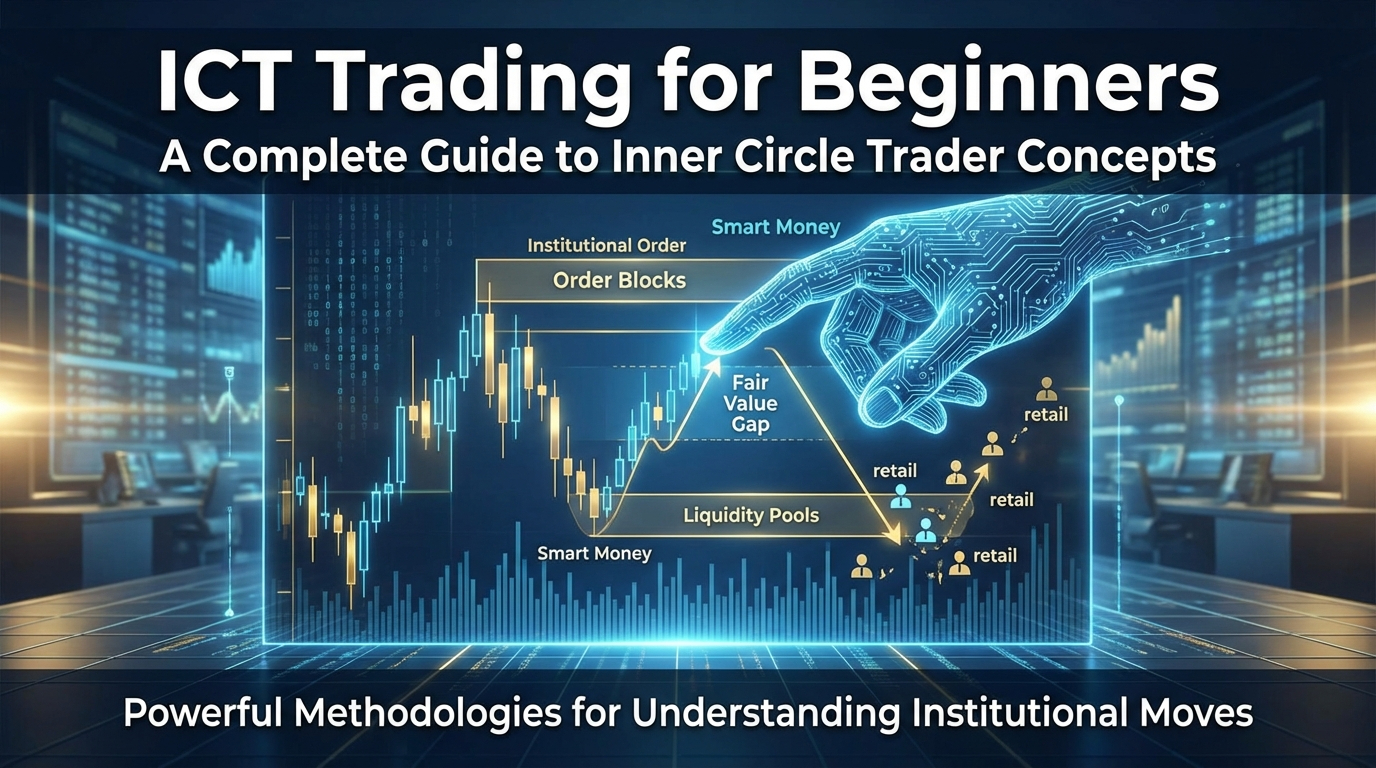
# ICT Trading for Beginners: A Complete Guide to Inner Circle Trader Concepts
If you've been exploring trading education, you've likely encountered ICT (Inner Circle Trader) concepts. These powerful methodologies have revolutionized how many traders approach the markets by focusing on how institutional money moves and creates opportunities. This comprehensive guide will introduce you to ict trading for beginners, breaking down complex concepts into digestible, actionable knowledge.
What is ICT Trading?
ICT trading, developed by Michael Huddleston (known as ICT or Inner Circle Trader), represents a methodology that focuses on understanding how smart money (banks, institutions, hedge funds) operates in the financial markets. Rather than relying on traditional retail indicators, ICT concepts teach traders to identify where large institutions are likely to enter and exit positions.
:::key-concept Smart Money vs Retail Money: Smart money refers to large institutional players who have the capital to move markets. Retail money represents individual traders who typically follow trends rather than create them. :::
The core philosophy behind ICT trading revolves around the idea that markets are manipulated by institutional players who create liquidity raids, stop hunts, and engineered price movements to accumulate positions at favorable prices.
Table of Contents
- [Understanding Market Structure](#understanding-market-structure)
- [Order Blocks: The Foundation of ICT Trading](#order-blocks-the-foundation-of-ict-trading)
- [Fair Value Gaps and Imbalances](#fair-value-gaps-and-imbalances)
- [Liquidity Concepts and Stop Hunts](#liquidity-concepts-and-stop-hunts)
- [Putting It All Together: A Practical Trading Approach](#putting-it-all-together-a-practical-trading-approach)
- [Common Mistakes to Avoid](#common-mistakes-to-avoid)
- [Conclusion](#conclusion)
Understanding Market Structure
Before diving into specific ICT concepts, it's crucial to understand how markets move according to ICT methodology. Markets don't move randomly; they follow specific patterns that institutional traders create and exploit.
Break of Structure (BOS)
A Break of Structure occurs when price breaks beyond a previous significant high or low, indicating a potential change in market direction. This is one of the first concepts in ict trading for beginners to master.
:::example BOS Example: If EUR/USD has been making lower highs and lower lows (downtrend), a break above the most recent significant high would constitute a bullish BOS, potentially signaling the start of an uptrend. :::
Change of Character (CHoCH)
Change of Character is similar to BOS but represents a more significant shift in market sentiment. It typically occurs when:
- An uptrend fails to make a higher high
- A downtrend fails to make a lower low
- Price begins moving in the opposite direction with conviction
Market Structure Shifts
ICT teaches that markets move in three phases: 1. Accumulation/Distribution: Smart money builds positions 2. Manipulation: Price moves against the intended direction to trap retail traders 3. Distribution/Accumulation: The real move begins in the intended direction
:::tip Pro Tip: Always wait for confirmation of market structure changes. A single candle breaking structure doesn't guarantee a trend reversal. :::
Order Blocks: The Foundation of ICT Trading
Order blocks represent areas where institutional orders were executed, creating significant price movement. These areas often act as support or resistance levels where price is likely to react when revisited.
Identifying Order Blocks
To identify order blocks, look for:
- Strong directional moves: Candles that show significant price rejection
- High volume areas: Where large orders were likely executed
- Areas of consolidation: Where institutions may have accumulated positions
Types of Order Blocks
Bullish Order Blocks:
- Form during downtrends before a strong bullish move
- Typically the last bearish candle before the impulse higher
- Act as support when price returns to test the area
Bearish Order Blocks:
- Form during uptrends before a strong bearish move
- Usually the last bullish candle before the impulse lower
- Act as resistance when price returns to test the area
:::warning Important: Not every strong candle creates a valid order block. Look for blocks that align with overall market structure and show clear institutional footprints. :::
Trading Order Blocks
When trading order blocks: 1. Wait for price to return to the order block area 2. Look for rejection signals (pin bars, doji, engulfing patterns) 3. Enter trades in the direction of the expected institutional flow 4. Place stops beyond the order block 5. Target the next likely institutional objective
Fair Value Gaps and Imbalances
Fair Value Gaps (FVGs) represent areas where price moved so quickly that it left behind inefficient pricing. These gaps often get filled as the market seeks to balance pricing inefficiencies.
Identifying Fair Value Gaps
A Fair Value Gap forms when:
- There's a significant gap between consecutive candles
- The high of candle 1 doesn't overlap with the low of candle 3
- The gap represents an imbalance in buying or selling pressure
Types of Fair Value Gaps
Bullish FVG:
- Forms when price gaps higher
- Creates a zone where there were more buyers than sellers
- Often fills during pullbacks in uptrends
Bearish FVG:
- Forms when price gaps lower
- Creates a zone where there were more sellers than buyers
- Often fills during retracements in downtrends
:::example FVG Trading Example: If you identify a bullish FVG at 1.1200-1.1220 in EUR/USD during an uptrend, you might place a buy limit order in that zone, expecting price to bounce higher after filling the gap. :::
Trading Fair Value Gaps
Successful FVG trading involves:
- Patience: Wait for price to return to the gap
- Confirmation: Look for additional signals that support your directional bias
- Risk Management: Use appropriate position sizing and stop losses
- Targeting: Aim for the next institutional objective or FVG
Liquidity Concepts and Stop Hunts
Liquidity is at the heart of ict trading for beginners. Understanding where liquidity pools exist and how institutions hunt for stops is crucial for successful trading.
Where Liquidity Pools Form
Liquidity typically accumulates:
- Above swing highs: Where retail stop losses and breakout orders cluster
- Below swing lows: Where retail stop losses and breakdown orders cluster
- At round numbers: Psychological levels where orders congregate
- Near equal highs/lows: Areas where multiple touches create order clusters
The Liquidity Hunt Process
1. Identification: Smart money identifies liquidity pools 2. Manipulation: Price is driven toward the liquidity 3. Execution: Orders are triggered, providing liquidity for institutions 4. Reversal: Price moves in the intended direction
:::key-concept Liquidity Grab: When price briefly spikes beyond a significant level to trigger stops and orders, then immediately reverses. This is often the best entry point for institutional-style trades. :::
Trading Liquidity Hunts
To profit from liquidity concepts:
- Identify potential liquidity zones on higher timeframes
- Wait for price to approach these areas
- Look for signs of manipulation (false breaks, wicks, immediate reversals)
- Enter trades in the direction of the expected institutional move
- Target the next liquidity pool or institutional objective
Putting It All Together: A Practical Trading Approach
Now that you understand the core ICT concepts, here's how to combine them into a coherent trading strategy suitable for ict trading for beginners:
Step-by-Step ICT Analysis
1. Higher Timeframe Analysis:
- Identify the overall market structure (uptrend, downtrend, consolidation)
- Mark key order blocks and fair value gaps
- Note significant liquidity pools
2. Lower Timeframe Confirmation:
- Look for market structure shifts that align with your higher timeframe bias
- Identify precise entry points using order blocks or FVGs
- Confirm your analysis with price action signals
3. Trade Execution:
- Enter trades with clear risk parameters
- Use appropriate position sizing
- Target logical institutional objectives
Sample Trade Setup
:::example Complete ICT Trade Example:
Setup: EUR/USD Daily Analysis
- Overall structure: Bullish (recent break of structure)
- Order block identified at 1.0850-1.0870 (daily timeframe)
- Fair value gap at 1.0820-1.0840
- Liquidity pool above 1.1000 (previous swing high)
Execution: 4-Hour Timeframe
:::
- Wait for pullback to test the order block or FVG
- Look for bullish price action confirmation
- Enter long position with stop below the order block
- Target the liquidity pool at 1.1000
Risk Management in ICT Trading
Successful ICT trading requires robust risk management:
- Position sizing: Never risk more than 1-2% per trade
- Stop placement: Use order block invalidation levels
- Profit targets: Aim for institutional objectives and liquidity pools
- Trade management: Consider partial profits at key levels
Common Mistakes to Avoid
As you begin your journey with ict trading for beginners, avoid these common pitfalls:
Over-Analysis Paralysis
- Don't try to find ICT concepts on every chart
- Focus on the clearest, most obvious setups
- Quality over quantity in trade selection
Ignoring Higher Timeframes
- Always start analysis from higher timeframes
- Lower timeframe signals should align with higher timeframe structure
- Don't fight the institutional flow
Poor Risk Management
- ICT concepts don't guarantee profits
- Always use appropriate stop losses
- Never risk more than you can afford to lose
:::warning Risk Warning: ICT trading, like all trading methodologies, involves significant risk. Practice on demo accounts before risking real money, and never trade with funds you cannot afford to lose. :::
Expecting Immediate Success
- ICT concepts take time to master
- Practice pattern recognition on historical charts
- Keep a trading journal to track your progress
- Be patient with the learning process
Ignoring Market Context
- Consider fundamental factors that might override technical analysis
- Be aware of high-impact news events
- Understand that central bank interventions can invalidate technical setups
Advanced ICT Concepts for Future Learning
Once you've mastered the basics of ict trading for beginners, consider exploring these advanced concepts:
- Silver Bullet: Specific time-based trading opportunities
- Optimal Trade Entry (OTE): Fibonacci-based entry techniques
- Breaker Blocks: Failed order blocks that become reversal zones
- Mitigation: How price returns to balance previous imbalances
- Market Maker Models: Understanding institutional accumulation and distribution patterns
:::tip Learning Path: Master basic order blocks and fair value gaps first before moving to advanced concepts. Build a solid foundation before adding complexity to your trading. :::
Conclusion
ICT trading concepts offer a powerful framework for understanding how institutional money moves markets and creates trading opportunities. By focusing on order blocks, fair value gaps, market structure, and liquidity concepts, ict trading for beginners provides a systematic approach to reading price action like professional traders.
Remember that success with ICT trading requires:
- Patience: Wait for high-probability setups that align with institutional flow
- Practice: Develop pattern recognition skills through chart study
- Discipline: Follow your analysis and risk management rules consistently
- Persistence: Allow time to master these concepts fully
The journey to becoming proficient with ICT concepts takes time and dedication, but the insights you'll gain into market mechanics are invaluable. Focus on understanding the 'why' behind price movements rather than just the 'what', and you'll develop the institutional mindset necessary for long-term trading success.
Start practicing these concepts on demo accounts, keep detailed records of your analysis, and gradually build confidence in your ability to read institutional footprints in the markets. With consistent effort and proper risk management, ICT trading concepts can become a cornerstone of your trading strategy.
Ready to start your ICT trading journey? Begin by analyzing charts with fresh eyes, looking for the institutional signatures we've discussed. Practice identifying order blocks and fair value gaps on historical data, and gradually work toward implementing these concepts in your live trading strategy.