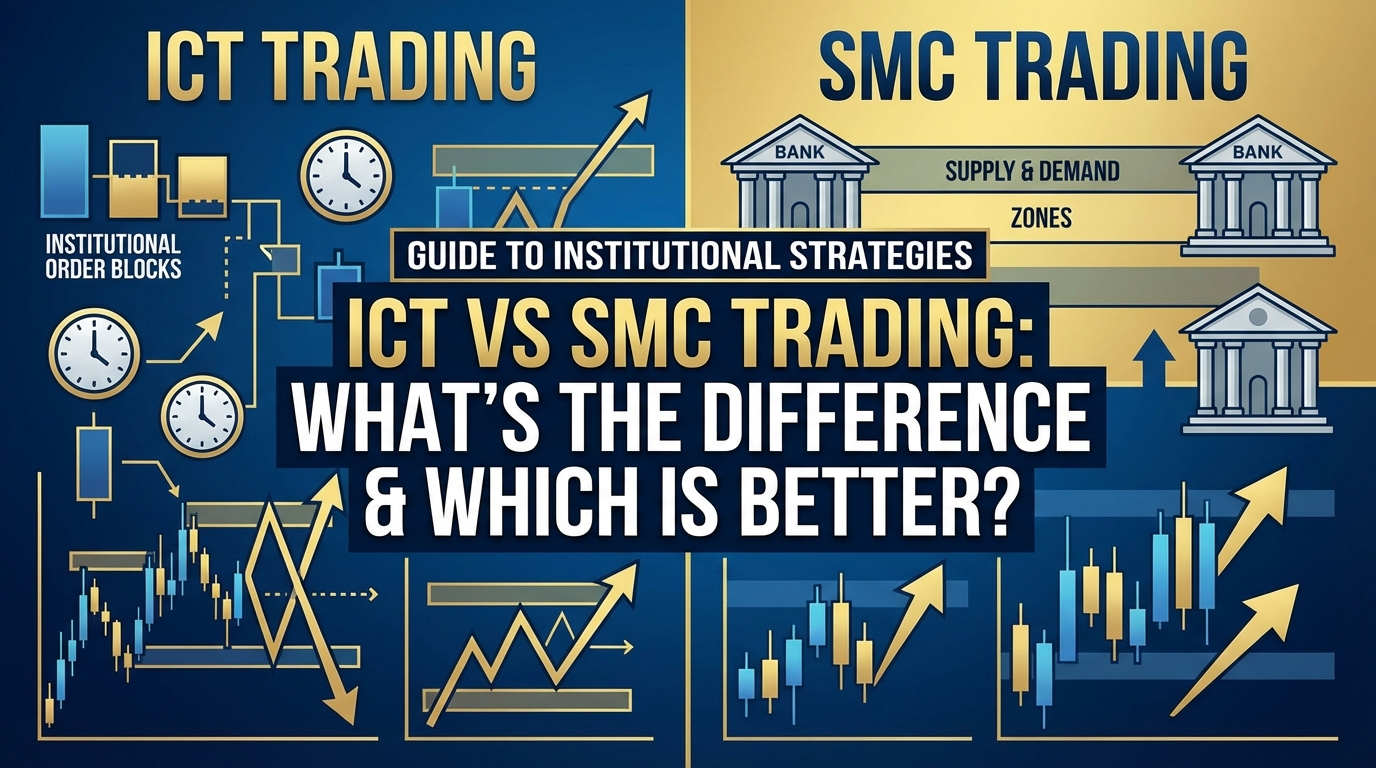
# ICT vs SMC Trading: What's the Difference and Which Strategy Is Better?
The trading world is filled with various methodologies, but two approaches have gained significant attention among modern traders: Inner Circle Trader (ICT) concepts and Smart Money Concepts (SMC). While these two trading methodologies share some similarities, they have distinct differences that can significantly impact your trading results.
Understanding the nuances between ICT vs SMC trading is crucial for developing a profitable trading strategy. Both approaches focus on institutional trading behavior and market structure, but they interpret and apply these concepts differently. This guide will break down each methodology, compare their strengths and weaknesses, and help you determine which approach might work best for your trading style.
Table of Contents
- [Understanding ICT Trading Concepts](#understanding-ict-trading-concepts)
- [Smart Money Concepts (SMC) Explained](#smart-money-concepts-smc-explained)
- [Key Differences Between ICT and SMC](#key-differences-between-ict-and-smc)
- [Practical Applications and Examples](#practical-applications-and-examples)
- [Which Methodology is Better for You](#which-methodology-is-better-for-you)
- [Conclusion](#conclusion)
Understanding ICT Trading Concepts
Inner Circle Trader (ICT) concepts, developed by Michael J. Huddleston, represent a comprehensive trading methodology that focuses on institutional order flow and market maker behavior. The ICT approach emphasizes understanding how large financial institutions move markets and how retail traders can align with these movements.
Core ICT Principles
ICT trading revolves around several fundamental concepts that form the backbone of this methodology:
Order Blocks and Fair Value Gaps Order blocks represent areas where institutions have placed significant orders, creating imbalances in the market. These zones often act as support or resistance levels where price may react strongly.
Liquidity Concepts ICT places heavy emphasis on liquidity grabs, where institutions target areas of concentrated retail stops to fuel their larger positions. Understanding these liquidity sweeps is crucial for timing entries and exits.
Market Structure Analysis The methodology focuses on identifying market structure shifts, breaks of structure (BOS), and changes of character (CHOCH) to determine trend direction and potential reversal points.
:::key-concept ICT concepts emphasize precision in timing and entry points, requiring traders to understand specific market timing and institutional behavior patterns. :::
ICT Trading Sessions and Timing
One of ICT's most distinctive features is its emphasis on specific trading sessions and times. The methodology identifies optimal trading windows based on institutional activity:
- London Open Kill Zone: Early London session activity
- New York Open Kill Zone: Early New York session movements
- Lunch Time Reversals: Mid-day institutional repositioning
These time-based concepts help traders focus on periods when institutional activity is highest, potentially leading to more predictable price movements.
:::tip ICT traders often use multiple timeframe analysis, studying higher timeframes for bias and lower timeframes for precise entry points. :::
Smart Money Concepts (SMC) Explained
Smart Money Concepts (SMC) is a trading methodology that focuses on following the "smart money" – institutions, banks, and large financial entities that have significant market influence. SMC aims to identify where these large players are positioning themselves and trade in alignment with their movements.
Fundamental SMC Principles
Market Structure Understanding SMC emphasizes the importance of identifying higher highs, higher lows, lower highs, and lower lows to determine the overall market trend and potential reversal points.
Supply and Demand Zones The methodology focuses on identifying institutional supply and demand areas where large orders were previously executed, expecting these zones to react when price returns.
Break of Structure (BOS) and Change of Character (CHOCH) SMC traders look for breaks in market structure to identify trend changes and potential trading opportunities.
:::example In SMC trading, if price breaks above a previous swing high in an uptrend, it confirms the continuation of the bullish trend. Conversely, if price fails to make a new high and breaks below a previous swing low, it signals a potential change of character. :::
SMC Trading Approach
SMC typically employs a more simplified approach compared to ICT, focusing on:
- Trend identification through market structure
- Supply and demand zone marking
- Entry triggers based on structure breaks
- Risk management through proper position sizing
The methodology emphasizes patience and waiting for clear structural confirmations before entering trades.
:::warning While SMC appears simpler than ICT, it still requires significant practice to accurately identify supply and demand zones and structure breaks. :::
Key Differences Between ICT and SMC
When comparing ICT vs SMC trading methodologies, several key differences emerge that can help traders choose the most suitable approach for their style and goals.
Complexity and Learning Curve
ICT Complexity ICT concepts are generally more complex and detailed, incorporating numerous specific concepts, timing elements, and precise entry techniques. The methodology includes:
- Multiple order block types
- Specific session-based trading rules
- Complex fair value gap analysis
- Detailed liquidity concepts
SMC Simplicity SMC offers a more streamlined approach, focusing on core concepts:
- Basic market structure analysis
- Supply and demand identification
- Simplified entry and exit rules
- Clearer trend identification methods
Time Commitment and Analysis
ICT Time Requirements ICT trading often requires more time for analysis due to its emphasis on specific sessions and detailed market structure analysis. Traders need to:
- Monitor multiple timeframes simultaneously
- Track specific trading sessions
- Analyze complex order flow patterns
SMC Efficiency SMC can be more time-efficient, allowing traders to:
- Focus on key structural levels
- Use simpler analysis methods
- Trade with less screen time
:::key-concept The choice between ICT vs SMC trading often comes down to how much time and complexity a trader is willing to handle in their analysis process. :::
Entry and Exit Strategies
ICT Precision ICT emphasizes precise entries using:
- Fair value gap entries
- Order block reactions
- Specific session-based timing
- Multiple confirmation signals
SMC Structure-Based Entries SMC focuses on:
- Structure break confirmations
- Supply and demand reactions
- Trend-following entries
- Simpler trigger mechanisms
Practical Applications and Examples
Understanding how ICT vs SMC trading concepts work in practice helps traders see the real-world applications of each methodology.
ICT Trading Example
Consider a EUR/USD trading scenario during the London session:
1. Setup Identification: Trader identifies a fair value gap from the Asian session 2. Session Timing: Waits for London Open Kill Zone 3. Entry Trigger: Price returns to the fair value gap during optimal timing 4. Risk Management: Stop loss below the order block, target based on next liquidity level
:::example An ICT trader might wait for price to sweep liquidity above a previous high, then look for a fair value gap entry to trade the reversal back toward an institutional order block. :::
SMC Trading Example
Using the same EUR/USD pair with SMC approach:
1. Structure Analysis: Identify current market structure (uptrend/downtrend) 2. Zone Marking: Mark key supply and demand zones 3. Entry Signal: Wait for break of structure or zone reaction 4. Trade Management: Use structure-based stops and targets
Risk Management Differences
ICT Risk Management
- Uses specific order block levels for stops
- Targets based on liquidity analysis
- Position sizing based on fair value gap width
- Multiple partial profit-taking levels
SMC Risk Management
- Structure-based stop losses
- Supply and demand zone targets
- Fixed risk-reward ratios
- Simpler position management
:::tip Both methodologies emphasize proper risk management, but ICT tends to use more complex position sizing and management techniques. :::
Which Methodology is Better for You?
Choosing between ICT vs SMC trading depends on several personal factors and trading preferences.
Choose ICT If You:
- Enjoy Complex Analysis: You appreciate detailed market analysis and don't mind spending time learning intricate concepts
- Can Dedicate Significant Time: You have the time to monitor specific sessions and conduct thorough analysis
- Prefer Precision Trading: You want very specific entry and exit points with multiple confirmation signals
- Have Experience: You're not a complete beginner and can handle advanced concepts
Choose SMC If You:
- Want Simplicity: You prefer straightforward concepts that are easier to learn and apply
- Have Limited Time: You need a methodology that doesn't require constant monitoring
- Are a Beginner: You're new to trading and want to start with more accessible concepts
- Prefer Structure-Based Trading: You like clear, defined rules based on market structure
Hybrid Approach Considerations
Many successful traders combine elements from both methodologies:
- Use SMC for overall bias: Determine market direction using simple structure analysis
- Apply ICT for entries: Use precise ICT entry techniques within the SMC bias
- Combine risk management: Use the best risk management techniques from both approaches
:::warning While combining methodologies can be effective, ensure you thoroughly understand each approach individually before attempting to merge them. :::
Performance Considerations
Both ICT and SMC can be profitable when applied correctly, but success depends on:
- Proper Education: Understanding the methodology completely
- Consistent Application: Following rules without emotional deviation
- Risk Management: Protecting capital through proper position sizing
- Practice: Developing skills through demo trading and backtesting
The "better" methodology is the one that aligns with your personality, schedule, and learning style while being applied consistently with proper risk management.
Conclusion
The debate between ICT vs SMC trading ultimately comes down to personal preference and trading style compatibility. ICT concepts offer detailed, precision-based analysis with complex timing elements, making them suitable for traders who enjoy thorough market analysis and have the time to dedicate to learning intricate concepts. SMC provides a more streamlined approach focusing on core market structure principles, making it accessible for beginners and time-constrained traders.
Both methodologies share the common goal of following institutional money flow and understanding market structure, but they achieve this through different levels of complexity and analysis. ICT's strength lies in its precision and detailed approach to market timing, while SMC's advantage is its simplicity and straightforward application.
The key to success with either methodology isn't necessarily which one you choose, but how well you understand and consistently apply your chosen approach. Many profitable traders have found success with ICT concepts, while others thrive using SMC principles. Some even combine elements from both approaches to create their own hybrid methodology.
Remember that no trading methodology guarantees success. Your profitability will depend on proper risk management, consistent application of your chosen approach, and continuous learning and adaptation to market conditions.
Ready to dive deeper into market structure analysis? Start by practicing chart analysis with either ICT or SMC concepts on demo accounts. Choose the methodology that resonates most with your learning style and time availability, then commit to mastering its principles through consistent study and practice.