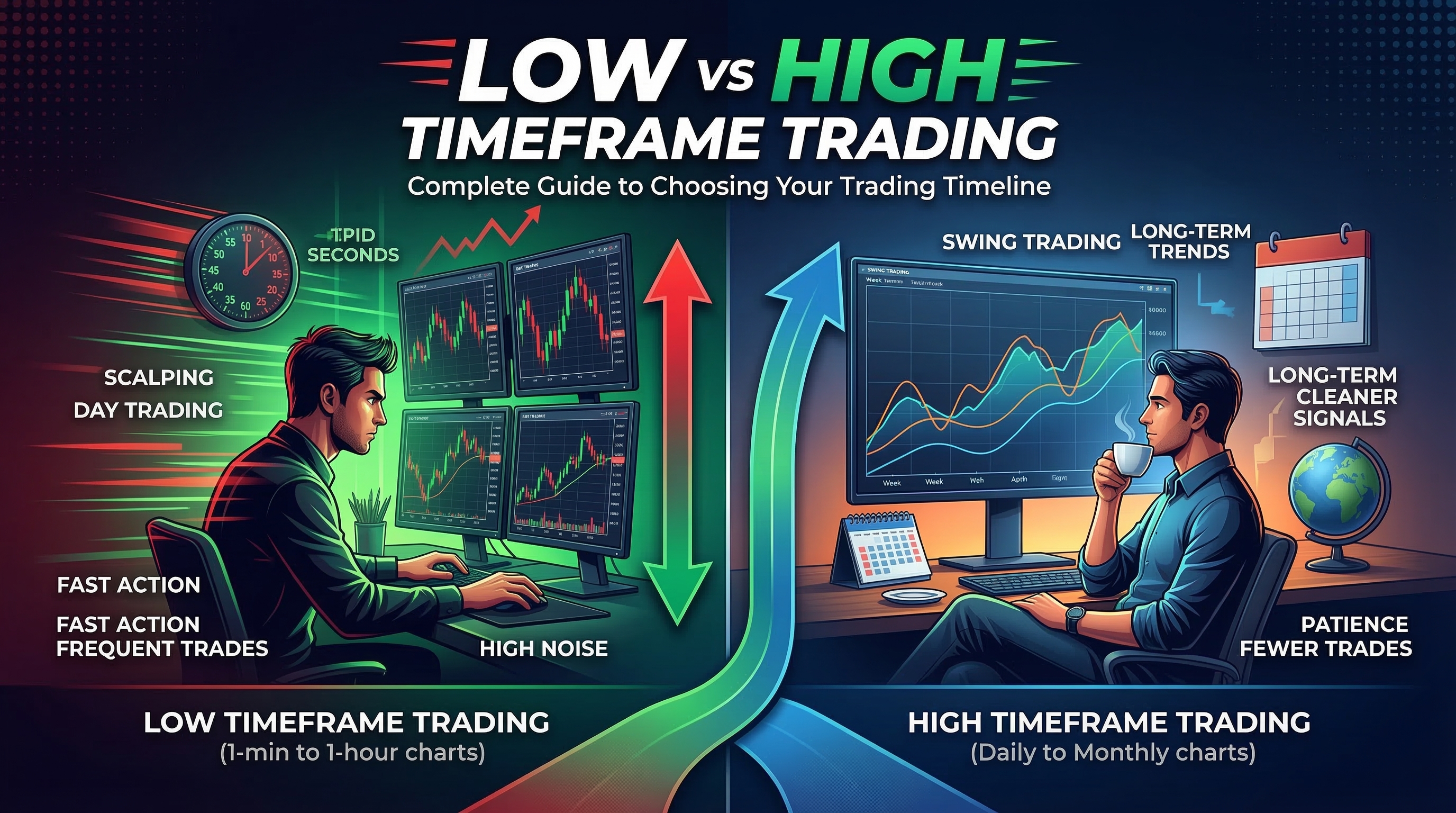
# Low vs High Timeframe Trading: Complete Guide to Choosing Your Trading Timeline
One of the most fundamental decisions every trader faces is selecting the optimal timeframe for their trading strategy. The debate between low vs high timeframe trading has shaped countless trading careers, with each approach offering distinct advantages and challenges. Understanding these differences is crucial for developing a successful trading methodology that aligns with your goals, lifestyle, and risk tolerance.
Timeframe selection impacts everything from your analysis approach to your emotional state during trades. Whether you're drawn to the fast-paced world of scalping on minute charts or prefer the broader perspective of daily and weekly timeframes, this comprehensive guide will help you make an informed decision about your trading timeline.
Table of Contents
- [Understanding Trading Timeframes](#understanding-trading-timeframes)
- [Low Timeframe Trading Analysis](#low-timeframe-trading-analysis)
- [High Timeframe Trading Analysis](#high-timeframe-trading-analysis)
- [Comparative Analysis and Decision Factors](#comparative-analysis-and-decision-factors)
- [Implementing Your Timeframe Strategy](#implementing-your-timeframe-strategy)
- [Conclusion](#conclusion)
Understanding Trading Timeframes
Trading timeframes represent the duration of each candlestick or bar on your trading chart. They range from seconds to months, with each timeframe providing different perspectives on market movement and price action.
:::key-concept Timeframe Categories:
:::
- Low Timeframes: 1-second to 1-hour charts
- Medium Timeframes: 2-hour to daily charts
- High Timeframes: Weekly, monthly, and quarterly charts
The choice between low vs high timeframe trading fundamentally affects your trading approach, required capital, time commitment, and psychological demands. Low timeframes show more granular price movements and frequent trading opportunities, while high timeframes reveal broader market trends and structural patterns.
Market Noise vs. Market Structure
Low timeframes contain more market "noise" – random price fluctuations that don't necessarily reflect true market sentiment. High timeframes filter out this noise, presenting cleaner price action that better represents institutional money flow and long-term market dynamics.
:::example Noise Illustration: On a 1-minute chart, you might see dozens of small price spikes and dips that appear significant. However, when viewed on a daily chart, these movements become insignificant fluctuations within a larger trend pattern. :::
Low Timeframe Trading Analysis
Low timeframe trading, often associated with day trading and scalping, focuses on capturing small price movements within short periods. This approach appeals to traders seeking quick profits and frequent market action.
Advantages of Low Timeframe Trading
Frequent Trading Opportunities Low timeframes provide numerous entry and exit points throughout the trading session. A scalper might execute dozens of trades daily, capitalizing on minor price fluctuations that occur regularly on minute charts.
Quick Profit Realization Positions are typically held for minutes to hours, allowing traders to realize profits quickly and reinvest capital for additional opportunities. This rapid turnover can compound profits effectively when executed skillfully.
Reduced Overnight Risk Most low timeframe traders close all positions before market close, eliminating exposure to overnight gaps and news events that can dramatically impact positions.
Lower Capital Requirements per Trade Since profit targets are smaller, traders can use tighter stop losses, requiring less risk capital per position. This makes low timeframe trading accessible to smaller account sizes.
:::tip Leverage Advantage: Low timeframe traders can effectively use higher leverage due to tighter stop losses, potentially amplifying returns on successful trades. :::
Disadvantages of Low Timeframe Trading
High Transaction Costs Frequent trading generates substantial commission and spread costs that can significantly erode profits. These costs compound quickly with multiple daily trades.
Psychological Pressure Constant market monitoring and rapid decision-making create intense psychological pressure. The fast-paced environment can lead to emotional trading and poor judgment.
Market Noise Interference Low timeframes are heavily influenced by market noise, making it difficult to distinguish between meaningful price movements and random fluctuations.
Time-Intensive Requirements Successful low timeframe trading demands full-time attention during market hours, making it unsuitable for traders with other commitments.
:::warning Overtrading Risk: The abundance of apparent opportunities on low timeframes can lead to overtrading, where transaction costs and poor trade selection erode account equity. :::
Optimal Conditions for Low Timeframe Trading
Low timeframe trading works best during:
- High volatility market sessions
- Major economic announcements
- Market open and close periods
- When clear intraday patterns emerge
High Timeframe Trading Analysis
High timeframe trading focuses on longer-term price movements, typically using daily, weekly, or monthly charts. This approach aligns with swing trading and position trading strategies.
Advantages of High Timeframe Trading
Clearer Market Direction High timeframes filter out market noise, presenting cleaner price action that more accurately reflects underlying market sentiment and institutional positioning.
Better Risk-Reward Ratios Longer-term trades typically offer superior risk-reward ratios, as traders can set wider profit targets while maintaining reasonable stop losses based on significant support and resistance levels.
Reduced Psychological Stress With positions held for days, weeks, or months, traders experience less psychological pressure from constant monitoring and decision-making.
Lower Transaction Costs Fewer trades mean reduced commission and spread costs, allowing more of the account's returns to come from market movements rather than being eroded by trading expenses.
:::key-concept Compound Growth: High timeframe trading allows profits to compound through fewer, larger winning trades rather than many small gains that may be offset by transaction costs. :::
Part-Time Trading Feasibility High timeframe analysis can be conducted outside market hours, making it suitable for traders with full-time jobs or other commitments.
Disadvantages of High Timeframe Trading
Fewer Trading Opportunities High timeframes generate fewer trading signals, potentially leading to long periods without active positions or new opportunities.
Larger Stop Losses Positions require wider stop losses based on higher timeframe support and resistance levels, demanding larger risk capital per trade.
Extended Drawdown Periods Losing trades may remain underwater for extended periods before hitting stop losses, testing trader patience and discipline.
Higher Capital Requirements The combination of larger stop losses and position sizing requirements typically demands more substantial account capital to trade effectively.
:::warning Patience Challenge: Many traders struggle with the patience required for high timeframe trading, often exiting profitable positions prematurely or abandoning their strategy during temporary drawdowns. :::
Market Conditions Favoring High Timeframe Trading
High timeframe trading excels during:
- Strong trending markets
- Major economic cycles
- Fundamental shifts in market sentiment
- When clear weekly/monthly patterns develop
Comparative Analysis and Decision Factors
When evaluating low vs high timeframe trading, consider these critical factors that will determine which approach aligns best with your trading goals and circumstances.
Capital Requirements Comparison
| Factor | Low Timeframe | High Timeframe | |--------|---------------|----------------| | Risk per trade | Smaller absolute amounts | Larger absolute amounts | | Account size needed | $1,000 - $10,000+ | $10,000 - $50,000+ | | Position sizing | Higher frequency, smaller size | Lower frequency, larger size | | Leverage utilization | Higher leverage potential | More conservative leverage |
Time Commitment Analysis
Low Timeframe Time Requirements:
- 4-8+ hours daily during market sessions
- Constant chart monitoring
- Quick decision-making under pressure
- Immediate trade management
High Timeframe Time Requirements:
- 1-2 hours daily for analysis
- Weekly comprehensive review
- Patient position management
- Periodic strategy adjustment
:::example Real-World Comparison: A day trader might spend 6 hours actively monitoring 5-minute charts, executing 15 trades with an average profit of $50 each. Meanwhile, a swing trader might spend 1 hour analyzing daily charts, executing 2 trades weekly with an average profit of $200 each. :::
Psychological Considerations
Your psychological makeup significantly influences timeframe suitability:
Low Timeframe Traders Need:
- High stress tolerance
- Quick decision-making ability
- Emotional detachment from individual trades
- Strong focus and concentration
High Timeframe Traders Need:
- Patience and discipline
- Ability to withstand drawdowns
- Long-term perspective
- Confidence in analysis
Skill Development Pathways
Low vs high timeframe trading requires different skill emphases:
Low Timeframe Skills:
- Rapid pattern recognition
- Order flow analysis
- Risk management execution
- Emotional regulation under pressure
High Timeframe Skills:
- Fundamental analysis integration
- Multi-timeframe analysis
- Position sizing optimization
- Long-term market cycle understanding
Implementing Your Timeframe Strategy
Once you've decided between low vs high timeframe trading, implementation requires a structured approach to maximize your chosen strategy's effectiveness.
Multi-Timeframe Analysis Integration
Regardless of your primary timeframe, successful traders often employ multi-timeframe analysis:
For Low Timeframe Traders: 1. Use daily charts for overall market direction 2. Use 1-hour charts for intermediate trend 3. Execute trades on 5-15 minute charts 4. Use 1-minute charts for precise entries
For High Timeframe Traders: 1. Use monthly charts for major trend identification 2. Use weekly charts for swing high/low identification 3. Use daily charts for trade execution 4. Use 4-hour charts for fine-tuning entries
:::tip Timeframe Harmony: Ensure your trading direction aligns across multiple timeframes. For example, don't take short-term long positions against a strong weekly downtrend. :::
Technology and Tools Optimization
Low Timeframe Trading Tools:
- High-speed internet connection
- Advanced charting platforms with real-time data
- Level II market data access
- Automated alert systems
- Direct market access (DMA) brokers
High Timeframe Trading Tools:
- Comprehensive fundamental analysis resources
- End-of-day data feeds (sufficient for most analysis)
- Portfolio management software
- Economic calendar integration
- Long-term backtesting capabilities
Risk Management Adaptation
Risk management principles must be adapted to your chosen timeframe:
Low Timeframe Risk Management:
- Tight stop losses (10-30 pips in forex)
- Quick position adjustments
- Daily loss limits
- High win rate focus
High Timeframe Risk Management:
- Wider stop losses (50-200+ pips in forex)
- Patient position management
- Monthly/quarterly performance evaluation
- High reward-to-risk ratio focus
:::key-concept Risk Scaling: As timeframes increase, individual trade risk typically increases in absolute terms but decreases in frequency, requiring careful position sizing adjustments. :::
Performance Measurement
Evaluate your timeframe strategy using appropriate metrics:
Low Timeframe Metrics:
- Daily profit/loss consistency
- Win rate percentage
- Average holding time
- Maximum daily drawdown
- Trades per day/week
High Timeframe Metrics:
- Monthly/quarterly returns
- Average reward-to-risk ratios
- Maximum portfolio drawdown
- Trades per month/quarter
- Long-term compound growth rate
Transitioning Between Timeframes
Some traders successfully transition from low to high timeframe trading or vice versa. Consider these guidelines:
Moving from Low to High Timeframes:
- Develop patience through gradual timeframe extension
- Adjust position sizing for larger stop losses
- Focus on improving fundamental analysis skills
- Practice holding positions through minor adverse movements
Moving from High to Low Timeframes:
- Develop faster decision-making skills
- Improve technical analysis precision
- Build tolerance for frequent small losses
- Enhance order execution speed and accuracy
Conclusion
The choice between low vs high timeframe trading represents one of the most significant strategic decisions in your trading journey. Each approach offers distinct advantages and challenges that must align with your personal circumstances, psychological makeup, and trading objectives.
Low timeframe trading provides frequent opportunities and quick profit realization but demands intense focus, substantial time commitment, and strong emotional regulation. It's ideal for traders who thrive in fast-paced environments and can dedicate full-time attention to the markets.
High timeframe trading offers clearer market direction, better risk-reward ratios, and reduced psychological stress while requiring patience, larger capital allocation per trade, and the discipline to withstand extended drawdown periods. This approach suits traders seeking part-time trading opportunities or those who prefer a more analytical, less emotionally demanding trading style.
Remember that successful traders in both timeframes share common traits: disciplined risk management, consistent strategy application, and continuous learning. Your chosen timeframe should complement your lifestyle and personality rather than work against them.
The key to mastering low vs high timeframe trading lies not in finding the "perfect" timeframe, but in selecting the approach that best matches your individual circumstances and then developing the specific skills required for success in that chosen domain.
Ready to optimize your trading timeframe strategy? Start by analyzing your current trading performance across different timeframes, identify which approach aligns best with your goals and constraints, then develop a focused plan to master your chosen timeframe methodology.