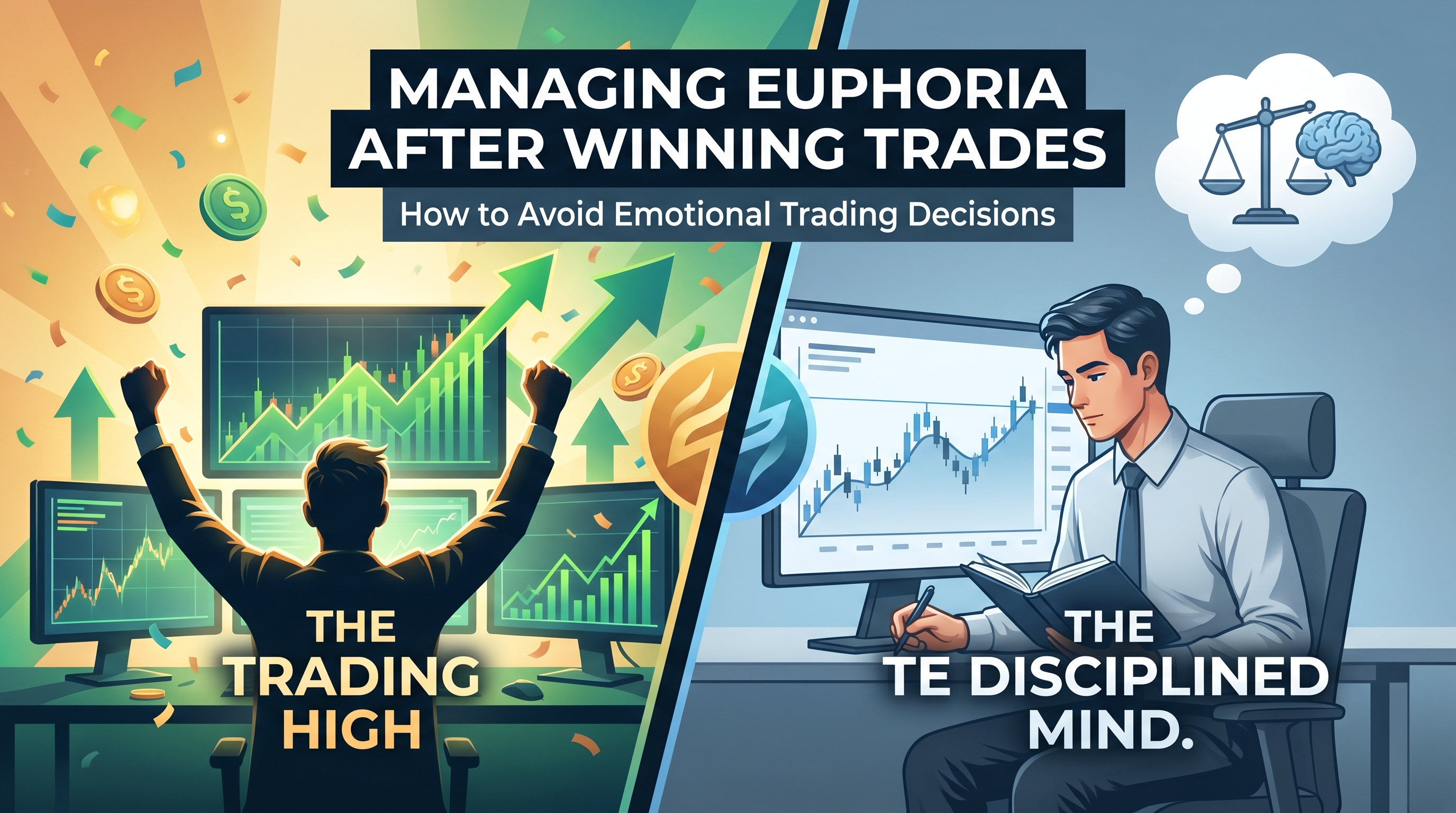
# Managing Euphoria After Winning Trade: How to Avoid Emotional Trading Decisions
Every trader has experienced it - that intoxicating rush after landing a significant winning trade. Your account balance jumps, your confidence soars, and suddenly you feel invincible. This powerful emotional state, known as trading euphoria, can be just as dangerous as the fear and panic that follows losses. In fact, some of the biggest trading disasters occur not after losses, but after major wins when traders become overconfident and abandon their proven strategies.
The euphoria after winning trade scenarios represents one of the most critical psychological challenges in trading. Understanding how to manage these emotions effectively separates consistently profitable traders from those who experience wild swings between success and failure. This guide will equip you with practical strategies to maintain emotional discipline and protect your capital when riding high on recent victories.
Table of Contents
- [Understanding Trading Euphoria and Its Dangers](#understanding-trading-euphoria-and-its-dangers)
- [The Psychology Behind Post-Win Overconfidence](#the-psychology-behind-post-win-overconfidence)
- [Recognizing Warning Signs of Emotional Trading](#recognizing-warning-signs-of-emotional-trading)
- [Practical Strategies to Control Post-Win Emotions](#practical-strategies-to-control-post-win-emotions)
- [Building Long-Term Emotional Discipline](#building-long-term-emotional-discipline)
- [Conclusion](#conclusion)
Understanding Trading Euphoria and Its Dangers
Trading euphoria is the intense emotional high that follows a successful trade, particularly one that generates substantial profits. This psychological state triggers a cascade of neurochemical reactions in the brain, releasing dopamine and creating feelings of invincibility and supreme confidence. While celebrating success is natural, unchecked euphoria can lead to devastating consequences for your trading account.
:::key-concept Trading Euphoria Definition: An intense emotional state characterized by overconfidence, reduced risk perception, and impaired decision-making following significant trading gains. :::
The dangers of post-win euphoria manifest in several destructive behaviors:
Increased Risk-Taking
Traders experiencing euphoria after winning trade situations often dramatically increase their position sizes, believing their "hot streak" will continue indefinitely. This leads to risking larger percentages of their account on subsequent trades, violating fundamental risk management principles.
Strategy Abandonment
Success can breed contempt for the very strategies that created the winning trade. Euphoric traders may abandon their tested methods, believing they've "outgrown" their systematic approach and can now rely purely on intuition.
Overtrading
The desire to capitalize on perceived momentum leads many traders to take excessive positions, often in markets or setups they wouldn't normally consider. This overactivity typically results in giving back profits and then some.
:::warning Critical Warning: Studies show that traders are more likely to make their largest losses immediately following their biggest wins due to euphoria-driven decision making. :::
Revenge of the Market
Markets have a way of humbling overconfident participants. The euphoria after winning trade experiences often sets traders up for significant drawdowns as they become disconnected from market reality and proper risk assessment.
:::example Real-World Scenario: A forex trader lands a 500-pip win on EUR/USD, turning their $10,000 account into $15,000 overnight. Feeling invincible, they immediately risk $7,500 (50% of their account) on the next trade, convinced their analysis is foolproof. The market moves against them, and they lose not just their profits but a significant portion of their original capital. :::
The Psychology Behind Post-Win Overconfidence
To effectively combat trading euphoria, we must understand the psychological mechanisms driving these dangerous behaviors. The human brain is wired to seek patterns and attribute success to skill rather than luck, even when randomness plays a significant role.
The Illusion of Control
Winning trades create an illusion that we have more control over market outcomes than we actually do. This cognitive bias, known as the illusion of control, makes traders believe they can predict and influence market movements with greater accuracy than reality allows.
Confirmation Bias Amplification
Success reinforces our existing beliefs about our trading abilities, causing us to seek information that confirms our perceived expertise while ignoring contradictory evidence. This selective perception becomes particularly pronounced during euphoria after winning trade periods.
Hot-Hand Fallacy
The hot-hand fallacy leads traders to believe that recent success increases the probability of continued success. In reality, each trade is an independent event, and past performance doesn't guarantee future results.
:::tip Psychological Insight: Recognition is the first step to control. By understanding these psychological biases, you can begin to recognize when they're influencing your decisions. :::
Dopamine and Reward Pathways
Winning trades trigger dopamine releases in the brain's reward centers, creating addictive-like behavior patterns. This neurochemical response can override rational decision-making processes, leading to impulsive and poorly calculated trades.
Social Validation Seeking
Big wins often lead traders to seek validation through social media sharing or trading community discussions. This external validation can further inflate ego and confidence levels, compounding the euphoria effect.
Recognizing Warning Signs of Emotional Trading
Awareness of euphoria symptoms is crucial for maintaining trading discipline. By recognizing these warning signs early, you can take corrective action before emotional trading destroys your profits.
Behavioral Warning Signs
Increased Position Sizing: You find yourself risking more than your predetermined risk percentage on trades, justifying it with recent success.
Shortened Analysis Time: You spend less time analyzing trades, believing your "hot streak" makes detailed analysis unnecessary.
Strategy Deviation: You begin taking trades outside your proven system, attracted to higher-risk, higher-reward opportunities.
Overconfident Language: Your trading journal or discussions reflect extreme confidence, using words like "guaranteed," "certain," or "can't lose."
:::warning Red Flag Alert: If you catch yourself thinking "I can't lose" or "I've figured out the market," you're likely experiencing dangerous levels of euphoria. :::
Physical and Emotional Indicators
Restlessness: Difficulty sitting still or focusing on non-trading activities.
Sleep Disruption: Excitement preventing normal sleep patterns or causing early wake-ups to check markets.
Impatience: Feeling frustrated when markets don't provide immediate trading opportunities.
Dismissive Attitude: Becoming dismissive of risk management principles or conservative trading advice.
Account-Related Warning Signs
Rapid Account Growth: While positive, extremely rapid account growth often indicates increased risk-taking that's unsustainable.
Decreased Documentation: Reducing the detail in your trading journal or skipping documentation altogether.
Risk Management Violations: Consistently exceeding your predetermined risk limits per trade.
:::example Self-Assessment Checklist: After each significant win, ask yourself: "Am I considering larger position sizes? Am I less thorough in my analysis? Do I feel like I can't lose?" Honest answers will help identify euphoria early. :::
Practical Strategies to Control Post-Win Emotions
Implementing structured approaches to manage euphoria after winning trade scenarios requires both preventive measures and reactive techniques. These strategies work best when implemented consistently, not just during emotional periods.
Pre-Trade Emotional Preparation
Set Clear Rules Before Success: Establish specific protocols for handling winning streaks before they occur. Write down your position sizing rules, maximum daily/weekly profits, and mandatory break triggers.
Predefined Profit Withdrawal: Decide in advance what percentage of profits you'll withdraw from your trading account after significant wins. This removes profits from temptation's reach.
Mandatory Cooling-Off Periods: Implement mandatory breaks after achieving predetermined profit targets. This could be taking the rest of the trading day off or even a complete trading break for 24-48 hours.
:::tip Professional Approach: Treat your trading like a professional athlete treats their training. Even at peak performance, rest and recovery periods are essential for long-term success. :::
In-the-Moment Control Techniques
The 24-Hour Rule: After any significant win, wait 24 hours before placing your next trade. Use this time for analysis and emotional regulation rather than immediate action.
Position Size Reduction: Automatically reduce your position size by 25-50% on the trade immediately following a significant win, regardless of setup quality.
Forced Journaling: Write a detailed trading journal entry immediately after wins, focusing on what could have gone wrong and what risks you took.
Reality Check Questions: Before each post-win trade, ask yourself:
- Am I risking more than my system allows?
- Would I take this trade if I had just experienced a loss?
- Am I following my proven strategy exactly?
Systematic Approaches
Profit Targets and Stops: Set specific account-level profit targets that trigger mandatory breaks or position size reductions. For example, after gaining 10% in a week, reduce position sizes by half for the following week.
Peer Accountability: Partner with another disciplined trader who can provide objective feedback when you're experiencing euphoria after winning trade situations.
Automated Controls: Use trading platforms' built-in controls to limit position sizes or daily losses, preventing emotional override of rational decisions.
:::key-concept The 3-2-1 Rule: After a significant win, take 3 deep breaths, wait 2 minutes before any trading decision, and ask yourself 1 critical question: "Is this trade part of my original plan?" :::
Recovery Strategies When Euphoria Strikes
Immediate Account Protection: If you recognize you're in a euphoric state, immediately reduce your maximum position size to 25-50% of normal until emotions stabilize.
Return to Basics: Refocus on fundamental analysis techniques and proven strategies rather than trying to capitalize on perceived "hot streaks."
Physical Reset Activities: Engage in physical exercise, meditation, or other activities that help reset your emotional state and provide perspective.
Building Long-Term Emotional Discipline
Sustainable trading success requires developing robust emotional control systems that function regardless of recent performance. This involves both mindset development and structural changes to your trading approach.
Developing Professional Mindset
Process Over Profits Focus: Shift your primary focus from profit generation to process execution. Measure success by how well you follow your system rather than just monetary gains.
Probability Thinking: Train yourself to think in terms of probabilities rather than certainties. Even the best setups have failure rates, and individual wins don't predict future performance.
Long-Term Perspective: Maintain focus on monthly and yearly performance rather than getting caught up in individual trade results.
:::example Mindset Shift Example: Instead of thinking "I made $5,000 today, I'm on fire!" train yourself to think "I executed my strategy well today and the market provided favorable conditions. I'll continue following my system regardless of results." :::
Structural Trading Improvements
Fixed Risk Per Trade: Establish and maintain consistent risk percentages per trade (typically 1-3% of account value) regardless of recent performance or confidence levels.
Position Sizing Algorithms: Use mathematical position sizing methods that automatically adjust for account size without emotional input.
Systematic Trade Selection: Develop clear, objective criteria for trade selection that don't change based on emotional states.
Continuous Education and Self-Improvement
Regular Psychology Study: Continuously educate yourself about trading psychology and cognitive biases. Understanding these concepts intellectually helps recognize them practically.
Performance Review Systems: Implement weekly and monthly reviews of your trading performance, focusing on process adherence rather than just profits.
Mentorship and Community: Engage with experienced traders who can provide perspective during both winning and losing periods.
:::tip Success Metric Redefinition: Redefine trading success as consistent execution of your proven strategy rather than short-term profit maximization. :::
Technology Integration
Trading Journal Software: Use advanced journaling tools that track emotional states alongside trade data, helping identify patterns in euphoria after winning trade scenarios.
Automated Alerts: Set up alerts that notify you when you're deviating from your trading plan parameters.
Performance Analytics: Use tools that provide objective analysis of your trading patterns, helping identify when emotions are influencing decisions.
Building Support Systems
Professional Networks: Develop relationships with other professional traders who understand the psychological challenges of trading.
Accountability Partners: Establish regular check-ins with trading partners who can provide objective feedback on your decision-making.
Professional Help: Consider working with trading psychologists or coaches, particularly if emotional control remains a persistent challenge.
Conclusion
Managing euphoria after winning trade experiences represents one of the most critical skills for long-term trading success. The intoxicating rush of significant profits can quickly transform into devastating losses when emotions override disciplined decision-making. By understanding the psychological mechanisms behind trading euphoria, recognizing early warning signs, and implementing structured control strategies, you can protect your capital and maintain consistent performance regardless of recent results.
Remember that successful trading is not about avoiding emotions entirely - that's impossible. Instead, it's about developing systems and practices that allow you to make rational decisions even when experiencing intense emotional states. The strategies outlined in this guide require practice and patience to implement effectively, but they form the foundation of professional-level trading discipline.
The journey from emotional trading to systematic success involves continuous self-improvement and honest self-assessment. Every euphoric moment presents an opportunity to strengthen your psychological resilience and refine your control systems. By treating these experiences as learning opportunities rather than validation of your trading prowess, you'll build the emotional intelligence necessary for sustainable profits.
Ready to master your trading emotions? Start by implementing one strategy from this guide after your next winning trade. Document your experience and gradually build a comprehensive emotional control system that works for your unique trading style. Remember, the most successful traders aren't those who never feel euphoria - they're those who have learned to trade successfully despite it.