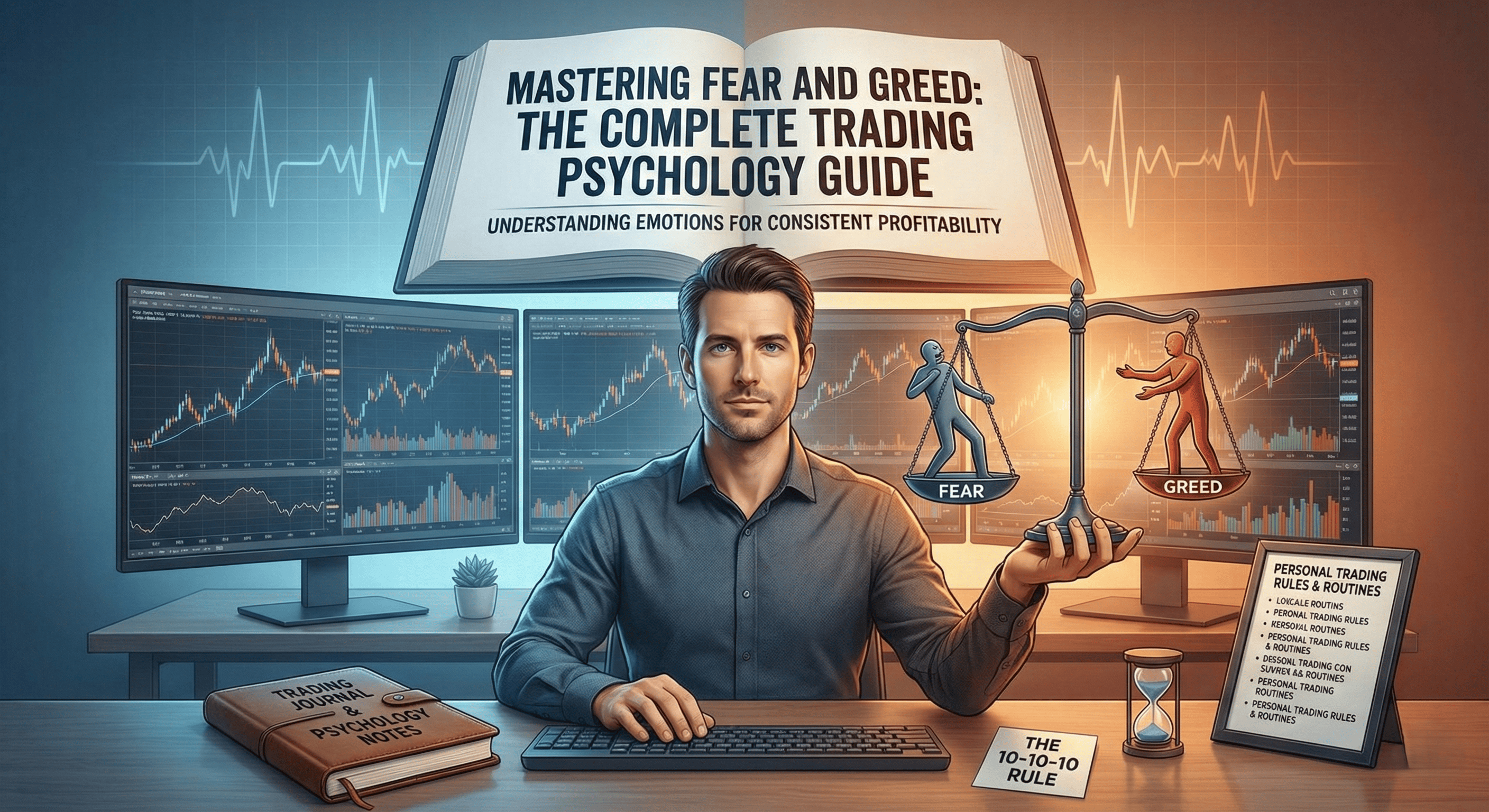
# Mastering Fear and Greed: The Complete Trading Psychology Guide
Trading success isn't just about technical analysis or fundamental research—it's largely about mastering your own mind. Fear and greed are the two primary emotions that drive market movements and can either make or break a trader's career. Understanding and controlling these powerful forces is essential for consistent profitability in any market.
Every successful trader has learned to recognize when emotions are influencing their decisions and has developed strategies to maintain objectivity. This guide will explore the psychology behind trading emotions, provide practical techniques for emotional control, and help you develop the mental discipline necessary for long-term trading success.
Table of Contents
- [Understanding Fear in Trading](#understanding-fear-in-trading)
- [The Psychology of Greed](#the-psychology-of-greed)
- [The Fear-Greed Cycle](#the-fear-greed-cycle)
- [Practical Techniques for Emotional Control](#practical-techniques-for-emotional-control)
- [Building Long-term Trading Discipline](#building-long-term-trading-discipline)
- [Conclusion](#conclusion)
Understanding Fear in Trading
Fear is perhaps the most destructive emotion in trading, manifesting in various forms that can paralyze decision-making or cause premature actions. The most common types of fear traders experience include fear of loss, fear of missing out (FOMO), and fear of being wrong.
Fear of Loss (Loss Aversion)
Loss aversion is a psychological principle where people feel the pain of losing money approximately twice as intensely as they feel the pleasure of gaining the same amount. In trading, this creates several problematic behaviors:
- Holding losing positions too long: Traders refuse to accept small losses, hoping the market will reverse
- Taking profits too early: Fear of giving back gains leads to premature exits on winning trades
- Avoiding necessary trades: Paralysis by analysis prevents taking valid setups
:::warning Loss aversion can cause traders to violate their risk management rules, turning small losses into account-destroying disasters. :::
Fear of Missing Out (FOMO)
FOMO drives traders to chase price movements, often entering positions at the worst possible times. This fear typically manifests when:
- Markets are making significant moves without you
- Other traders are sharing their winning trades on social media
- You see a setup that "looks perfect" but haven't done proper analysis
:::example A trader sees Bitcoin rallying 10% in one day and decides to buy at the peak out of FOMO, only to watch the price reverse and lose 15% the next day. The fear of missing further gains led to entering without a proper plan. :::
Fear of Being Wrong
This fear prevents traders from taking trades even when their analysis suggests a high-probability setup. It stems from:
- Past trading failures and losses
- Perfectionist tendencies
- Lack of confidence in trading system
- Social pressure and fear of judgment
:::key-concept Accepting that being wrong is part of trading is crucial. Even the best traders are wrong 40-60% of the time—their edge comes from risk management and position sizing, not accuracy. :::
The Psychology of Greed
While fear can prevent action, greed often drives reckless behavior that can quickly destroy trading accounts. Greed manifests in several dangerous ways that every trader must recognize and control.
Overtrading and Position Sizing
Greed often leads traders to:
- Trade with position sizes that are too large for their account
- Take multiple trades simultaneously without proper risk assessment
- Trade more frequently than their system dictates
- Chase every potential opportunity regardless of quality
The "Get Rich Quick" Mentality
This mindset creates unrealistic expectations and leads to:
- Risk levels that far exceed appropriate limits
- Abandoning proven strategies for "hot tips"
- Focusing on potential profits rather than potential losses
- Impatience with steady, consistent growth
:::warning Greed-driven trading often results in the "boom and bust" cycle where traders make significant gains quickly, only to lose everything even faster. :::
Profit Target Abandonment
When trades move in their favor, greedy traders often:
- Move profit targets further away from current price
- Remove stop losses to "let profits run" without proper justification
- Add to winning positions without considering increased risk
- Ignore exit signals from their trading system
:::example A swing trader has a profit target at $50 on a stock currently trading at $48. Seeing the strong momentum, they move their target to $55, then $60. The stock reverses at $49, turning a winning trade into a loss due to greed. :::
The Fear-Greed Cycle
Understanding how fear and greed create cyclical behavior patterns is crucial for breaking free from emotional trading. This cycle typically follows predictable stages:
Stage 1: Optimism (Greed Building)
- Markets are trending upward
- Recent trades have been profitable
- Confidence is high, risk tolerance increases
- Position sizes may start growing
Stage 2: Euphoria (Peak Greed)
- Markets reach new highs
- Everyone seems to be making money
- FOMO drives maximum risk-taking
- Rational analysis is abandoned
Stage 3: Anxiety (Greed to Fear Transition)
- First signs of market weakness appear
- Profits begin evaporating
- Uncertainty increases but hope remains
- Denial about changing market conditions
Stage 4: Panic (Peak Fear)
- Markets are falling rapidly
- Losses are mounting
- Emotional selling at worst possible prices
- Complete abandonment of trading plan
Stage 5: Despair (Extreme Fear)
- Markets have bottomed
- Account may be severely damaged
- Complete loss of confidence
- Avoidance of trading opportunities
:::key-concept The most successful traders learn to recognize these cycle stages and trade counter to the prevailing emotion—buying when others are fearful and being cautious when others are greedy. :::
Practical Techniques for Emotional Control
Developing emotional control requires consistent practice and implementation of proven techniques. Here are the most effective methods for managing trading psychology:
Pre-Market Preparation
Starting each trading session with proper mental preparation helps establish emotional discipline:
1. Review your trading plan: Remind yourself of your rules and objectives 2. Set daily risk limits: Decide maximum loss you're willing to accept 3. Identify key levels: Mark important support, resistance, and entry points 4. Visualize scenarios: Mental rehearsal of both winning and losing trades
The Trading Journal Approach
Maintaining a detailed trading journal that includes emotional states helps identify patterns:
- Pre-trade emotions: How did you feel before entering?
- During-trade emotions: What emotions arose while in the position?
- Post-trade analysis: How did emotions affect the outcome?
- Lesson identification: What can be learned for future trades?
:::tip Rate your emotional state on a scale of 1-10 for each trade. Over time, you'll see correlations between emotional states and trading performance. :::
The 10-10-10 Rule
Before making any trading decision, ask yourself:
- How will I feel about this decision in 10 minutes?
- How will I feel about this decision in 10 hours?
- How will I feel about this decision in 10 days?
This technique helps you step back from immediate emotional reactions and consider longer-term consequences.
Position Sizing for Emotional Control
Using appropriate position sizes based on your emotional comfort level:
1. Start small: Use smaller position sizes until emotional control is mastered 2. The "sleep test": If a position keeps you awake at night, it's too large 3. Scale up gradually: Increase size only after demonstrating consistent emotional discipline 4. Risk percentage rule: Never risk more than 1-2% of your account on any single trade
Breathing and Mindfulness Techniques
Physical techniques can help manage emotional responses in real-time:
- Box breathing: 4 counts in, hold 4, out 4, hold 4
- 5-minute meditation: Clear your mind before trading sessions
- Body scan: Check for physical tension that indicates emotional stress
- Grounding exercises: Focus on present moment awareness
:::example When you feel the urge to chase a breakout or revenge trade after a loss, take five deep breaths and ask: "Is this trade part of my plan, or am I acting on emotion?" :::
Building Long-term Trading Discipline
Developing lasting emotional discipline requires systematic approaches and consistent practice over time.
Creating Accountability Systems
1. Trading buddy system: Partner with another trader for honest feedback 2. Mentor relationships: Learn from experienced traders who've mastered psychology 3. Regular self-assessments: Weekly reviews of emotional trading patterns 4. Professional support: Consider trading psychology coaching when needed
Developing Personal Trading Rules
Create specific rules that address your emotional weaknesses:
- Maximum daily loss rule: Stop trading after losing predetermined amount
- Consecutive loss rule: Take a break after 3 consecutive losing trades
- Profit protection rule: Move stops to breakeven after specific profit target
- FOMO prevention rule: Wait for proper setup confirmation, no exceptions
The Importance of Routine
Establishing consistent daily routines helps maintain emotional stability:
Morning routine:
- Review market conditions and news
- Check economic calendar for important events
- Identify potential trade setups
- Set daily goals and risk limits
Trading session routine:
- Follow predetermined entry and exit criteria
- Update trading journal in real-time
- Take regular breaks to assess emotional state
- Stick to position sizing rules
End-of-day routine:
- Review all trades and decisions
- Analyze emotional responses
- Plan for next trading session
- Celebrate discipline, not just profits
Continuous Education and Improvement
Never stop learning about trading psychology:
- Read books on behavioral finance and trading psychology
- Study cognitive biases and how they affect decision-making
- Practice meditation and stress management techniques
- Analyze the psychology behind market movements
:::key-concept Trading discipline is like physical fitness—it requires consistent practice and maintenance. You can't achieve it once and expect it to last forever. :::
Managing Drawdowns and Losing Streaks
How you handle inevitable losing periods determines long-term success:
1. Accept drawdowns as normal: They're part of every successful trader's journey 2. Reduce position sizes during rough patches: Preserve capital for recovery 3. Focus on process, not outcomes: Good decisions sometimes lead to losses 4. Take breaks when needed: Sometimes stepping away is the best strategy
The Role of Patience in Trading Success
Patience is perhaps the most undervalued trait in trading:
- Wait for high-quality setups: Don't force trades when conditions aren't ideal
- Allow time for analysis: Rushed decisions are usually emotional decisions
- Let profits develop: Don't exit winning trades prematurely
- Accept slow, steady growth: Sustainable profits compound over time
:::tip Some of the best trades happen when you're doing nothing—waiting patiently for the perfect setup while others are acting on emotion. :::
Conclusion
Mastering fear and greed is not a destination but an ongoing journey that requires constant vigilance and practice. Every trader, regardless of experience level, continues to battle these emotions throughout their career. The difference between successful and unsuccessful traders lies not in the absence of these emotions, but in their ability to recognize and control them.
The techniques outlined in this guide—from pre-market preparation and journaling to breathing exercises and accountability systems—provide a comprehensive framework for developing emotional discipline. However, knowledge alone isn't enough. You must consistently apply these principles, especially when you least want to.
Remember that trading psychology is deeply personal. What works for one trader may not work for another. Experiment with different techniques, adapt them to your personality and trading style, and be patient with yourself as you develop these crucial skills.
The market will always present opportunities, but your ability to capitalize on them depends largely on your emotional state and discipline. By mastering fear and greed, you'll not only improve your trading performance but also enjoy the process more and experience less stress.
Start implementing these psychological principles today. Begin with a trading journal, establish clear rules for your emotional triggers, and practice the breathing techniques during your next trading session. Your future self—and your trading account—will thank you for the investment in psychological development.