# Pre-Market Trading: What You Need to Know to Trade Before the Bell
Pre-market trading represents one of the most dynamic and potentially profitable periods in financial markets, yet it remains largely misunderstood by many traders. This extended trading session, which occurs before regular market hours, offers unique opportunities for those who understand its mechanics and respect its challenges.
Whether you're looking to react to overnight news, position yourself for the opening bell, or simply expand your trading opportunities, pre-market sessions can be a valuable addition to your trading arsenal. However, success in pre-market trading requires a different approach than regular hours trading, with its own set of rules, risks, and rewards.
Table of Contents
- [What is Pre-Market Trading?](#what-is-pre-market-trading)
- [Pre-Market Trading Hours and Sessions](#pre-market-trading-hours-and-sessions)
- [Benefits and Opportunities](#benefits-and-opportunities)
- [Risks and Challenges](#risks-and-challenges)
- [Pre-Market Trading Strategies](#pre-market-trading-strategies)
- [Technical Analysis for Pre-Market](#technical-analysis-for-pre-market)
- [Getting Started with Pre-Market Trading](#getting-started-with-pre-market-trading)
- [Conclusion](#conclusion)
What is Pre-Market Trading?
Pre-market trading refers to the buying and selling of securities before the regular trading session begins. This extended trading period allows investors and traders to react to news events, earnings announcements, and other market-moving information that occurs outside of normal market hours.
:::key-concept Pre-Market Definition: Trading activity that occurs before the official market opening, typically characterized by lower volume, wider spreads, and higher volatility than regular trading hours. :::
Unlike regular trading hours where all market participants can trade simultaneously, pre-market trading is limited to electronic communication networks (ECNs) and involves primarily institutional investors, active traders, and retail traders with access to extended-hours trading platforms.
How Pre-Market Trading Works
Pre-market trading operates through electronic networks that match buy and sell orders without the need for traditional market makers. These systems include:
- Electronic Communication Networks (ECNs): Automated systems that match orders between buyers and sellers
- Alternative Trading Systems (ATS): Private exchanges that facilitate trading outside traditional exchanges
- Institutional Networks: Private trading platforms used by large financial institutions
:::example Real Trading Scenario: A pharmaceutical company announces positive clinical trial results at 6:00 AM, two hours before market open. Pre-market traders can immediately react to this news, with the stock potentially moving 20-30% before regular hours begin. By the time regular markets open, much of the initial reaction may already be priced in. :::
Pre-Market Trading Hours and Sessions
Understanding when pre-market trading occurs is crucial for planning your trading activities. Different markets and brokers offer varying pre-market hours, and these sessions often have distinct characteristics.
Standard Pre-Market Hours
U.S. Stock Markets:
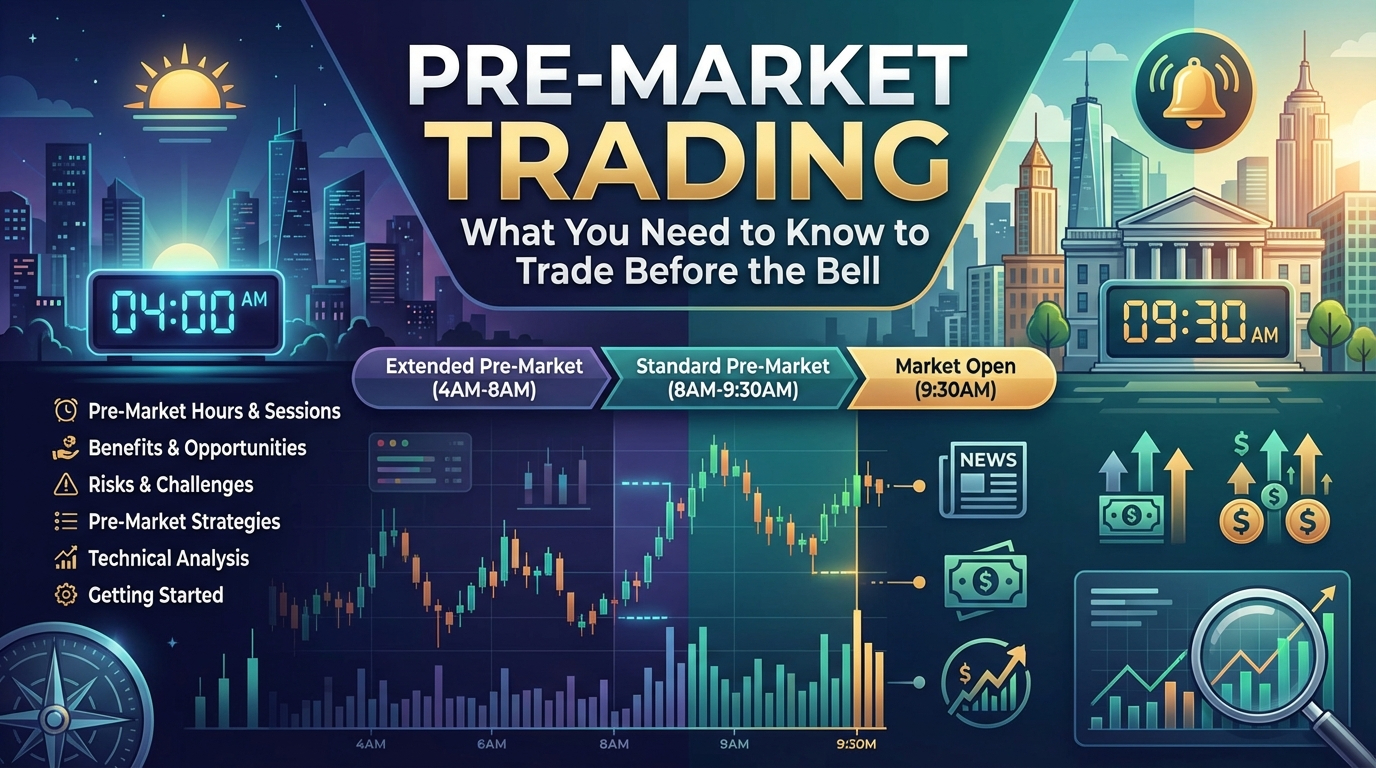
- Extended Pre-Market: 4:00 AM - 9:30 AM ET (varies by broker)
- Standard Pre-Market: 8:00 AM - 9:30 AM ET (most common)
- Late Pre-Market: 9:00 AM - 9:30 AM ET (final preparation period)
International Markets:
- European markets typically open during U.S. pre-market hours
- Asian markets close during U.S. pre-market sessions
- Currency markets operate 24 hours with varying liquidity levels
Session Characteristics by Time Period
4:00 AM - 6:00 AM ET:
- Extremely low volume
- Wide bid-ask spreads
- Primarily institutional activity
- Reaction to overnight international news
6:00 AM - 8:00 AM ET:
- Increased volume from earnings announcements
- Economic data releases begin
- More retail participation
- Price discovery for major news events
8:00 AM - 9:30 AM ET:
- Highest pre-market volume
- Tightest spreads
- Active price discovery
- Final positioning before market open
:::tip Trading Tip: The most liquid and tradeable pre-market period typically occurs between 8:00 AM and 9:30 AM ET. This window offers the best balance of volume, spread tightness, and price reliability. :::
Benefits and Opportunities
Pre-market trading offers several distinct advantages that can enhance your trading strategy and provide unique profit opportunities.
Immediate News Reaction
One of the primary benefits of pre-market trading is the ability to react immediately to market-moving news:
- Earnings Announcements: Many companies report earnings before market open
- Economic Data: Key economic indicators are often released at 8:30 AM ET
- Geopolitical Events: Overnight developments can be traded immediately
- FDA Approvals: Healthcare stocks often move significantly on regulatory news
Strategic Positioning
Pre-market sessions allow traders to position themselves advantageously:
- Gap Anticipation: Position for expected price gaps at market open
- Momentum Building: Establish positions in trending stocks early
- Risk Management: Exit positions before potential negative news impact
:::example Gap Trading Strategy: A stock closes at $50 and reports strong earnings at 6:00 AM, opening pre-market at $55. Traders can either ride the momentum higher or position for a gap-fill back toward $50, depending on volume and market sentiment. :::
Extended Trading Opportunities
For traders with limited availability during regular hours, pre-market trading provides:
- Time Zone Advantages: European traders can participate in U.S. markets
- Work Schedule Flexibility: Trade before the regular workday begins
- Additional Trading Hours: Expand profit opportunities beyond standard sessions
Reduced Competition
With fewer participants, pre-market trading can offer:
- Less algorithmic trading interference
- Clearer technical patterns
- More predictable price movements
- Opportunities for informed traders
Risks and Challenges
While pre-market trading offers opportunities, it also presents unique risks that traders must understand and manage effectively.
Liquidity Concerns
The most significant challenge in pre-market trading is reduced liquidity:
- Lower Volume: Significantly fewer shares change hands
- Wide Spreads: Bid-ask spreads can be 2-5 times wider than regular hours
- Price Gaps: Prices may jump significantly between trades
- Execution Difficulty: Large orders may move prices substantially
:::warning Risk Alert: A stock that normally has a $0.01 bid-ask spread during regular hours might have a $0.10 or wider spread in pre-market trading. This increased cost can significantly impact profitability, especially for short-term trades. :::
Increased Volatility
Pre-market sessions often exhibit higher volatility due to:
- News Reactions: Immediate and often overblown responses to information
- Thin Trading: Small orders can cause large price movements
- Emotional Trading: Less rational decision-making with limited information
- Institutional Activity: Large orders from professional traders
Limited Order Types
Many brokers restrict order types during pre-market hours:
- No Market Orders: Only limit orders may be accepted
- No Stop Orders: Stop-loss orders typically don't function
- No Complex Orders: Multi-leg strategies may be unavailable
- Shorter Order Duration: Orders may expire at market open
Information Gaps
Pre-market traders often operate with incomplete information:
- Limited Analysis: Fewer research reports and analyst updates
- Incomplete News: Full details of breaking news may not be available
- Reduced Market Makers: Fewer professionals providing price discovery
- Technical Analysis Limitations: Lower volume can distort indicators
:::tip Risk Management: Never risk more than 1-2% of your account on pre-market trades, and always use limit orders to control your entry and exit prices. The increased volatility and reduced liquidity can quickly turn small losses into significant ones. :::
Pre-Market Trading Strategies
Successful pre-market trading requires specific strategies adapted to the unique characteristics of extended trading hours.
News-Based Trading
This strategy focuses on immediate reactions to market-moving news:
Setup Process: 1. News Monitoring: Use financial news feeds and earnings calendars 2. Stock Selection: Focus on stocks with scheduled announcements 3. Pre-Analysis: Prepare potential trade scenarios before news hits 4. Quick Execution: React swiftly to news developments
Execution Guidelines:
- Use limit orders only
- Set tight stop-losses
- Take profits quickly
- Monitor volume carefully
Gap Trading Strategy
Gap trading capitalizes on price differences between closing and opening prices:
Gap Up Strategy:
- Continuation Play: Buy gaps up with strong volume and news support
- Fade Play: Short gaps up that appear unsustainable
Gap Down Strategy:
- Bounce Play: Buy oversold gaps down with strong fundamentals
- Breakdown Play: Short gaps down with negative catalysts
:::example Gap Trading Example: Stock XYZ closes at $40 and opens pre-market at $44 on earnings news. A gap trader might buy at $44.20 expecting continuation to $46, with a stop-loss at $43.50. Alternatively, they might short at $43.80 expecting a gap-fill back to $40. :::
Momentum Scalping
This high-frequency strategy captures small profits from price movements:
Requirements:
- Direct market access (DMA)
- Low-latency trading platform
- Strong risk management skills
- Ability to read Level II data
Technique: 1. Identify stocks with strong pre-market volume 2. Look for clear directional momentum 3. Enter positions in the direction of momentum 4. Exit quickly for small profits (0.1-0.3%) 5. Use strict stop-losses (0.15-0.25%)
Economic Data Trading
Trade market reactions to scheduled economic releases:
Key Release Times:
- 8:30 AM ET: Most major U.S. economic data
- 10:00 AM ET: Secondary economic indicators
- 2:00 PM ET: Federal Reserve announcements
Strategy Components: 1. Preparation: Know the schedule and market expectations 2. Positioning: Set up trades before the release 3. Execution: React quickly to data surprises 4. Management: Close positions quickly as initial reactions fade
Technical Analysis for Pre-Market
Technical analysis in pre-market trading requires adjustments for lower volume and different market dynamics.
Volume Analysis
Volume is even more critical in pre-market trading:
- Relative Volume: Compare pre-market volume to historical averages
- Volume Spikes: Identify significant increases that may signal major moves
- Volume Confirmation: Ensure price movements are supported by adequate volume
:::key-concept Volume Rule: A pre-market move without significant volume is more likely to reverse once regular trading begins. Look for at least 10-20% of average daily volume in pre-market for reliable signals. :::
Support and Resistance
Key levels remain important but require different interpretation:
- Previous Day's Levels: High, low, and close are critical reference points
- Extended Hours Levels: Pre-market and after-hours levels create new support/resistance
- Round Numbers: Psychological levels become more significant in thin trading
- Volume Profile: Areas of high volume concentration from previous sessions
Indicator Adjustments
Standard indicators need modification for pre-market conditions:
Moving Averages:
- Use shorter periods (5, 10, 20) for quicker responses
- Focus on price position relative to key averages
- Watch for decisive breaks above or below
RSI and Oscillators:
- Expect more extreme readings
- Use wider overbought/oversold levels (80/20 instead of 70/30)
- Look for divergences with price action
VWAP (Volume Weighted Average Price):
- Calculate from pre-market open, not previous close
- Use as dynamic support/resistance level
- Monitor for institutional positioning
Chart Pattern Recognition
Certain patterns work better in pre-market conditions:
Effective Patterns:
- Breakouts from overnight ranges
- Flag and pennant continuations
- Simple support/resistance bounces
Less Reliable Patterns:
- Complex formations requiring high volume
- Patterns dependent on multiple time frames
- Reversal patterns without volume confirmation
Getting Started with Pre-Market Trading
Entering pre-market trading requires proper preparation, tools, and mindset.
Broker Selection
Not all brokers offer pre-market trading, and terms vary significantly:
Key Features to Look For:
- Extended trading hours (preferably from 4:00 AM)
- Competitive pre-market commissions
- Level II market data access
- Reliable platform during high-volatility periods
- Multiple order types (at minimum, limit orders)
Questions to Ask Your Broker:
- What are the exact pre-market trading hours?
- Are there additional fees for extended-hours trading?
- What order types are available?
- Is real-time data included?
- Are there minimum account requirements?
Technology Requirements
Successful pre-market trading demands robust technology:
Essential Tools:
- High-speed internet connection
- Professional trading platform
- Real-time news feeds
- Level II market data
- Backup systems for connectivity issues
Recommended Setup:
- Multiple monitors for news, charts, and order management
- Direct market access (DMA) platform
- Mobile trading app for backup
- Uninterruptible power supply (UPS)
Education and Preparation
Before risking capital in pre-market trading:
Study Phase: 1. Paper trade for at least one month 2. Focus on 3-5 stocks you know well 3. Track your hypothetical performance 4. Analyze your decision-making process 5. Refine your strategies based on results
Knowledge Requirements:
- Understanding of extended-hours rules
- News interpretation skills
- Risk management techniques
- Order type functionality
- Market structure basics
:::tip Start Small: Begin with small position sizes (10-25% of your normal trade size) until you develop comfort and proficiency with pre-market conditions. The learning curve is steep, and early mistakes can be costly. :::
Risk Management Framework
Develop strict risk management rules for pre-market trading:
Position Sizing:
- Reduce normal position sizes by 50-75%
- Never risk more than 1% per trade
- Limit total pre-market exposure to 5% of portfolio
Stop-Loss Strategy:
- Use mental stops (since stop orders may not work)
- Set maximum loss per trade before entering
- Be prepared to exit manually if needed
- Don't average down in pre-market conditions
Time Management:
- Set specific hours for pre-market activity
- Don't trade if you're rushed or distracted
- Allow time for proper preparation
- Have exit strategies planned in advance
Building Your Trading Plan
Create a specific plan for pre-market activities:
Daily Preparation Routine: 1. 6:00 AM: Check overnight news and Asian market close 2. 6:30 AM: Review earnings announcements and economic calendar 3. 7:00 AM: Analyze key stocks and set up watchlists 4. 7:30 AM: Review trading plan and position sizing 5. 8:00 AM: Begin active monitoring and trading
Trade Evaluation Process:
- Journal every pre-market trade
- Analyze what worked and what didn't
- Track profitability by strategy type
- Adjust rules based on performance data
Conclusion
Pre-market trading represents a powerful tool for experienced traders who understand its unique characteristics and respect its inherent risks. While the extended trading sessions offer opportunities to react quickly to news, capture gaps, and position for the regular trading day, they also present challenges in the form of reduced liquidity, wider spreads, and increased volatility.
Success in pre-market trading requires a different skill set than regular-hours trading. You must be comfortable making quick decisions with limited information, managing wider spreads and lower liquidity, and adapting your technical analysis to different market conditions. The strategies that work best—news-based trading, gap trading, and momentum scalping—all require quick execution, strict risk management, and the ability to take profits rapidly.
The key to profitable pre-market trading lies in preparation, discipline, and realistic expectations. Start with paper trading to understand the dynamics, invest in proper technology and data feeds, and develop specific strategies adapted to extended-hours conditions. Always use appropriate position sizing and risk management, as the increased volatility can quickly amplify both gains and losses.
Remember that pre-market trading is not suitable for all traders or all market conditions. It requires active participation, quick decision-making, and the ability to monitor markets during early morning hours. However, for those who master its intricacies, pre-market trading can provide valuable additional opportunities and enhance overall trading performance.
Ready to explore pre-market opportunities? Start by paper trading different strategies during extended hours, focusing on building your skills in news interpretation, quick execution, and risk management. Practice with small positions until you develop the confidence and expertise needed to succeed in this challenging but potentially rewarding trading environment.