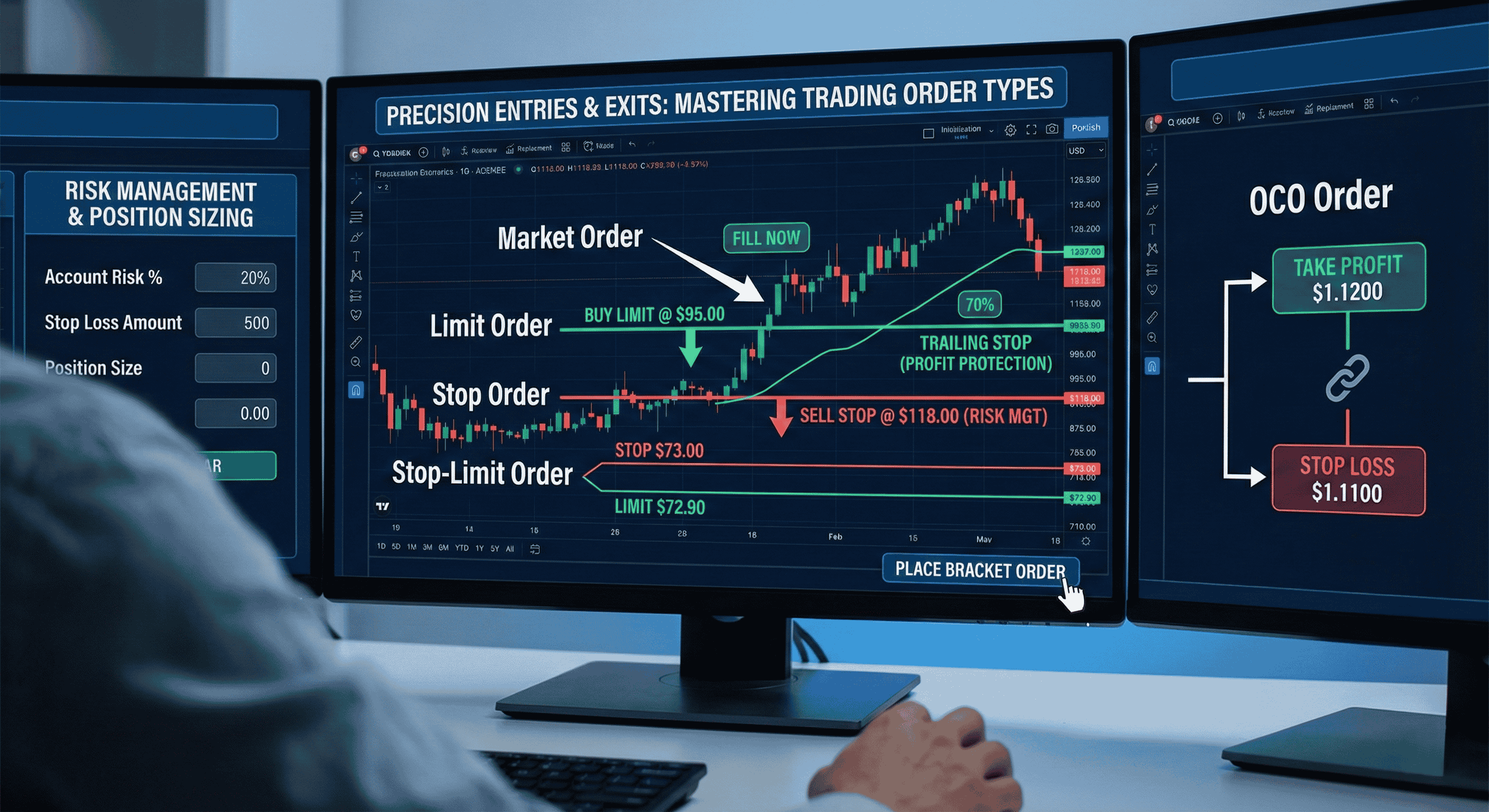
# Precision Entries & Exits: Mastering Trading Order Types
In the fast-paced world of trading, even the most brilliant analysis can fail without precise execution. Understanding and effectively utilizing different order types is not just a technicality; it's a cornerstone of professional trading. It dictates how efficiently you enter and exit trades, how well you manage risk, and ultimately, your profitability.
This guide will demystify the essential order types – from the basics to more advanced strategies – equipping you with the knowledge to execute your trading plan with surgical precision. We'll explore how each order type functions, its pros and cons, and when to deploy them effectively in various market conditions.
By the end of this guide, you'll be able to confidently navigate your brokerage platform, choose the right order for every situation, and move closer to executing your trades like a seasoned professional.
Table of Contents
- [The Foundation: Understanding Basic Order Types](#the-foundation-understanding-basic-order-types)
- [Market Orders](#market-orders)
- [Limit Orders](#limit-orders)
- [Stop Orders (Stop Loss)](#stop-orders-stop-loss)
- [Advanced Order Types for Strategic Execution](#advanced-order-types-for-strategic-execution)
- [Stop-Limit Orders](#stop-limit-orders)
- [Trailing Stop Orders](#trailing-stop-orders)
- [OCO (One Cancels the Other) Orders](#oco-one-cancels-the-other-orders)
- [Bracket Orders](#bracket-orders)
- [Choosing the Right Order Type for Your Strategy](#choosing-the-right-order-type-for-your-strategy)
- [Entry Strategies](#entry-strategies)
- [Exit Strategies](#exit-strategies)
- [Risk Management & Position Sizing](#risk-management-position-sizing)
- [Best Practices for Order Execution](#best-practices-for-order-execution)
The Foundation: Understanding Basic Order Types
At the core of all trade execution are three fundamental order types: market, limit, and stop orders. Mastering these is crucial before moving on to more complex strategies.
Market Orders
A market order is an instruction to buy or sell an asset immediately at the best available current price. It guarantees execution but not a specific price.
:::key-concept A market order prioritizes speed and certainty of execution over price precision. :::
Pros:
- Guaranteed Execution: Your order will almost certainly be filled, assuming there's sufficient liquidity.
- Simplicity: Easiest order type to place, suitable for urgent entries or exits.
Cons:
- Price Slippage: The executed price might be different (worse) than the displayed price when you placed the order, especially in volatile or thinly traded markets. This difference is known as slippage.
- Lack of Control: You accept whatever price is available, which might not be ideal.
:::example You analyze a stock breaking out and decide to enter immediately. You place a market buy order for 100 shares. If the price displayed was $50.00, but during the milliseconds it took for your order to reach the exchange, the price moved to $50.05, your order would be filled at $50.05 (or an average price if multiple offers were taken). :::
Limit Orders
A limit order is an instruction to buy or sell an asset at a specific price or better. A buy limit order can only be executed at the limit price or lower, while a sell limit order can only be executed at the limit price or higher.
:::key-concept A limit order prioritizes price precision over certainty of execution. :::
Pros:
- Price Control: You dictate the exact (or better) price at which you are willing to trade.
- Avoid Slippage: Protects you from adverse price movements upon execution.
- Passive Trading: Often used by traders who want to enter at a specific level without chasing the market.
Cons:
- No Guarantee of Execution: The market might never reach your specified limit price, or it might touch it briefly without your order getting filled due to lack of liquidity at that exact moment.
- Missed Opportunities: If the market rallies or drops significantly without touching your limit price, you might miss the trade entirely.
:::example You want to buy Stock XYZ if it pulls back to a specific support level at $95.00. You place a buy limit order at $95.00 for 50 shares. If the stock trades at $95.00 or lower, your order will be executed. If it only dips to $95.01 and then rallies, your order will not be filled. :::
Stop Orders (Stop Loss)
A stop order (most commonly used as a stop-loss order) is an instruction to buy or sell an asset once a specified "stop price" is reached or passed. Once the stop price is triggered, the stop order becomes a market order and is executed at the best available price.
:::key-concept Stop orders are primarily used for risk management, limiting potential losses on an open position or initiating a new position once a certain momentum threshold is met. :::
Pros:
- Risk Management: Essential for defining your maximum acceptable loss on a trade.
- Automated Protection: Works even when you're not actively monitoring the market.
- Breakout Entries: Can be used to enter a trade when a key price level is breached.
Cons:
- Slippage Risk: Since a stop order converts to a market order upon trigger, it is susceptible to slippage, especially in volatile markets or during news events. You might be filled at a worse price than your stop price.
- "Stop Hunting": In thinly traded markets, large players might intentionally drive prices to trigger stop losses, only for the price to reverse shortly after.
:::example You are long 200 shares of Stock ABC at $120.00. To limit your potential loss, you place a sell stop order at $118.00. If the price drops to $118.00 or below, your stop order converts to a market order and sells your 200 shares at the best available price, protecting you from further downside. :::
Advanced Order Types for Strategic Execution
Beyond the basics, several advanced order types offer more sophisticated control over your trade execution, allowing for greater automation and tailored strategies.
Stop-Limit Orders
A stop-limit order combines features of both stop and limit orders. It has two price points: a stop price and a limit price. Once the stop price is triggered, the order converts to a limit order rather than a market order.
Pros:
- Price Protection (Post-Trigger): Reduces slippage risk compared to a pure stop order by ensuring execution only occurs at your specified limit price or better.
- More Control: Ideal for managing risk in volatile markets where slippage on a market order could be significant.
Cons:
- No Execution Guarantee: If the market moves rapidly past your limit price after the stop is triggered, your limit order might not be filled, leaving you in the trade or missing an entry.
- Complexity: Requires setting two price points, which can be confusing for beginners.
:::example You are long Stock DEF at $75.00 and want to limit your loss. You place a sell stop-limit order with a stop price of $73.00 and a limit price of $72.90. If the price drops to $73.00, your order becomes a limit order to sell at $72.90 or higher. If the market immediately gaps down to $72.50, your order might not be filled. :::
Trailing Stop Orders
A trailing stop order is a dynamic stop-loss order that automatically adjusts as the price of an asset moves in your favor. It typically trails the market price by a fixed percentage or absolute amount.
Pros:
- Profit Protection: Locks in profits as a trade moves favorably, allowing you to stay in a winning trade longer.
- Risk Management: Still limits downside risk, but intelligently adjusts to market conditions.
- Automation: Reduces the need for constant monitoring and manual adjustment of stop losses.
Cons:
- Premature Exit: In volatile markets with normal price fluctuations, a trailing stop can be triggered too early, forcing you out of a trade before a larger move unfolds.
- Parameter Setting: Choosing the right trailing amount (percentage or points) can be challenging and is crucial for effectiveness.
:::example You buy Stock GHI at $100.00 and place a trailing stop order 2% below the highest price reached. If the stock immediately drops to $98.00, your stop is triggered. If the stock rises to $105.00, your stop automatically moves up to $102.90 (2% below $105.00). If it then corrects to $102.50, your stop remains at $102.90. If it then rises to $110.00, your stop adjusts to $107.80, effectively locking in profit. :::
OCO (One Cancels the Other) Orders
An OCO order links two orders together such that if one order is executed, the other is automatically canceled. This is commonly used to place a profit target and a stop-loss simultaneously.
Pros:
- Automated Trade Management: Allows you to set both your desired exit for profit and your maximum acceptable loss at the same time.
- Efficiency: Reduces the need for manual intervention and helps prevent costly errors.
- Ideal for Trade Plans: Perfect for implementing a pre-defined risk-reward strategy.
Cons:
- Not universally available: Some smaller brokers might not offer OCO orders.
- Broker-specific nuances: The exact implementation can vary slightly between brokers.
:::example You enter a long trade on Forex pair EUR/USD. You expect it to reach 1.1200, and your maximum risk is down to 1.1100. You place an OCO order consisting of a sell limit order at 1.1200 (your take-profit) and a sell stop order at 1.1100 (your stop-loss). If EUR/USD hits 1.1200, your profit target is filled, and the sell stop order at 1.1100 is automatically canceled. Conversely, if it drops to 1.1100, your stop-loss is triggered, and the profit target is canceled. :::
Bracket Orders
Bracket orders are an advanced variation of OCO orders that are often placed simultaneously with an initial entry order. They "bracket" an open position with both a stop-loss order and a take-profit order, becoming active once the primary entry order is filled.
:::tip Bracket orders are excellent for traders who want to pre-define their entire trade management strategy from the moment they enter a position. :::
Pros:
- Comprehensive Risk Management: Ensures every new position is immediately protected by a stop-loss and has a profit target.
- Discipline: Enforces a systematic approach to trade management, reducing emotional decisions.
- Hands-off Management: Once the entry is filled, the rest of the trade management is automated.
Cons:
- May not be available for all asset classes or brokers.
- Requires precise planning: The stop and profit target need to be well-defined before entry.
:::example You want to day trade a futures contract. You place a buy limit order to enter at a specific price. Attached to this entry order is a bracket: a sell stop order 5 points below your entry (for stop-loss) and a sell limit order 10 points above your entry (for take-profit). As soon as your buy limit order is filled, the sell stop and sell limit orders become active, automatically managing your risk and potential profit. :::
Choosing the Right Order Type for Your Strategy
The most effective order type depends heavily on your trading strategy, market conditions, and personal preferences regarding risk and execution certainty.
Entry Strategies
- Aggressive Entry (Chasing Momentum): Use market orders when you absolutely must enter a trade immediately, acknowledging potential slippage. Often used for news-driven breakouts or when confirmation is paramount.
- Patient Entry (Pullbacks/Support): Use limit orders to patiently wait for price to come to you at desired support or resistance levels. This optimizes your entry price, but risks missing the trade.
- Breakout Entry (Confirmation): Use stop orders (specifically a buy stop for long breakouts or a sell stop for short breakdowns) to enter trades only once a key level has been decisively breached, confirming momentum. For better price control post-trigger, consider a stop-limit order for breakouts.
:::tip Always consider the market's liquidity. In illiquid markets, market orders carry significant slippage risk. Limit orders are often safer, though they might not fill. :::
Exit Strategies
- Exiting Losing Trades (Risk Management): Always use stop orders (standard stop-loss or trailing stop) to define your maximum acceptable loss. For volatile markets where slippage is a concern, a stop-limit order can provide better price control, though with the risk of not executing at all.
- Exiting Winning Trades (Profit Taking): Use limit orders to take profits at specific target levels. This ensures you sell at or above your desired price. Alternatively, a trailing stop order can be used to let profits run while still protecting against a reversal.
- Exiting Urgently (Unexpected News/Rapid Reversal): In emergency situations where you need to get out of a trade immediately, a market order is the fastest way to exit, accepting whatever price is available to avoid further losses.
Risk Management & Position Sizing
Proper order execution is intimately linked with risk management. Every stop-loss order should be placed with your permissible risk per trade in mind, influencing your position sizing.
:::key-concept Your stop-loss defines the maximum loss per share/contract. Together with your account risk percentage, it determines your optimal position size. For example, if you risk 1% of a $10,000 account ($100) and your stop is $2.00 per share, you can buy 50 shares ($100 / $2.00). :::
Using OCO or bracket orders helps integrate your risk management directly into your trade setup, ensuring that your stop-loss and profit target are considered from the outset. This systematic approach is critical for long-term consistency.
Best Practices for Order Execution
1. Define Your Plan First: Before placing any order, clearly define your entry criteria, profit target, and stop-loss level. This reduces impulsive decisions. 2. Understand Your Broker's Platform: Familiarize yourself with how your specific broker implements each order type. Test with small positions or a demo account. 3. Consider Market Conditions: Volatility and liquidity are key. Use limit orders in choppy or illiquid markets to avoid poor fills. Use market orders only when speed is paramount and slippage is acceptable. 4. Avoid "Fading" the Market with Market Orders: Don't try to pick tops or bottoms with market orders; use limit orders at planned reversal points. 5. Place Stops with Every Trade: This is non-negotiable for risk management. Even if you use a mental stop, inputting a physical stop order is crucial. 6. Don't Move Your Stop in the Wrong Direction: Once a stop-loss is placed, moving it further away from the market to avoid being stopped out is a common, costly mistake. 7. Review Executions: Regularly review your executed prices against your intended prices. This helps you understand slippage and refine your order type selection.
:::warning Never blindly use market orders. Always understand the potential for slippage, especially during periods of high volatility or low liquidity. Your intended entry or exit price can vary significantly from your actual fill price. :::
Conclusion
Mastering order types is not merely about clicking buttons; it's about executing your trading strategy with precision, confidence, and robust risk management. Each order type serves a specific purpose, and understanding when and how to use them effectively can dramatically impact your trading performance.
From basic market and limit orders to advanced trailing stops and OCOs, the tools are available to help you manage your entries, define your exits, and protect your capital. By integrating these order types thoughtfully into your trade planning, you transition from reactive trading to proactive, strategic execution.
Begin by practicing with a demo account or small positions. Experiment with different order types in varying market conditions. Review your executions carefully to understand how your choice of order type affects your overall results. The journey to precise execution is ongoing, but with diligent practice, you'll build the skills necessary to trade like a true professional.