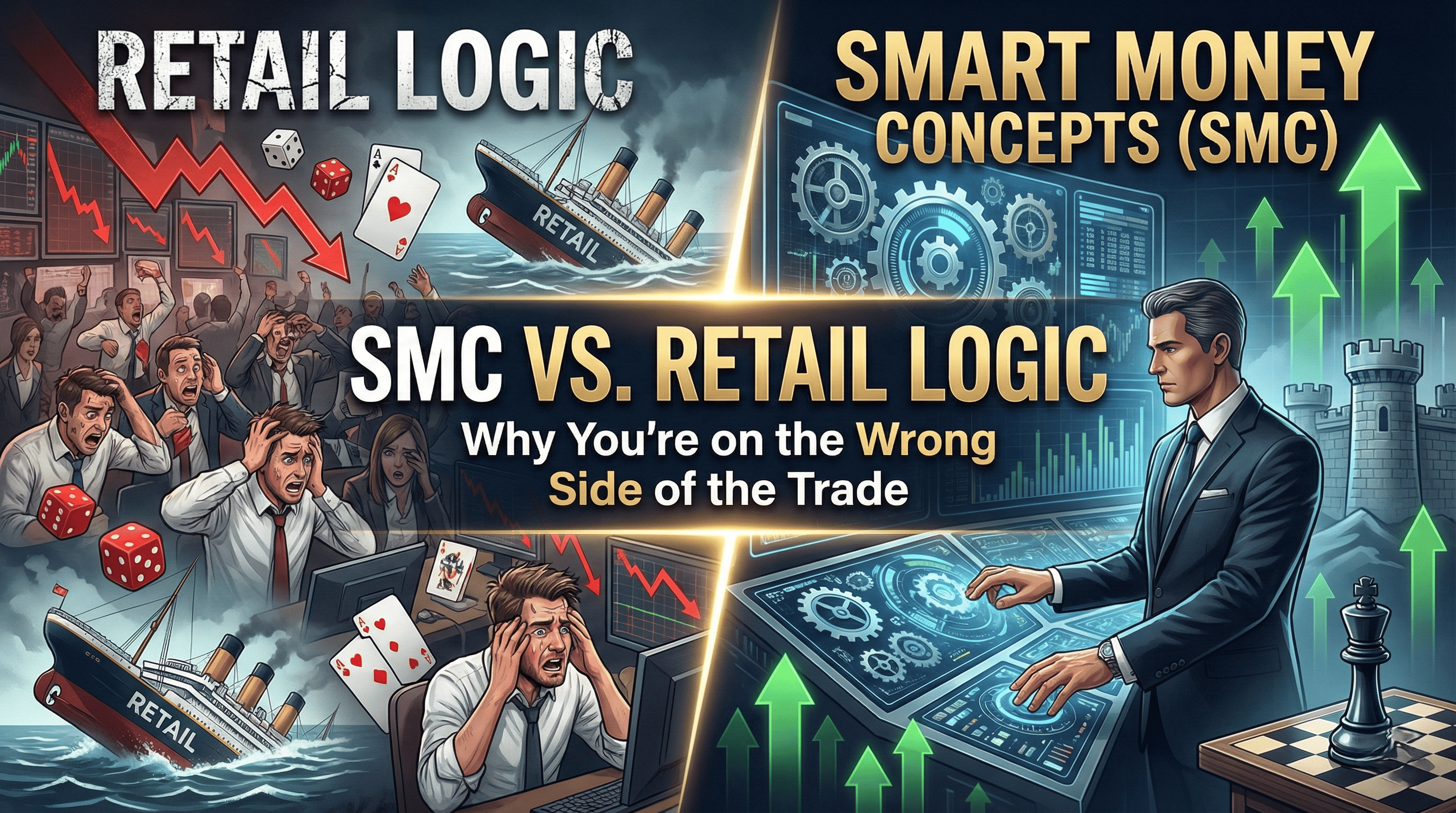
# SMC vs. Retail Logic: Why You're on the Wrong Side of the Trade
Have you ever wondered why 90% of retail traders lose money while institutional traders consistently profit? The answer lies in the fundamental difference between retail trading logic and smart money concepts (SMC). Understanding this distinction is the key to transforming your trading from gambling to strategic positioning alongside the market makers.
The divide between smc vs retail logic represents one of the most crucial educational gaps in trading. While retail traders chase breakouts and follow indicators, smart money operates with precision, creating the very market movements that trap the masses. This guide will reveal why your current approach might be working against you and how to align with institutional thinking.
Table of Contents
- [Understanding Retail Logic vs Smart Money Concepts](#understanding-retail-logic-vs-smart-money-concepts)
- [The Psychology Behind Retail Trading Failures](#the-psychology-behind-retail-trading-failures)
- [How Smart Money Creates Market Structure](#how-smart-money-creates-market-structure)
- [Key Differences in Trade Execution](#key-differences-in-trade-execution)
- [Transitioning from Retail to Institutional Thinking](#transitioning-from-retail-to-institutional-thinking)
- [Practical Applications and Examples](#practical-applications-and-examples)
- [Conclusion](#conclusion)
Understanding Retail Logic vs Smart Money Concepts
The battle between smc vs retail logic begins with understanding how each group approaches the market. Retail traders, representing the majority, operate under assumptions that seem logical on the surface but are fundamentally flawed when viewed through institutional eyes.
Retail Logic Characteristics
Retail traders typically follow these patterns:
- Support and Resistance Thinking: Viewing horizontal lines as absolute barriers
- Indicator Dependence: Relying heavily on lagging indicators for entry signals
- Breakout Mentality: Buying breaks above resistance or selling breaks below support
- Risk-On Behavior: Taking high-risk trades with poor risk-to-reward ratios
- Emotional Decision Making: Letting fear and greed drive trading decisions
Smart Money Concepts Foundation
Institutional traders operate differently:
- Market Structure Analysis: Understanding how price creates higher highs/lows and lower highs/lows
- Order Block Recognition: Identifying where large orders were placed
- Liquidity Targeting: Recognizing where stop losses cluster
- Fair Value Gap Utilization: Trading imbalances in price action
- Risk Management Priority: Protecting capital above seeking profits
:::key-concept Smart Money Concepts aren't just another trading strategy—they're a complete paradigm shift in how you view market mechanics. Instead of predicting where price will go, SMC teaches you to understand where price must go based on market structure. :::
The Psychology Behind Retail Trading Failures
The difference in smc vs retail logic extends beyond technical analysis into fundamental psychological approaches. Retail traders often fall victim to cognitive biases that smart money exploits systematically.
The Retail Trap Cycle
1. Pattern Recognition Bias: Retail traders see patterns everywhere, even in random price movement 2. Confirmation Bias: Seeking information that confirms their existing position 3. Overconfidence Effect: Believing past success guarantees future results 4. Loss Aversion: Holding losing trades too long while cutting winners short 5. Herd Mentality: Following the crowd into obvious setups
How Smart Money Exploits Retail Psychology
Institutional traders understand retail behavior and use it strategically:
- Creating False Breakouts: Pushing price beyond obvious levels to trigger retail stops
- Accumulating at Retail Distribution: Buying when retail traders are selling in panic
- Using Retail Liquidity: Filling large orders against retail stop losses
- Timing Reversals: Entering when retail sentiment reaches extremes
:::warning The market is designed to separate money from the uninformed. Every time you follow obvious retail logic, you're likely providing liquidity to institutional traders who positioned themselves earlier with better information and deeper analysis. :::
Breaking the Retail Mindset
To transition from retail to institutional thinking:
- Question Everything: Challenge assumptions about support, resistance, and breakouts
- Think in Probabilities: Focus on risk management rather than being right
- Study Market Structure: Learn to read price action without indicators
- Practice Patience: Wait for high-probability setups rather than forcing trades
- Embrace Being Wrong: Use stop losses as tools, not failures
How Smart Money Creates Market Structure
Understanding market structure is crucial in the smc vs retail logic debate. While retail traders see chaotic price movement, institutional traders see deliberate manipulation and positioning.
Market Structure Components
Higher Highs and Higher Lows (Bullish Structure)
- Creation: Smart money accumulates positions during downtrends
- Maintenance: Strategic buying at key support levels
- Exploitation: Using retail selling as buying opportunities
Lower Highs and Lower Lows (Bearish Structure)
- Creation: Institutional distribution during uptrends
- Maintenance: Strategic selling at key resistance levels
- Exploitation: Using retail buying as selling opportunities
Order Block Dynamics
Order blocks represent areas where institutional traders placed significant orders:
Bullish Order Blocks
- Formation: Large buying orders create strong upward moves
- Characteristics: Green candles with strong bodies and minimal wicks
- Function: Act as future support when price returns
- Retail Perception: Often seen as random price spikes
Bearish Order Blocks
- Formation: Large selling orders create strong downward moves
- Characteristics: Red candles with strong bodies and minimal wicks
- Function: Act as future resistance when price returns
- Retail Perception: Often ignored or misunderstood
:::example Imagine EUR/USD breaks below a key support level at 1.1000. Retail traders see this as a sell signal and short the market. However, smart money recognizes this as a liquidity grab—pushing price below retail stops to collect orders before reversing higher. The bearish candle that broke support becomes a bullish order block when price returns to test it. :::
Liquidity Concepts
Smart money targets liquidity pools where retail stops cluster:
- Buy-Side Liquidity: Stop losses above swing highs
- Sell-Side Liquidity: Stop losses below swing lows
- Equal Highs/Lows: Multiple touches at the same level create obvious targets
- Trendline Breaks: Retail traders place stops just beyond trendlines
Key Differences in Trade Execution
The execution phase reveals the starkest contrast in smc vs retail logic. While both groups may identify similar market areas, their approach to entering and managing trades differs dramatically.
Retail Execution Patterns
Entry Strategy
- Momentum Chasing: Buying after strong moves up, selling after strong moves down
- Breakout Trading: Entering when price breaks obvious levels
- Indicator Signals: Waiting for RSI oversold or moving average crossovers
- Pattern Completion: Trading triangles, flags, and other textbook patterns
Risk Management
- Wide Stops: Placing stops far from entry to avoid being "stopped out"
- No Position Sizing: Risking the same amount regardless of setup quality
- Emotional Exits: Closing trades based on fear or greed rather than plan
- Averaging Down: Adding to losing positions hoping for recovery
Smart Money Execution
Entry Strategy
- Value Seeking: Buying at discount prices, selling at premium prices
- Structure Confirmation: Entering only after market structure supports the direction
- Liquidity Targeting: Positioning before price moves to grab retail stops
- Patience: Waiting for optimal risk-to-reward opportunities
Risk Management
- Tight Stops: Placing stops just beyond invalidation levels
- Position Sizing: Adjusting size based on setup quality and account risk
- Planned Exits: Taking profits at predetermined levels
- Capital Preservation: Cutting losses quickly and letting winners run
:::tip Smart money doesn't try to predict the market—they position themselves where they have the highest probability of success and the lowest risk of significant loss. This approach leads to consistent profitability over time. :::
Risk-to-Reward Comparison
| Aspect | Retail Logic | Smart Money Concepts | |--------|--------------|----------------------| | Risk-to-Reward | Often 1:1 or worse | Minimum 1:3, often 1:5+ | | Win Rate | 30-40% | 40-60% | | Position Size | Fixed or emotional | Calculated based on risk | | Stop Loss | Far from entry | Close to invalidation | | Take Profit | Early or never | Multiple targets |
Transitioning from Retail to Institutional Thinking
Shifting from retail logic to SMC requires rewiring your understanding of market mechanics. This transition doesn't happen overnight but follows a predictable progression.
Phase 1: Unlearning Retail Concepts
The first step involves questioning everything you've learned about trading:
Challenge These Retail Beliefs
- "Support and resistance are permanent levels"
- "Breakouts always lead to continuation"
- "Higher volume always means stronger moves"
- "Technical indicators predict future price"
- "The market is random and unpredictable"
Replace with SMC Understanding
- Market structure determines directional bias
- Breakouts often reverse to trap retail traders
- Volume analysis requires context and order flow
- Price action reveals institutional intentions
- The market follows logical, exploitable patterns
Phase 2: Learning Market Structure
Develop the ability to read charts like an institutional trader:
Daily Practice Routine
1. Identify Current Structure: Is the market trending or ranging? 2. Mark Key Levels: Locate order blocks, fair value gaps, and liquidity pools 3. Assess Bias: Determine if smart money is bullish or bearish 4. Plan Scenarios: What would confirm or invalidate your bias? 5. Manage Risk: Where would you place stops and targets?
Study Focus Areas
- Higher Timeframe Structure: Weekly and daily bias
- Lower Timeframe Entries: 4-hour and hourly precision
- Order Block Behavior: How price reacts at institutional levels
- Liquidity Sweeps: Recognizing false breakouts
- Fair Value Gaps: Trading imbalances and inefficiencies
:::warning Avoid the temptation to mix SMC with retail indicators. The power of smart money concepts lies in their purity—adding RSI or moving averages will only cloud your analysis and reduce effectiveness. :::
Phase 3: Developing Institutional Patience
Perhaps the hardest transition involves changing your relationship with time and opportunity:
Patience Principles
- Quality over Quantity: Trade less frequently but with higher probability
- Structure Confirmation: Wait for clear market bias before entering
- Multiple Timeframe Alignment: Ensure higher and lower timeframes agree
- Risk-First Mentality: Only trade when risk-to-reward is favorable
- Emotional Detachment: Execute your plan regardless of profit/loss
Practical Applications and Examples
Let's examine real scenarios where smc vs retail logic creates opposite trading decisions, demonstrating why understanding this difference is crucial for trading success.
Example 1: The False Breakout Setup
Market Context
- Pair: GBP/USD
- Timeframe: 4-hour chart
- Structure: Range-bound between 1.2500 and 1.2700
- Setup: Price approaches the 1.2700 resistance for the third time
Retail Logic Response
Retail Analysis:
- "Price has tested resistance multiple times"
- "A breakout above 1.2700 signals continuation"
- "I'll buy the breakout with a stop at 1.2690"
- "Target: 1.2800 (1:1 risk-to-reward)"
Smart Money Concepts Response
SMC Analysis:
- "Multiple tests created buy-side liquidity above 1.2700"
- "Smart money likely needs to clear these stops"
- "I'll wait for the liquidity grab and reversal"
- "Entry: 1.2720 after false break, Stop: 1.2730, Target: 1.2600"
Outcome
Price spikes to 1.2720, grabbing retail stops, then reverses sharply to 1.2580. The retail trader loses money on the false breakout while the SMC trader profits from understanding institutional intentions.
:::example This example perfectly illustrates why smc vs retail logic produces opposite results. Retail traders see breakouts as opportunity while smart money sees them as liquidity collection events. :::
Example 2: The Trend Reversal Signal
Market Context
- Pair: USD/JPY
- Timeframe: Daily chart
- Structure: Downtrend with lower highs and lower lows
- Setup: Price creates a potential higher high
Retail Logic Response
Retail Analysis:
- "Downtrend might be ending"
- "Price made a higher high—trend change signal"
- "RSI showing bullish divergence"
- "I'll buy now with tight stop below recent low"
Smart Money Concepts Response
SMC Analysis:
- "Higher high needs to be confirmed by higher low"
- "Current structure still bearish until proven otherwise"
- "I'll wait for market structure break confirmation"
- "No trade until clear change of character occurs"
Advanced SMC Considerations
When transitioning between retail and institutional thinking, consider these advanced concepts:
Change of Character (CHoCH)
- Definition: Clear break of market structure indicating potential reversal
- Confirmation: Price creates opposite structure (HH after LL or LL after HH)
- Patience Required: Wait for confirmation rather than anticipating
Break of Structure (BoS)
- Definition: Continuation of existing trend with new structural high/low
- Significance: Confirms trend strength and continuation probability
- Trading Implication: Look for retracement entries in trend direction
Inducement
- Concept: Smart money creates obvious setups to trap retail traders
- Recognition: Textbook patterns that seem "too perfect"
- Response: Fade the obvious trade or wait for reversal confirmation
Building Your SMC Trading Plan
Developing a systematic approach to smc vs retail logic requires structured planning:
Pre-Market Analysis
1. Weekly Structure Review: Determine overall market bias 2. Daily Structure Assessment: Identify key levels and potential scenarios 3. News Impact Evaluation: Consider fundamental catalysts 4. Risk Management Planning: Calculate position sizes and maximum loss
During Market Hours
1. Structure Monitoring: Watch for breaks, retests, and confirmations 2. Entry Trigger Identification: Look for precise SMC entry signals 3. Risk Management Execution: Place stops and adjust positions as planned 4. Bias Reassessment: Adapt to changing market structure
Post-Market Review
1. Trade Analysis: Review what worked and what didn't 2. Structure Evolution: Note how market structure developed 3. Learning Extraction: Identify patterns and improve recognition 4. Plan Adjustment: Refine approach based on market feedback
:::key-concept Consistent profitability comes from developing a systematic approach to market analysis that aligns with institutional logic rather than fighting against it. The goal isn't to be right about every trade but to position yourself with the market makers rather than against them. :::
Conclusion
The fundamental difference between smc vs retail logic represents more than just different trading approaches—it's the difference between swimming with the current and against it. Throughout this guide, we've explored how retail traders unknowingly position themselves as liquidity providers for institutional players, while smart money concepts offer a pathway to align with market makers.
The transformation from retail to institutional thinking requires patience, discipline, and a willingness to unlearn conventional trading wisdom. By understanding market structure, recognizing order blocks, and identifying liquidity pools, you can begin to see the market through institutional eyes. This shift in perspective doesn't guarantee immediate success, but it provides the foundation for consistent, long-term profitability.
Remember that smart money concepts aren't just another trading strategy—they're a complete paradigm shift that requires dedication to master. The institutional traders didn't become successful overnight, and neither will you. However, by consistently applying SMC principles and maintaining proper risk management, you can gradually transition from being market liquidity to becoming a strategic participant.
The choice is clear: continue following retail logic and remain part of the 90% who lose money, or embrace smart money concepts and join the ranks of consistently profitable traders. The market will always need liquidity providers, but that doesn't have to be you.
Start your journey today by analyzing your current charts through the lens of market structure rather than retail patterns. Practice identifying order blocks, liquidity pools, and fair value gaps. Most importantly, develop the patience to wait for high-probability setups that align with institutional intentions rather than fighting against them.
Ready to transform your trading approach? Begin by reviewing your recent trades and identifying where retail logic led you astray. Then practice reading market structure on your favorite trading pairs—the first step toward trading with smart money rather than against it.
Additional Resources and Next Steps
Now that you understand the fundamental differences between retail and institutional thinking, your journey toward consistent profitability requires structured practice and continuous learning.
Essential Practice Exercises
Daily Chart Analysis Routine: 1. Morning Market Structure Review - Before any trading session, identify key support/resistance levels using SMC principles rather than traditional S/R 2. Order Block Recognition - Scan multiple timeframes to locate fresh order blocks and assess their validity 3. Liquidity Mapping - Mark equal highs/lows and obvious support/resistance where retail stops likely cluster
:::tip Start with just 2-3 currency pairs or stocks to avoid information overload. Master SMC concepts on familiar instruments before expanding your watchlist. :::
Weekly Performance Evaluation:
- Review all trades through the SMC lens
- Identify instances where retail thinking influenced your decisions
- Document market structure breaks you missed
- Analyze whether your entries aligned with or against institutional flow
Common Transition Challenges
The Impatience Trap: Many traders struggle with SMC because it requires waiting for clear structural confirmations. Retail habits of overtrading must be broken.
Analysis Paralysis: Learning SMC concepts can initially create hesitation. Focus on one concept at a time—master order blocks before moving to complex liquidity analysis.
Confirmation Bias: Don't force SMC patterns where they don't exist. The market won't always present clear institutional setups.
:::warning Avoid mixing retail and SMC approaches in the same trade. This hybrid thinking often leads to confused decision-making and inconsistent results. :::
Building Your SMC Toolkit
Essential Elements for Every Chart:
- Daily/Weekly bias direction based on market structure
- Key order blocks on multiple timeframes
- Liquidity zones where retail stops accumulate
- Fair value gaps requiring institutional rebalancing
- Change of character points indicating trend shifts
Risk Management Integration: Smart money risk management differs significantly from retail approaches:
- Position sizing based on order block strength rather than arbitrary percentages
- Stop losses placed beyond institutional levels, not at obvious retail points
- Profit targets aligned with next institutional objectives rather than round numbers
:::example Instead of risking 2% on every trade, risk based on setup quality: 0.5% on uncertain setups, 1% on good setups, and 2% only on exceptional institutional confluences. :::
Advanced SMC Concepts to Explore
Once you've mastered the fundamentals, consider studying:
Intermarket Analysis: How institutional flow moves between related markets (forex majors, indices, commodities)
Volume Profile Integration: Combining traditional volume analysis with SMC principles for enhanced confirmation
Multi-Timeframe Confluence: Aligning SMC signals across different timeframes for higher probability trades
Market Maker Models: Understanding specific algorithms and patterns institutional traders use
Technology and Tools
Recommended Platform Features:
- Multiple timeframe capability for structural analysis
- Drawing tools for marking order blocks and liquidity zones
- Alert systems for structural breaks
- Replay functionality for historical pattern study
:::key-concept The most expensive trading platform won't replace proper SMC understanding. Focus on education before tools. :::
Final Thoughts
The journey from retail to institutional thinking represents one of the most challenging yet rewarding transitions in trading. Success requires not just learning new concepts, but fundamentally rewiring your market perception.
Institutional traders view the market as a strategic battlefield where positioning and patience determine outcomes. Retail traders see it as a casino where quick decisions and luck drive results. This philosophical difference creates the performance gap between consistently profitable traders and the struggling majority.
Your transformation won't happen overnight. Expect months of practice before SMC concepts become second nature. Expect periods of frustration when institutional setups don't immediately materialize. Most importantly, expect to question everything you previously believed about market movement.
But also expect something else: the gradual realization that market behavior finally makes sense. The seemingly random price action begins revealing institutional intentions. The frustration of being stopped out at "perfect" levels transforms into understanding of liquidity engineering.
Your Next Action: Open your charts right now and identify one clear order block on a daily timeframe. Mark it, set an alert for price return, and wait. Don't trade it yet—just observe how price reacts when it returns to that institutional level. This simple exercise will begin rewiring your market perception from retail patterns to institutional logic.
The market doesn't care about your retail education or conventional trading wisdom. But it will reward your patience, discipline, and commitment to understanding how smart money really moves. The choice to join them instead of funding them starts with your next chart analysis.