# The Future of Trading: AI Pattern Recognition Trading Revolution
The trading landscape is undergoing a remarkable transformation. While traditional technical analysis has served traders for decades, we're now witnessing the emergence of artificial intelligence as a game-changing force in market analysis. AI pattern recognition trading represents more than just a technological upgrade—it's fundamentally reshaping how traders identify opportunities, manage risk, and execute strategies across global markets.
Modern AI systems can process vast amounts of market data in milliseconds, identifying complex patterns that might take human traders hours or days to recognize. This technological evolution isn't replacing human intuition and experience; instead, it's amplifying our analytical capabilities and providing unprecedented insights into market behavior.
Table of Contents
- [Understanding AI Pattern Recognition in Trading](#understanding-ai-pattern-recognition-in-trading)
- [Key Technologies Driving the Revolution](#key-technologies-driving-the-revolution)
- [Practical Applications in Modern Trading](#practical-applications-in-modern-trading)
- [Implementation Strategies for Traders](#implementation-strategies-for-traders)
- [Benefits and Limitations](#benefits-and-limitations)
- [Getting Started with AI-Enhanced Analysis](#getting-started-with-ai-enhanced-analysis)
- [Conclusion](#conclusion)
Understanding AI Pattern Recognition in Trading
AI pattern recognition trading leverages machine learning algorithms to identify recurring patterns in market data that precede specific price movements. Unlike traditional technical indicators that rely on mathematical formulas applied to historical data, AI systems learn from vast datasets to recognize subtle correlations and complex relationships that human traders might miss.
:::key-concept AI pattern recognition differs from traditional technical analysis by using machine learning to identify patterns across multiple timeframes and market conditions simultaneously, rather than relying on predefined mathematical formulas. :::
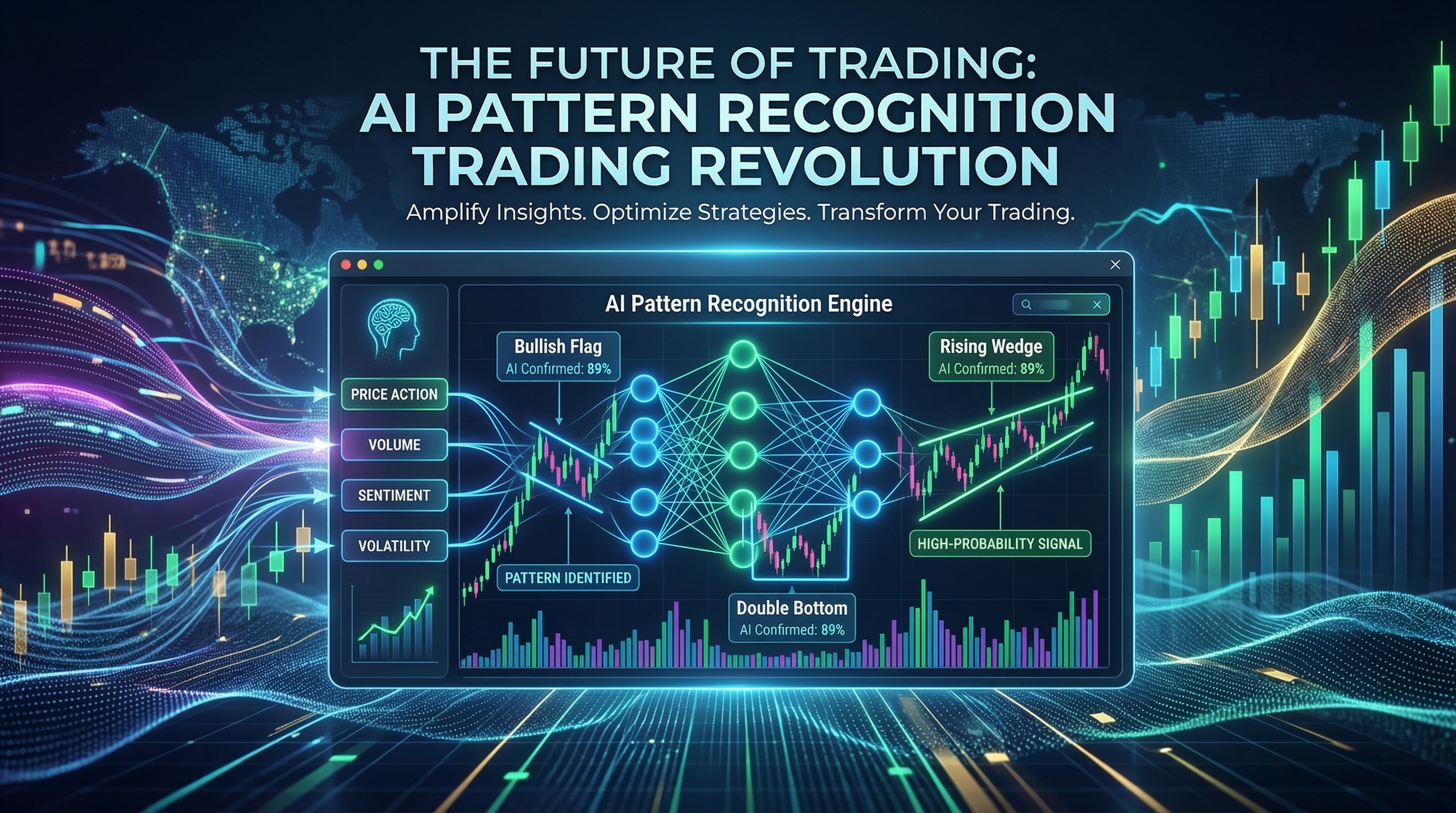
The foundation of AI pattern recognition lies in neural networks that can process multiple data streams simultaneously. These systems analyze price action, volume patterns, market sentiment indicators, and even external factors like news sentiment or economic data. The AI learns to identify which combinations of factors have historically led to profitable trading opportunities.
Core Components of AI Pattern Recognition
Successful AI pattern recognition systems typically incorporate several key elements:
- Multi-dimensional Analysis: Processing price, volume, volatility, and sentiment data simultaneously
- Adaptive Learning: Continuously updating pattern recognition based on new market data
- Cross-market Correlation: Identifying patterns across different assets and timeframes
- Real-time Processing: Analyzing incoming data streams in real-time for immediate pattern identification
:::example Consider a traditional head and shoulders pattern. While a human trader might identify this pattern on a daily chart, an AI system could simultaneously recognize similar formations across multiple timeframes, correlate them with volume patterns, and assess the probability of success based on thousands of historical examples across different market conditions. :::
Key Technologies Driving the Revolution
Several breakthrough technologies are making AI pattern recognition trading increasingly sophisticated and accessible to traders of all levels.
Machine Learning Algorithms
Deep learning networks form the backbone of modern AI pattern recognition systems. These algorithms excel at identifying non-linear relationships in complex datasets. Convolutional Neural Networks (CNNs) are particularly effective at recognizing visual patterns in charts, while Recurrent Neural Networks (RNNs) excel at understanding sequential data patterns over time.
Natural Language Processing
Advanced AI systems now incorporate sentiment analysis from news feeds, social media, and economic reports. This natural language processing capability allows the AI to factor in market sentiment and external events when identifying trading patterns.
:::tip Look for AI systems that combine technical pattern recognition with sentiment analysis for a more comprehensive market view. This multi-faceted approach often provides more reliable signals than purely technical systems. :::
Computer Vision for Chart Analysis
Computer vision technology enables AI systems to "see" chart patterns the same way human traders do, but with enhanced precision and speed. These systems can identify support and resistance levels, trend lines, and complex chart formations across multiple assets simultaneously.
Big Data Processing
Modern AI pattern recognition systems can process enormous datasets that would be impossible for human analysis. This includes tick-by-tick price data, order book information, and cross-asset correlations across global markets.
Practical Applications in Modern Trading
AI pattern recognition trading has found practical applications across various trading styles and market segments, offering benefits to day traders, swing traders, and long-term investors alike.
Enhanced Chart Pattern Recognition
Traditional chart patterns like triangles, flags, and double tops take on new dimensions when analyzed through AI pattern recognition. The system can identify these patterns with greater accuracy and provide probability assessments based on historical performance under similar market conditions.
:::example An AI system might identify a bullish flag pattern on EUR/USD while simultaneously recognizing that similar patterns in correlated currency pairs suggest a high probability of success. The AI could also factor in current market volatility and economic calendar events to refine its probability assessment. :::
Multi-Timeframe Analysis
AI excels at synthesizing information across multiple timeframes. While a human trader might struggle to correlate patterns between 5-minute and daily charts, AI systems can seamlessly integrate these perspectives to provide more comprehensive analysis.
Real-time Market Scanning
AI-powered scanners can monitor hundreds or thousands of assets simultaneously, alerting traders to emerging patterns as they develop. This capability is particularly valuable for traders focusing on breakout strategies or momentum plays.
Risk Assessment and Position Sizing
Advanced AI systems can assess the risk profile of identified patterns and suggest appropriate position sizes based on historical volatility and pattern reliability. This helps traders maintain consistent risk management across different opportunities.
:::warning While AI can provide sophisticated risk assessments, always maintain your own risk management rules. No AI system is infallible, and proper position sizing remains crucial for long-term trading success. :::
Implementation Strategies for Traders
Successfully integrating AI pattern recognition into your trading routine requires a structured approach that combines technological capabilities with sound trading principles.
Starting with Hybrid Approaches
Most successful traders don't immediately replace their entire analysis process with AI. Instead, they use AI pattern recognition as a powerful supplement to their existing strategies. This hybrid approach allows you to maintain your trading edge while gradually incorporating AI insights.
Recommended Implementation Steps:
1. Use AI for Market Scanning: Let AI systems identify potential opportunities across multiple markets 2. Validate with Traditional Analysis: Apply your existing technical analysis skills to confirm AI-identified patterns 3. Track Performance: Monitor how AI-assisted trades perform compared to your traditional analysis 4. Gradually Increase Reliance: As you build confidence, allow AI insights to play a larger role in your decision-making
Selecting the Right AI Tools
The AI pattern recognition trading landscape offers various tools and platforms, each with different strengths and applications:
- Integrated Trading Platforms: Many modern platforms now include AI-powered pattern recognition features
- Specialized AI Trading Software: Dedicated applications focused specifically on AI market analysis
- Custom Solutions: For advanced traders, custom AI models tailored to specific strategies
- Cloud-based Services: Subscription services that provide AI analysis without requiring local software installation
:::tip Start with simpler AI tools integrated into familiar trading platforms before moving to more sophisticated standalone solutions. This approach helps you understand how AI insights fit into your existing workflow. :::
Backtesting AI Strategies
Thorough backtesting remains crucial when implementing AI pattern recognition strategies. However, AI backtesting requires some unique considerations:
- Walk-forward Analysis: Ensure the AI model performs well on unseen data, not just historical optimization
- Multiple Market Conditions: Test across different market environments (trending, ranging, volatile, calm)
- Overfitting Prevention: Verify that the AI hasn't simply memorized historical patterns without understanding underlying market dynamics
Benefits and Limitations
Understanding both the advantages and constraints of AI pattern recognition trading helps set realistic expectations and develop effective implementation strategies.
Key Benefits
Enhanced Pattern Detection: AI systems can identify subtle patterns and correlations that human analysis might miss, particularly across multiple assets and timeframes simultaneously.
Speed and Efficiency: Real-time pattern recognition across hundreds of assets enables traders to capture more opportunities and respond faster to changing market conditions.
Emotional Discipline: AI systems don't experience fear, greed, or other emotions that can cloud human judgment, providing more consistent pattern identification.
Continuous Learning: Modern AI systems adapt and improve their pattern recognition capabilities as they process new market data.
:::key-concept The greatest strength of AI pattern recognition lies not in replacing human traders, but in augmenting human capabilities with superior data processing and pattern identification speed. :::
Important Limitations
Market Regime Changes: AI systems trained on historical data may struggle when market dynamics shift significantly, such as during unprecedented economic events.
Black Box Problem: Many AI systems provide limited transparency about why they identified specific patterns, making it difficult to understand the reasoning behind recommendations.
Technology Dependence: Relying heavily on AI systems creates vulnerability to technical failures, data feed issues, or software bugs.
Overfitting Risk: AI models may become too specialized for historical conditions and fail to generalize to future market environments.
:::warning Never rely solely on AI pattern recognition for trading decisions. Maintain your fundamental understanding of markets and technical analysis as a foundation for evaluating AI-generated insights. :::
Getting Started with AI-Enhanced Analysis
For traders ready to incorporate AI pattern recognition into their analysis, a systematic approach ensures the best chance of success.
Essential First Steps
Education and Understanding: Before implementing any AI tools, invest time in understanding how these systems work. You don't need to become a data scientist, but basic knowledge helps you evaluate AI recommendations more effectively.
Paper Trading Integration: Begin by using AI pattern recognition in a simulated trading environment. This allows you to observe how AI insights perform without risking capital while you learn to interpret the system's recommendations.
Data Quality Assessment: Ensure your chosen AI system has access to high-quality, comprehensive market data. Poor data quality will significantly impact pattern recognition accuracy.
Building Your AI-Enhanced Trading Process
1. Morning Market Scan: Use AI systems to scan for emerging patterns across your watchlist 2. Pattern Validation: Apply traditional technical analysis to validate AI-identified opportunities 3. Risk Assessment: Combine AI probability assessments with your risk management rules 4. Execution and Monitoring: Execute trades based on combined AI and traditional analysis, monitoring performance closely 5. Regular Review: Analyze the performance of AI-assisted trades compared to traditional analysis
Measuring Success
Track specific metrics to evaluate the effectiveness of your AI pattern recognition integration:
- Pattern Accuracy: How often do AI-identified patterns result in profitable trades?
- Time Efficiency: How much time does AI assistance save in your analysis process?
- Opportunity Discovery: How many additional trading opportunities does AI help you identify?
- Risk-Adjusted Returns: Does AI assistance improve your overall risk-adjusted performance?
:::example A trader might discover that AI pattern recognition helps identify 30% more trading opportunities while maintaining similar accuracy rates. Even if individual trade performance remains the same, the increased opportunity flow could significantly improve overall profitability. :::
Conclusion
AI pattern recognition trading represents a fundamental shift in how traders analyze markets and identify opportunities. Rather than replacing traditional analysis methods, AI serves as a powerful complement to human expertise, offering enhanced pattern detection capabilities, faster processing speeds, and the ability to synthesize complex multi-dimensional data.
The technology continues evolving rapidly, with improvements in machine learning algorithms, data processing capabilities, and user-friendly interfaces making AI tools increasingly accessible to traders at all levels. However, successful implementation requires a balanced approach that combines AI capabilities with solid trading fundamentals and proper risk management.
As you explore AI pattern recognition trading, remember that the most successful traders will be those who learn to effectively combine artificial intelligence with human insight, market experience, and disciplined execution. The future belongs to traders who can harness the power of AI while maintaining the critical thinking and market understanding that defines successful trading.
Ready to explore how AI can enhance your trading analysis? Start by examining your current charts with a focus on identifying patterns that might benefit from AI recognition, and consider how automated pattern scanning could expand your market coverage and opportunity identification.