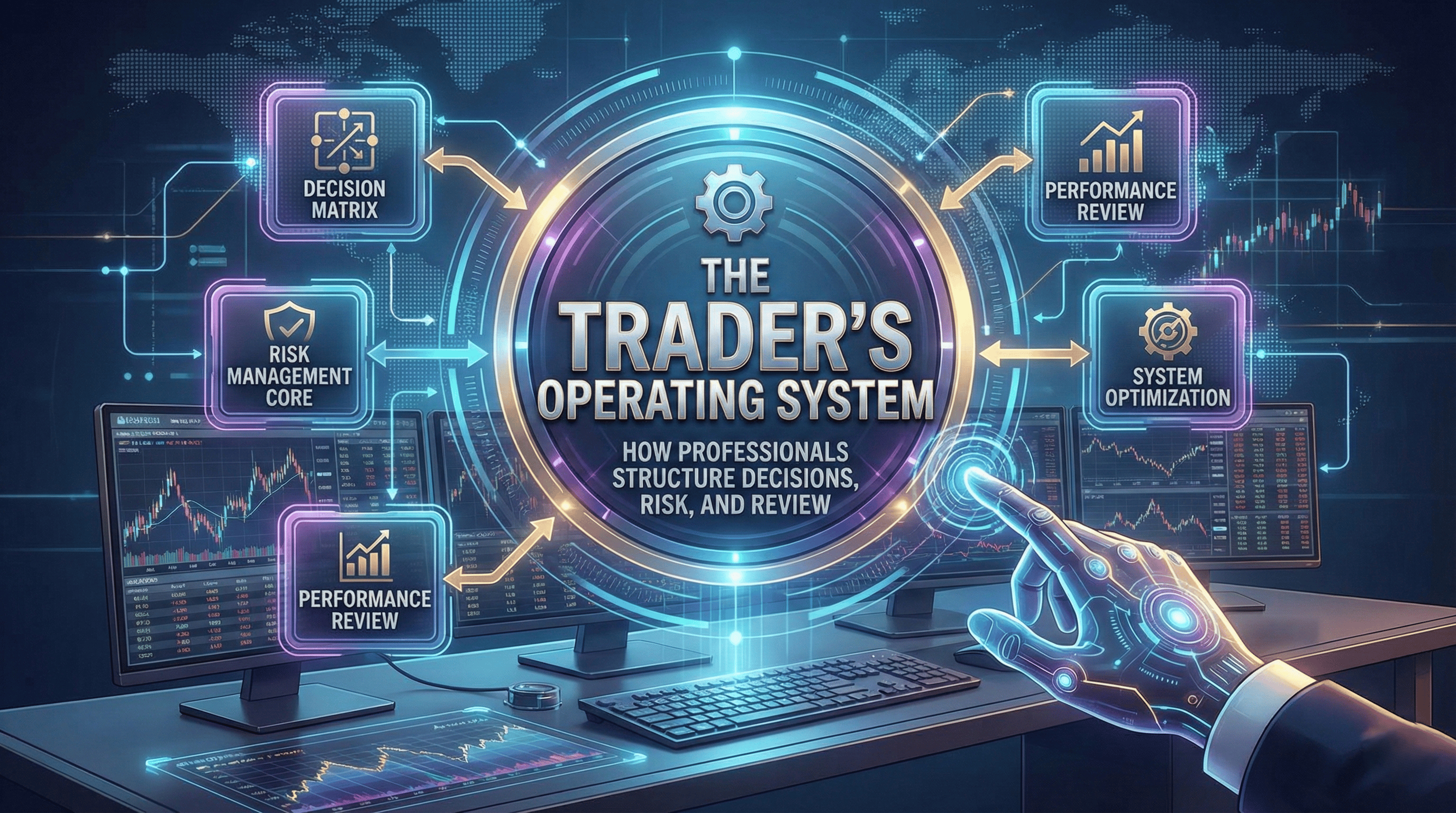
# The Trader's Operating System: How Professionals Structure Decisions, Risk, and Review
Professional trading isn't about finding the perfect setup or having the highest win rate. It's about operating within a systematic framework that consistently guides decision-making, risk management, and performance evaluation. Just as computer operating systems manage hardware resources and provide a platform for applications to run, successful traders develop their own "operating system" that manages psychological resources, risk capital, and decision-making processes.
This systematic approach is what separates professional traders from retail participants who rely on emotional reactions and ad-hoc decisions. While retail traders focus on individual trades, professionals focus on the system that generates those trades. Understanding and implementing this professional framework can transform your trading from a series of disconnected bets into a cohesive business operation.
Table of Contents
- [The Foundation: Core System Architecture](#the-foundation-core-system-architecture)
- [Decision-Making Framework: The Professional Process](#decision-making-framework-the-professional-process)
- [Risk Management Operating System](#risk-management-operating-system)
- [Performance Review and System Optimization](#performance-review-and-system-optimization)
- [Integration and Daily Operations](#integration-and-daily-operations)
- [Conclusion](#conclusion)
The Foundation: Core System Architecture
Every professional trading operation runs on three fundamental pillars that form the core architecture of their operating system. These aren't just abstract concepts—they're concrete frameworks that guide every aspect of trading activity.
Market Philosophy and Edge Definition
Your market philosophy serves as the foundation layer of your operating system. This isn't about whether you're bullish or bearish on a particular asset, but rather your fundamental beliefs about how markets operate and where your edge lies.
:::key-concept A professional trader's edge must be clearly defined, measurable, and consistently applicable. It's not enough to say "I'm good at reading charts"—you need specific criteria that define when your edge is present. :::
Professional traders typically build their philosophy around one of several core market concepts:
- Information asymmetry: Exploiting gaps in information flow or interpretation
- Behavioral inefficiencies: Capitalizing on predictable human behavior patterns
- Statistical arbitrage: Finding recurring mathematical relationships
- Market microstructure: Understanding how order flow creates price movement
System Boundaries and Operating Parameters
Just as computer operating systems define what hardware they can run on and what applications they support, your trading system needs clearly defined boundaries. These parameters act as guardrails that keep you operating within your area of competence.
Key boundary definitions include:
- Market selection criteria: Which markets align with your edge
- Timeframe specialization: The temporal scope of your analysis and execution
- Position size limits: Maximum exposure relative to account size and volatility
- Market condition filters: When your system operates optimally versus when to reduce activity
:::example A professional momentum trader might define their boundaries as: "US large-cap stocks during the first two hours of trading, with minimum average daily volume of 1 million shares, maximum 2% position size, only during trending market conditions as defined by the S&P 500 being above its 20-day moving average." :::
Resource Allocation Framework
Professionals treat their trading capital as a business resource that must be allocated efficiently across opportunities. This goes beyond simple position sizing to encompass attention allocation, time management, and cognitive resource distribution.
The resource allocation framework addresses:
- Capital allocation: How much of your total capital is at risk at any given time
- Attention allocation: Which markets and timeframes deserve your focus
- Opportunity cost evaluation: Whether to take a trade or wait for better setups
- Capacity management: Understanding your limits in terms of simultaneous positions and decisions
Decision-Making Framework: The Professional Process
Professional trading decisions aren't made in isolation—they're the output of a systematic process that evaluates every potential trade through multiple filters. This process removes emotion from decision-making and ensures consistency across all market conditions.
The Multi-Stage Filtering System
Every trade idea must pass through a series of increasingly stringent filters before execution. This cascade system ensures that only the highest-probability setups reach your position sizing and execution stages.
Stage 1: Market Environment Assessment
Before evaluating individual setups, professionals first assess the overall market environment. This macro filter determines whether conditions favor their particular edge and trading style.
Environment assessment criteria:
- Volatility regime (high/low/transitioning)
- Market trend and momentum
- Correlation patterns between major assets
- Upcoming events and potential disruptions
Stage 2: Setup Identification and Grading
Once the environment is deemed favorable, individual setups are identified and graded on their quality. This isn't a binary pass/fail system but a nuanced evaluation that affects position sizing and risk parameters.
:::tip Professionals often use a grading system (A, B, C quality setups) rather than a simple yes/no decision. A-grade setups might receive full position size, while C-grade setups get reduced size or are skipped entirely. :::
Stage 3: Risk-Reward Optimization
Before execution, each trade is evaluated for its risk-reward profile. This includes not just the obvious entry, stop, and target levels, but also the probability-weighted expected value and how the trade fits within the current portfolio.
Execution Decision Trees
Professional traders use decision trees to handle the complexity of trade execution. These branching logic structures account for different market conditions and scenarios that might occur after entry.
A typical execution decision tree addresses:
- What to do if the market gaps against you
- How to handle partial fills
- When to add to positions versus when to reduce
- How to adjust stops and targets based on market behavior
:::warning Decision trees must be created before entering the trade, not during the heat of battle. Trying to make complex decisions while managing open positions leads to emotional decision-making and system breakdown. :::
The Professional's Time Architecture
Successful traders structure their time around their decision-making process, not around market hours. This temporal architecture ensures that adequate time is devoted to analysis, planning, and review rather than just execution.
A professional time structure typically includes:
- Preparation phase: Market analysis and trade planning (usually during off-market hours)
- Execution phase: Order placement and initial position management
- Monitoring phase: Active position management and opportunity scanning
- Review phase: Performance analysis and system refinement
Risk Management Operating System
Risk management for professionals isn't just about setting stop losses—it's a comprehensive operating system that manages risk at multiple levels and timeframes. This system operates continuously in the background, much like antivirus software protecting a computer.
Multi-Layered Risk Architecture
Professional risk management operates on multiple layers, each with specific functions and triggers. This redundant system ensures that no single point of failure can destroy the trading account.
Layer 1: Position-Level Risk
This is the most visible layer—the individual stop loss and position sizing decisions that limit loss on any single trade. However, professionals don't just set a stop and forget it. They use dynamic risk management that adjusts based on market behavior.
Position-level risk components:
- Initial risk (stop loss placement)
- Running risk (how much you're currently at risk)
- Opportunity risk (risk of missing profits)
- Time risk (how long you're willing to hold)
Layer 2: Portfolio-Level Risk
This layer manages correlation and concentration risk across all positions. It prevents the portfolio from becoming too exposed to any single market factor or sector.
:::key-concept Portfolio-level risk management requires understanding not just how much you could lose on individual trades, but how much you could lose if multiple positions move against you simultaneously. :::
Portfolio risk metrics include:
- Total gross exposure (sum of all position sizes)
- Net exposure (long positions minus short positions)
- Sector/market concentration limits
- Correlation-adjusted risk (accounting for how positions might move together)
Layer 3: Account-Level Risk
This is the ultimate backstop—rules that protect the overall trading account from catastrophic loss. These are typically percentage-based rules that trigger systematic reduction in position sizes or temporary cessation of trading.
Account-level triggers might include:
- Maximum daily loss limits
- Maximum weekly/monthly drawdown limits
- Consecutive loss limits
- Risk-adjusted return thresholds
Dynamic Risk Scaling
Unlike retail traders who often use fixed position sizes, professionals scale their risk based on multiple factors including market conditions, recent performance, and setup quality. This dynamic approach maximizes profits during favorable periods while preserving capital during challenging conditions.
Risk scaling factors:
- Volatility adjustment: Smaller positions during high volatility periods
- Performance scaling: Reducing size after losses, increasing after wins
- Confidence scaling: Larger positions for higher-conviction trades
- Market condition scaling: Adjusting for trending versus ranging environments
:::example A professional might normally risk 1% per trade, but scale this down to 0.5% during high market volatility, reduce to 0.3% after three consecutive losses, or increase to 1.5% for A-grade setups during strongly trending markets. :::
Risk Communication Systems
Professional traders develop systems for monitoring and communicating risk in real-time. This includes both automated alerts and manual check procedures that ensure risk parameters are being followed.
Effective risk communication includes:
- Real-time P&L monitoring with alerts
- Daily risk reports summarizing exposure
- Weekly performance reviews with risk attribution
- Monthly system health checks and parameter adjustments
Performance Review and System Optimization
The review process is where professionals separate themselves from amateurs. While most traders either don't review their performance at all or focus only on profits and losses, professionals conduct comprehensive system audits that identify both strengths to leverage and weaknesses to address.
Multi-Dimensional Performance Analysis
Professional performance review goes far beyond simple win rate and profit/loss calculations. It examines performance across multiple dimensions to understand not just what happened, but why it happened and how to improve.
Trade Execution Analysis
This examines how well you executed your planned trades relative to your system rules. Perfect execution of a mediocre system often produces better results than poor execution of an excellent system.
Execution metrics include:
- Slippage analysis (difference between planned and actual prices)
- Timing analysis (how well you entered and exited relative to signals)
- Size accuracy (whether you took appropriate position sizes)
- Rule compliance (how often you followed your system)
Market Condition Attribution
This analysis breaks down performance by different market conditions to understand when your system works best and when it struggles. This information guides future position sizing and activity level decisions.
:::tip Track performance across different volatility regimes, trending versus ranging markets, and different news/event environments. This helps you understand your system's conditional performance. :::
Setup Quality Analysis
By grading your setups before entry and then analyzing performance by grade, you can validate your setup identification process and refine your criteria.
Quality analysis includes:
- Performance by setup grade (A, B, C quality)
- Hit rate by setup type
- Average profit/loss by market condition
- Time-based performance patterns
System Evolution Framework
Professional traders treat their trading system as a living entity that requires continuous refinement and evolution. However, this evolution is systematic and controlled, not reactive to recent results.
The Scientific Method in Trading
System improvements follow a scientific approach:
1. Hypothesis formation: Based on performance analysis, form specific hypotheses about potential improvements 2. Testing protocol: Design controlled tests to evaluate the hypothesis 3. Data collection: Implement the test while carefully tracking results 4. Statistical analysis: Determine if the change produces statistically significant improvement 5. Implementation decision: Decide whether to permanently adopt the change
Change Management Process
Professionals have strict protocols for implementing system changes to prevent the system from devolving into a constantly shifting set of rules.
Change management principles:
- Never make changes based on single trades or short time periods
- Test changes with reduced position sizes before full implementation
- Only change one variable at a time to isolate effects
- Maintain detailed records of all system modifications
- Have objective criteria for evaluating change effectiveness
:::warning The biggest threat to a profitable trading system is the trader's desire to "improve" it after every loss. Stick to your systematic review schedule and resist the urge to make emotional adjustments. :::
Performance Benchmarking
Professionals don't just look at absolute returns—they benchmark their performance against relevant standards to understand whether their results justify the time, effort, and risk involved.
Benchmarking considerations:
- Risk-adjusted returns (Sharpe ratio, Calmar ratio)
- Performance versus relevant market indices
- Comparison to similar trading strategies or managers
- Consistency metrics (percentage of profitable months/quarters)
- Maximum drawdown relative to average returns
Integration and Daily Operations
The true test of any trading operating system is how it functions during daily operations. All the frameworks and processes must integrate seamlessly into a workflow that can be executed consistently under various market conditions.
The Professional Trading Day Structure
Successful traders structure their day around their system requirements, not around market hours. This structured approach ensures that all critical system functions receive adequate attention.
Pre-Market Preparation
This phase sets the foundation for the trading day by updating market analysis, reviewing existing positions, and preparing for potential trades.
Preparation checklist:
- Review overnight news and events
- Update market analysis and key levels
- Check existing positions and adjust stops/targets if needed
- Identify potential new setups and create alert levels
- Review risk parameters and current exposure
Active Trading Session Management
During active market hours, professionals focus on execution and position management rather than analysis. The heavy analytical work was completed during preparation.
Active session priorities:
- Monitor alerts and execute planned trades
- Manage existing positions according to predetermined rules
- Update position logs and track key metrics
- Scan for emergency situations requiring immediate attention
Post-Market Review and Planning
After markets close, professionals conduct their daily review and begin preparing for the next session.
Review activities:
- Update trading journal with trade details and market observations
- Calculate daily performance metrics
- Identify lessons learned and potential system improvements
- Prepare initial analysis for the next trading session
System Maintenance and Upgrades
Like any operating system, your trading system requires regular maintenance to continue functioning optimally. This includes both routine maintenance tasks and periodic major upgrades.
Routine Maintenance Tasks
- Weekly performance reviews and metric calculations
- Monthly system health checks and parameter validation
- Quarterly comprehensive system audits
- Annual strategic reviews and major system updates
Technology and Tool Integration
Professional traders leverage technology to automate routine tasks and reduce the cognitive load of system management.
Useful technology integrations:
- Automated alert systems for entry and exit signals
- Position sizing calculators based on current risk parameters
- Performance tracking dashboards with real-time updates
- Trade journal software that integrates with broker data
:::example A professional might use automated alerts to notify them when their key levels are hit, a spreadsheet that automatically calculates position sizes based on their current risk parameters, and software that imports trade data directly from their broker for performance analysis. :::
Stress Testing and Scenario Planning
Professionals regularly stress-test their system to ensure it can handle various market conditions and unexpected events. This proactive approach helps identify potential weaknesses before they become costly problems.
Stress testing scenarios:
- Extended drawdown periods
- High volatility/low volatility environments
- Major news events and market disruptions
- Technology failures and execution problems
- Personal/psychological stress situations
Conclusion
The difference between professional and amateur trading isn't found in secret indicators or perfect market timing—it's in the systematic approach professionals use to structure every aspect of their trading operation. Like a well-designed operating system, this framework provides stability, consistency, and scalability to the trading process.
The professional trader's operating system encompasses five critical components: a solid foundation built on clearly defined edges and boundaries, a systematic decision-making process that removes emotion from trade selection, a multi-layered risk management system that protects capital at all levels, a comprehensive performance review process that drives continuous improvement, and integrated daily operations that ensure consistent execution.
Implementing this professional framework requires significant upfront work to define your system parameters, create your decision trees, and establish your review processes. However, this investment pays dividends through improved consistency, better risk management, and the ability to scale your trading operation over time.
The key to success isn't perfecting every component immediately, but rather building and refining your system systematically over time. Start with the foundation—clearly define your edge and operating parameters. Then gradually add layers of sophistication to your decision-making, risk management, and review processes.
Remember that your trading operating system should be uniquely suited to your personality, resources, and market focus. While the framework is universal, the specific implementation should reflect your individual circumstances and goals.
Ready to build your professional trading operating system? Start by analyzing your current approach through the lens of these five components. Identify which areas need the most development, and begin systematically implementing the frameworks that will transform your trading from a collection of individual trades into a professional operation. Take time to chart and review your recent trades, examining them not just for profit and loss, but for how well they fit within a systematic framework.