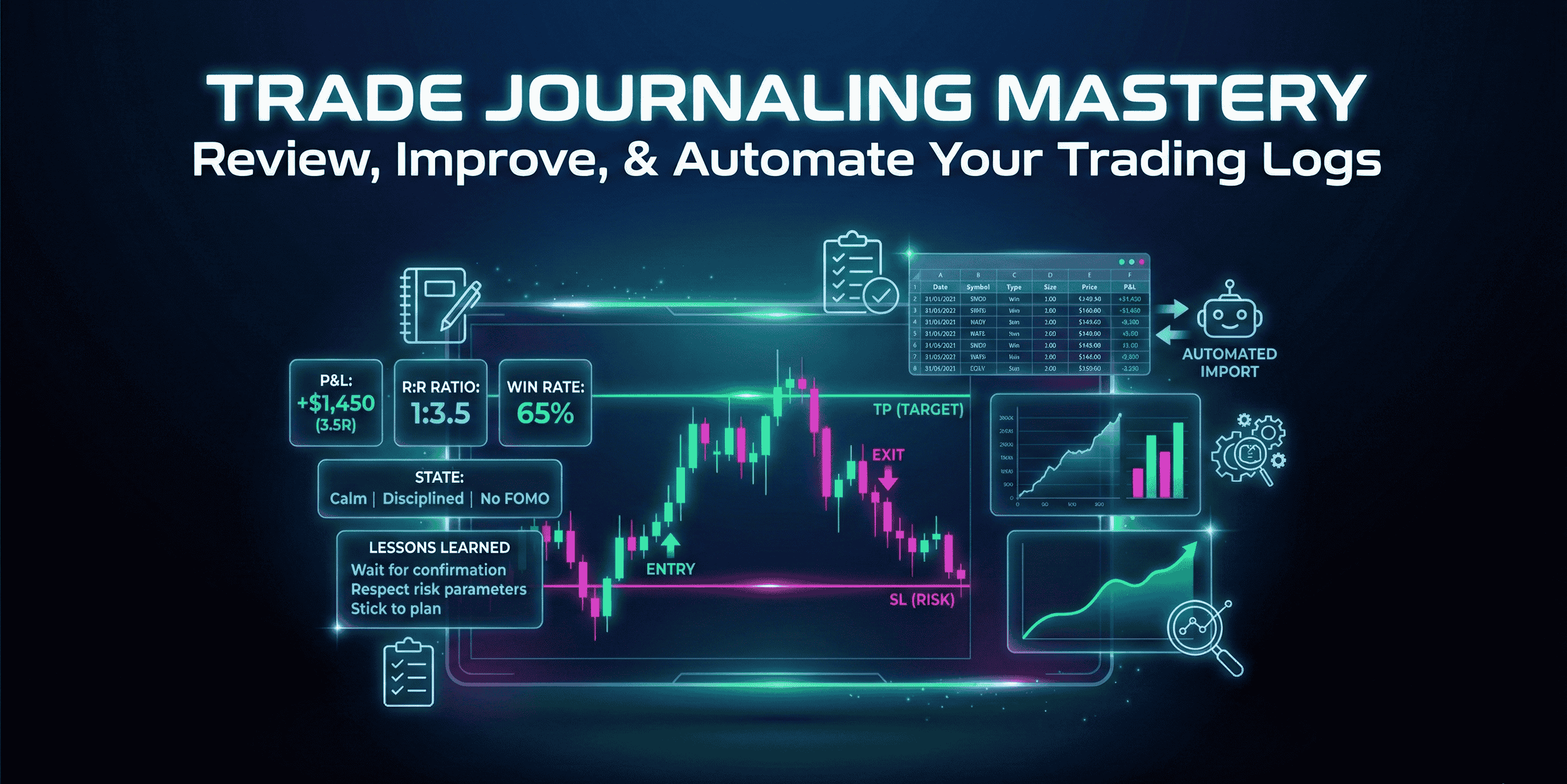
# Trade Journaling Mastery: Review, Improve, & Automate Your Trading Logs
Every successful trader, regardless of their strategy or market focus, shares one common, often understated, habit: meticulous trade journaling. While the act of recording trades might seem like a mere administrative task, its true power lies in the insights it unlocks. A well-maintained trade journal is more than just a ledger; it's a roadmap to your strengths and weaknesses, a database of your market interactions, and a personal coach offering objective feedback.
Yet, many traders struggle with consistency, knowing what to log, or how to effectively use their journal for actual improvement. This guide will demystify the process, transforming your journaling from a chore into a powerful tool for self-assessment, growth, and ultimately, enhanced profitability. We'll cover not only the "what" and "how" of journaling but also the "why" – focusing on actionable review processes and even exploring how automation can streamline your efforts.
:::key-concept The Purpose of a Trade Journal: A trade journal serves as an objective record of your trading decisions and their outcomes, allowing for systematic review, identification of patterns, and continuous refinement of your trading strategy and psychology. :::
Table of Contents
- [The Foundation of Effective Trade Journaling](#the-foundation-of-effective-trade-journaling)
- [Mastering the Review Process: Unlocking Insights](#mastering-the-review-process-unlocking-insights)
- [Identifying & Addressing Trading Biases and Mistakes](#identifying--addressing-trading-biases-and-mistakes)
- [Leveraging Automation for Enhanced Journaling](#leveraging-automation-for-enhanced-journaling)
- [Continuous Improvement and Strategic Evolution](#continuous-improvement-and-strategic-evolution)
- [Conclusion: Your Path to Trading Excellence](#conclusion-your-path-to-trading-excellence)
The Foundation of Effective Trade Journaling
Before you can review and improve, you need a solid foundation of data. What you choose to record in your journal is crucial. While the specifics might vary slightly based on your trading style, a comprehensive journal should capture both quantitative and qualitative aspects of each trade.
Essential Data Points to Log
Here's a breakdown of what every trade journal should ideally contain:
- Trade Identification:
- Date and Time: Entry and exit.
- Asset/Symbol: The specific instrument traded.
- Direction: Long or Short.
- Strategy Used: The specific setup or system you were following.
- Entry & Exit Details:
- Entry Price: Exact price of your entry.
- Exit Price: Exact price of your exit.
- Position Size: Number of shares, contracts, or lot size.
- Stop Loss (Initial & Trailing): Where you initially placed your stop and any adjustments.
- Take Profit Target: Your intended profit target.
- Risk per Trade: The percentage or dollar amount you risked.
- Reward/Risk Ratio (R:R): Calculated at entry based on your stop and target.
- Outcome & Performance:
- Gross P&L: Total profit or loss for the trade.
- Net P&L: Gross P&L minus commissions/fees (crucial for true profitability).
- Duration: How long the trade was open.
- Qualitative & Psychological Notes:
- Pre-Trade Analysis/Reason for Entry: Why did you take this trade? What were the confirming factors?
- Market Context: General market conditions (trending, range-bound, volatile).
- Trade Management Notes: How did you manage the trade? Did you adjust your stop, scale out, or make any other in-trade decisions?
- Emotional State: How were you feeling before, during, and after the trade? (e.g., confident, fearful, impatient, overconfident).
- Lessons Learned/Self-Critique: What did you do well? What could you have done better? Did you follow your plan?
- Screenshot/Chart Markup: A picture speaks a thousand words. Mark up your entry, exit, stop, and target on a chart. This is invaluable during review.
:::tip Don't overwhelm yourself initially. Start with the core quantitative data points and gradually introduce qualitative notes as you become more comfortable. Consistency is more important than perfection in the beginning. :::
Choosing Your Journaling Method
There are several ways to keep a trade journal, each with its pros and cons:
1. Spreadsheet (Excel/Google Sheets): Highly customizable, free, and allows for basic calculations and data analysis. Requires manual input. 2. Dedicated Trading Journal Software: Offers specialized features like automatic data import, advanced analytics, and integrated chart markups. This often comes with a subscription fee. 3. Physical Notebook: Good for qualitative notes and quick sketches, but lacks the analytical power of digital methods.
:::example Spreadsheet Setup Example:
Create columns for: Date | Asset | Dir | Strategy | Entry Price | Exit Price | Pos Size | Initial SL | TP Target | R:R | Net P&L | Duration | Pre-Trade Thesis | Emotional State | Lessons Learned | Chart Link
For the "Chart Link," you can use a service like TradingView to save private chart snapshots and paste the URL. This keeps your journal organized and visually rich. :::
Mastering the Review Process: Unlocking Insights
Simply logging trades isn't enough; the real value comes from a structured and consistent review process. This is where you transform raw data into actionable insights.
The Importance of Regular Reviews
- Identify Patterns: Spot recurring mistakes, effective setups, or consistent emotional triggers.
- Validate Strategies: Determine if your trading strategy has a positive edge over a statistically significant number of trades.
- Track Progress: Monitor improvements in your decision-making, discipline, and overall performance.
- Build Confidence: Reinforce successful actions and learn from unsuccessful ones without repeating them.
A Step-by-Step Review Cycle
Adopt a multi-tiered review process:
1. Daily Micro-Review (Post-Trade):
- Immediately after closing a trade, record all basic data points.
- Add quick notes on your emotional state and initial thoughts on what went well or wrong.
- Capture a chart screenshot.
2. Weekly Deep Dive:
- Set aside dedicated time (e.g., Saturday morning) for an in-depth review of all trades from the past week.
- Categorize, Filter, and Group: Look at trades by strategy, direction, asset, or outcome (winners vs. losers).
- Question Everything: For each trade, ask:
- Did I follow my trading plan precisely?
- Were my entry and exit signals valid according to my strategy?
- Was my risk management sound (position size, stop loss placement)?
- What market conditions were present, and how did they influence the outcome?
- How did my emotions affect my decisions, if at all?
- What is the key lesson from this trade?
- Identify Themes: Are there common threads among your losing trades? Or patterns in your winning trades?
- Formulate Actionable Steps: Based on your findings, what specific adjustments will you make to your plan, mindset, or market approach for the coming week?
3. Monthly/Quarterly Macro-Review:
- Perform a larger analysis of your overall performance over a more extended period.
- Performance Metrics: Calculate win rate, average win/loss, profit factor, maximum drawdown.
- Strategy Performance: Which strategies are most profitable? Which are underperforming?
- Long-Term Psychological Trends: Are certain emotional states leading to repeated errors?
- Refine Your Edge: Based on this broader view, make larger adjustments to your trading system, risk parameters, or even consider new strategies.
:::warning It's easy to dwell on losses, but it's equally important to analyze your winning trades. Understand why they worked. Was it pure luck, or did you execute your strategy flawlessly? Replicating success requires understanding its drivers. :::
Identifying & Addressing Trading Biases and Mistakes
One of the most powerful outcomes of consistent journaling and review is the ability to shine a light on your inherent biases and recurring mistakes.
Common Trading Biases to Watch For
- Confirmation Bias: Seeking out or interpreting information in a way that confirms your existing beliefs.
- Availability Heuristic: Overestimating the likelihood of events that are easily recalled (e.g., a recent big win or loss).
- Anchoring Bias: Over-relying on the first piece of information offered (e.g., initial entry price) when making decisions.
- Loss Aversion: The tendency to prefer avoiding losses over acquiring equivalent gains, often leading to holding losing trades too long or cutting winners too short.
- Overconfidence Bias: Believing your predictive abilities are better than they actually are, leading to oversized positions or neglecting risk management.
:::example Identifying Confirmation Bias:
During your weekly review, you notice a pattern: you only take trades where you have already decided the market must go in a certain direction, then you find indicators to support that pre-determined view, ignoring contrary evidence. Your journal notes might show phrases like "I knew it would drop" even when the price action was ambiguous.
Actionable Step: For the next week, mandate that you must identify at least one piece of contrary evidence for every trade idea, and note it in your journal. This forces a more balanced perspective. :::
Recurring Mistakes and How to Correct Them
Your journal is a goldmine for uncovering repeated errors. Once identified, create specific, actionable steps to mitigate them.
- Holding Losing Trades Too Long:
- Journal Clue: Frequent notes like "hoped it would come back," "didn't want to take a small loss."
- Solution: Strict adherence to initial stop loss. Consider using automated stop losses. Review your initial risk assessment more rigorously.
- Cutting Winning Trades Too Short:
- Journal Clue: Notes like "got scared it would reverse," "took profit too early."
- Solution: Stick to your original take-profit target or use a trailing stop. Practice allowing winners to run by scaling out of positions, securing partial profit while maintaining exposure.
- Overtrading/Revenge Trading:
- Journal Clue: Many trades taken after a significant loss, often with larger than usual position sizes and vague rationales.
- Solution: Implement a daily loss limit. After reaching it, close your screens. Institute a cool-down period after a significant loss before taking another trade. Focus on quality over quantity.
- Missing Trades / Hesitation:
- Journal Clue: Many "should have taken this trade" entries, or trades where you entered late with worse risk-reward.
- Solution: Refine your entry criteria for clarity. Practice identifying setups on historical charts. Build conviction through consistent backtesting.
:::key-concept The Iterative Process: Trading improvement isn't a one-time fix. It's an ongoing cycle: Journal -> Review -> Identify -> Adjust -> Repeat. Each cycle refines your edge. :::
Leveraging Automation for Enhanced Journaling
While the qualitative aspects of journaling require human input, many quantitative data points can be automated, saving time and improving accuracy. This allows you to focus more on the critical review and psychological aspects.
Tools and Techniques for Automation
1. Brokerage Statements & APIs: Many brokers offer detailed statements or even API access that can export your trade history. This data can often be imported directly into spreadsheet software or specialized journaling tools.
2. Specialized Journaling Software: Platforms like Tradervue, Chartlog, or TraderSync are designed to integrate with various brokers, automatically importing trades and providing advanced analytics. They often include features for attaching charts and adding notes.
3. Spreadsheet Macros/Scripts: For those comfortable with Excel or Google Sheets, you can write simple macros or scripts to process exported trade data, calculate metrics, and format your journal entries automatically.
4. Trading Platform Integrations: Some advanced trading platforms have built-in journaling features or can export data in formats easily digestible by journal software.
:::example Automating P&L Calculation in a Spreadsheet:
If you export your trades, you might get columns like Entry Price, Exit Price, Quantity, Buy/Sell. You can then create a new column Gross P&L and use a formula like this (for a long trade):
=IF(D2="BUY",(F2-E2)G2,-(F2-E2)G2)
Where:
D2is the "Direction" column ("BUY" or "SELL")E2is "Entry Price"F2is "Exit Price"G2is "Quantity"
Similar formulas can calculate commissions, risk, and R:R automatically. :::
The Benefits of Automation
- Time Savings: Reduces the manual effort of data entry.
- Accuracy: Eliminates human error in calculations.
- Comprehensive Data: Can capture every detail provided by your broker or platform.
- Focus on Analysis: Frees up more time for the critical review and psychological introspection.
:::warning While automation is powerful, it should not replace the qualitative aspect of journaling. Automated tools can tell you what happened, but your notes tell you why and how you felt. Both are indispensable. :::
Continuous Improvement and Strategic Evolution
Your trade journal is a living document, constantly evolving as you do. It's not a static record but a dynamic feedback loop that drives your progression as a trader.
Adapting Your Strategy
Based on your long-term reviews, you'll start to see definitive trends. Perhaps a certain market condition consistently undermines your strategy, or a particular asset class yields better results.
- Refine Entry/Exit Rules: Tighten your criteria for signals that frequently lead to losses. Loosen them (carefully) for highly successful, but perhaps under-utilized, opportunities.
- Adjust Position Sizing: Allocate more capital to higher-conviction, historically successful setups, and reduce it for riskier ones.
- Explore New Markets/Assets: Your data might reveal that your edge is stronger in crypto than in forex, or vice-versa.
- Develop New Strategies: If an existing strategy is consistently underperforming, use your journal's insights to adapt it or formulate an entirely new approach, testing it rigorously.
The Role of Market Structure and Price Action
Your journal helps you connect your trades to the larger market narrative. By reviewing charts alongside your notes, you'll gain a deeper understanding of how price action and market structure impact your results.
- Support & Resistance: Were your stops consistently hit near strong support/resistance levels? Did you enter too close to them? Your journal helps you identify if you are respecting or ignoring these critical areas.
- Trend Analysis: Are your trend-following strategies performing well in trending markets but struggling in choppy ones? Your journal provides the data to confirm this.
- Candlestick Patterns & Chart Patterns: Which patterns consistently lead to successful trades when combined with your strategy? Which are unreliable?
:::tip Don't just look at whether a strategy won or lost. Analyze why it did. Was it strong price action pushing through resistance, or a liquidity grab that trapped other traders? Understanding the underlying market mechanics captured in your charts and journal notes is key. :::
Psychological Growth
Beyond strategy, your journal is paramount for psychological mastery. Identifying emotional triggers and patterns of indiscipline is the first step towards overcoming them.
- Emotional Resilience: By consistently facing your emotional mistakes in the journal, you build self-awareness and can develop coping mechanisms.
- Discipline Reinforcement: Reviewing adherence to your plan (or lack thereof) helps reinforce good habits and highlight areas needing discipline.
- Mindset Shifts: Over time, objective data from your journal can help debunk self-sabotaging beliefs and replace them with a more rational, probability-driven mindset.
Conclusion: Your Path to Trading Excellence
Trade journaling is not a secret weapon; it is the fundamental cornerstone of deliberate practice in trading. It bridges the gap between theoretical knowledge and practical application, transforming every trade—win or loss—into a valuable learning experience. By meticulously logging quantitative and qualitative data, engaging in systematic review, identifying and addressing biases, and leveraging automation where appropriate, you empower yourself with unparalleled insights into your trading performance and psychology.
Embrace your trade journal as your most trusted mentor. It offers unbiased feedback, reveals hidden patterns, and illuminates the path to sustained improvement. The journey to trading mastery is iterative, and your journal is the engine that drives that iteration forward.
Start today. Your past trades hold the keys to your future success. Open your journal, review your performance with honesty and an open mind, and commit to the ongoing process of self-assessment and strategic refinement.
Your Next Step: Begin by reviewing your last 5-10 trades using the comprehensive review steps outlined in this guide. Don't just look at P&L; truly dig into the why behind each outcome. Use TradingView or similar platforms to capture and mark up your charts, then link them directly into your journal for a powerful visual reference during your ongoing self-analysis.