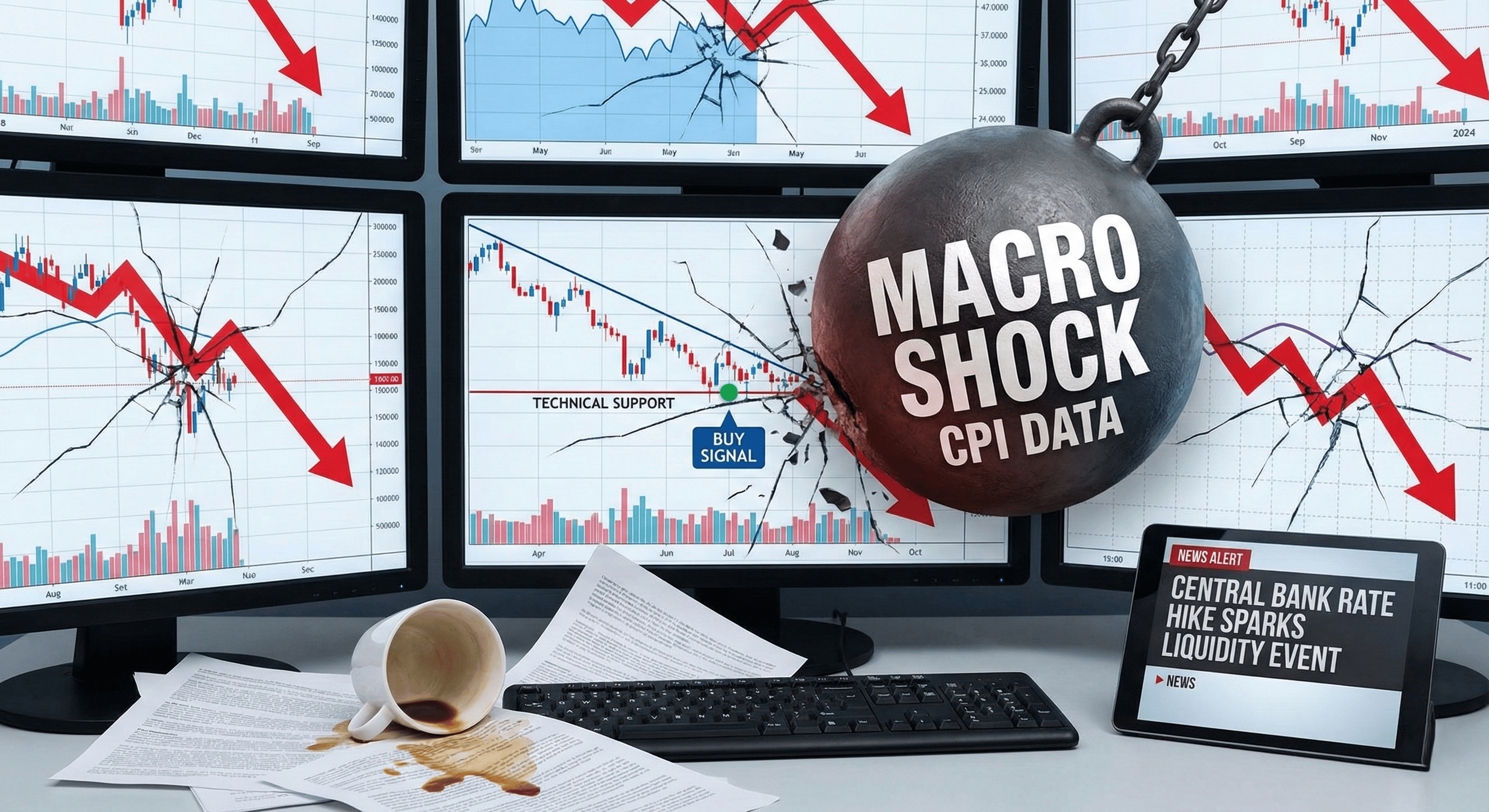
# Trading During Macro Shocks: How Interest Rates, CPI, and Liquidity Events Break Technical Setups
Macroeconomic events represent the ultimate stress test for technical traders. While price action, support and resistance levels, and chart patterns form the foundation of trading decisions, macro shocks can render these tools temporarily ineffective or create false signals that trap unprepared traders. Understanding how fundamental forces interact with technical structures separates professional traders from those caught off-guard by sudden market reversals.
The modern trading environment is increasingly dominated by algorithmic systems that react instantaneously to economic data releases, central bank communications, and liquidity conditions. These automated responses can create violent moves that break through previously reliable technical levels, stop out positioned traders, and establish new market regimes within minutes.
This guide explores advanced strategies for navigating the intersection of macroeconomic events and technical analysis, providing experienced traders with frameworks to anticipate, adapt to, and profit from macro-driven market volatility.
Table of Contents
- [Understanding Macro Market Drivers](#understanding-macro-market-drivers)
- [How Macro Events Break Technical Setups](#how-macro-events-break-technical-setups)
- [Advanced Pre-Event Positioning Strategies](#advanced-pre-event-positioning-strategies)
- [Real-Time Adaptation During Macro Shocks](#real-time-adaptation-during-macro-shocks)
- [Post-Event Technical Analysis and Recovery](#post-event-technical-analysis-and-recovery)
- [Building Macro-Aware Trading Systems](#building-macro-aware-trading-systems)
Understanding Macro Market Drivers
Macroeconomic forces operate on different time horizons and impact markets through various transmission mechanisms. Professional traders must understand these relationships to anticipate how fundamental events will interact with existing technical structures.
Central Bank Policy and Interest Rate Decisions
Central bank communications and interest rate decisions create some of the most significant market dislocations. These events operate through multiple channels:
Direct Impact Mechanisms:
- Immediate repricing of interest rate expectations across the yield curve
- Currency strength/weakness adjustments based on relative rate differentials
- Equity sector rotation between growth and value based on discount rate changes
- Credit spread adjustments reflecting changing risk premiums
Secondary Effects:
- Liquidity flow redirections between asset classes
- Changes in carry trade attractiveness
- Mortgage and lending rate adjustments affecting real economy demand
- Corporate financing cost modifications influencing earnings expectations
:::key-concept The market's reaction to central bank events depends heavily on the deviation from expectations. A 25bp rate cut that was expected often produces minimal market movement, while unexpected hawkish commentary during a dovish cut can cause significant technical level breaks. :::
Inflation Data and Economic Indicators
Consumer Price Index (CPI), Producer Price Index (PPI), and other inflation metrics directly influence central bank policy expectations and real return calculations.
CPI Release Dynamics:
- Core vs. headline inflation divergence creates nuanced market reactions
- Monthly vs. yearly comparisons provide different policy implications
- Regional variations (services vs. goods inflation) influence sector-specific moves
- Inflation expectations embedded in bond yields often move before actual data
Market Transmission Channels: 1. Bond Markets: Yield curve steepening/flattening based on inflation trajectory expectations 2. Currency Markets: Real interest rate differentials driving capital flows 3. Equity Markets: Sector rotation based on pricing power and margin compression risks 4. Commodity Markets: Inflation hedging demand and input cost considerations
:::example A higher-than-expected CPI reading might break upward through a key resistance level in 10-year Treasury yields while simultaneously breaking downward through support in growth stocks, as traders rapidly repriced Fed policy expectations and sector valuations. :::
Liquidity Events and Market Structure
Liquidity conditions fundamentally alter how technical levels function. During high liquidity periods, technical levels tend to hold as there are sufficient market participants to absorb flows. During liquidity crunches, these same levels can be overwhelmed rapidly.
Liquidity Indicators:
- Federal Reserve reverse repo facility usage
- Term structure of funding markets (SOFR, LIBOR-OIS spreads)
- Cross-currency basis swaps indicating USD funding stress
- Options market maker inventory and gamma exposure
- Bank lending surveys and credit availability metrics
Liquidity-Driven Technical Breaks:
- Month-end and quarter-end rebalancing flows
- Options expiry gamma squeezes and pin effects
- Margin call cascades during volatility spikes
- Algorithmic stop-loss clustering around technical levels
How Macro Events Break Technical Setups
Macroeconomic events disrupt technical patterns through several mechanisms that experienced traders must recognize and adapt to in real-time.
Volatility Expansion and Range Breakouts
Macro events typically cause immediate volatility expansion that can break established trading ranges and invalidate consolidation patterns.
Pre-Event Range Compression: Markets often compress volatility in the days leading up to major announcements, creating tight trading ranges and apparent technical setups. This compression represents uncertainty rather than genuine consolidation.
Event-Driven Expansion:
- Average True Range (ATR) can double or triple within hours
- Previously respected support/resistance levels get overwhelmed by volume
- Stop-loss levels clustered around technical points get triggered en masse
- Intraday reversal patterns form and break within the same session
:::warning Do not assume pre-event consolidation patterns will resolve in the direction of the preceding trend. Macro events can completely reverse established directional bias regardless of technical setup quality. :::
Correlation Breakdown and Divergence
Normal inter-market relationships often break down during macro shocks as different assets respond to varying aspects of the same fundamental development.
Traditional Correlation Failures:
- Risk-on/risk-off relationships may invert based on specific policy implications
- Currency correlations with interest rate differentials can temporarily disconnect
- Sector rotation patterns may accelerate beyond normal technical relationships
- Safe haven flows may contradict traditional technical momentum signals
Divergence Trading Opportunities: 1. Currency Pairs: Major pairs may diverge from interest rate differentials during initial shock periods 2. Equity Sectors: Growth vs. value spreads can create technical breakouts independent of broader market direction 3. Fixed Income: Yield curve segments may move independently based on duration-specific policy impacts 4. Commodities: Individual commodity technicals may diverge from broader commodity complex moves
Algorithm-Driven Technical Level Violations
Modern markets feature heavy algorithmic participation that can amplify macro-driven moves beyond what fundamental analysis alone would suggest.
Algorithmic Amplification Factors:
- Momentum algorithms that chase breakouts regardless of fundamental justification
- Risk parity systems that adjust exposure based on realized volatility changes
- Options market makers hedging gamma exposure during large moves
- High-frequency systems exploiting temporary liquidity imbalances
Technical Level Cascade Effects: 1. Initial Break: Macro event breaks first technical level 2. Stop Triggering: Clustered stops around broken level get hit 3. Momentum Acceleration: Algorithms detect breakout and add to move 4. Liquidity Gaps: Next significant technical level may be much further away 5. Exhaustion: Move finally stops at major structural level or due to position size limits
Advanced Pre-Event Positioning Strategies
Professional traders develop sophisticated approaches to position for macro events while managing the inherent unpredictability of market reactions.
Scenario-Based Position Sizing
Rather than taking directional bets, advanced traders construct portfolios that can profit from multiple potential outcomes while limiting downside in adverse scenarios.
Multi-Outcome Framework: 1. Base Case (40-50% probability): Most likely market reaction based on consensus expectations 2. Upside Surprise (25-30% probability): More extreme positive reaction than expected 3. Downside Surprise (25-30% probability): Negative or opposite reaction to expectations 4. Black Swan (5-10% probability): Completely unexpected outcome requiring damage control
Position Construction Principles:
- No single position should risk more than 2-3% of capital on event outcome
- Include positions that benefit from volatility expansion regardless of direction
- Maintain dry powder for post-event opportunities when volatility normalizes
- Consider time decay effects for options-based strategies
:::tip Use options strategies like straddles or strangles around key technical levels to profit from volatility expansion while limiting directional risk. The key is positioning these strategies at levels where technical breaks are most likely to occur. :::
Technical Level Identification for Event Trading
Identifying the most likely technical levels to break during macro events requires understanding where algorithmic systems and human traders have positioned stops and entries.
Critical Level Hierarchy: 1. Primary Levels: Major support/resistance with multiple timeframe confluence 2. Secondary Levels: Important but less significant technical points 3. Tertiary Levels: Minor intraday levels useful for execution timing
Stop Cluster Analysis:
- Use market depth data to identify where stops are likely clustered
- Monitor previous failed breakout levels where trapped traders may exit
- Identify round number psychological levels that attract algorithmic strategies
- Analyze options strike concentration for potential pin or squeeze effects
Confluence Factor Weighting:
- Volume Profile: High volume nodes indicate stronger support/resistance
- Multiple Timeframes: Levels respected on daily, weekly, and monthly charts
- Fibonacci Relationships: Retracement and extension levels with historical significance
- Moving Average Clusters: Multiple MAs converging at similar price levels
Options Market Intelligence
The options market provides valuable intelligence about where professional traders expect macro events to drive prices.
Key Options Metrics:
- Implied Volatility Skew: Shows where traders expect larger moves
- Put/Call Ratios: Indicates directional bias and hedging activity
- Gamma Exposure: Reveals where market makers will amplify moves
- Options Flow: Large institutional orders indicating smart money positioning
Event-Specific Options Strategies: 1. Volatility Plays: Long straddles/strangles positioned at key technical levels 2. Directional Hedges: Protective puts or calls to limit adverse scenario damage 3. Time Decay Advantage: Short premium strategies if implied volatility is excessive 4. Structural Plays: Calendar spreads exploiting event-driven volatility patterns
Real-Time Adaptation During Macro Shocks
The ability to adapt quickly during macro events separates profitable traders from those caught in adverse positions. This requires both technical skills and mental frameworks for rapid decision-making under pressure.
Immediate Response Protocols
Develop systematic approaches for the first minutes after major macro announcements when markets are most volatile and technical analysis is least reliable.
First 15 Minutes Protocol: 1. Pause New Entries: Avoid initiating new positions until initial volatility subsides 2. Review Existing Positions: Check if any positions are at risk of catastrophic loss 3. Monitor Key Levels: Watch for breaks of pre-identified critical technical levels 4. Assess Liquidity: Determine if normal market functioning has been disrupted 5. Gather Information: Rapidly process the actual announcement vs. expectations
Position Management Decisions:
- Stop Loss Adjustment: Widen stops temporarily if normal volatility has expanded
- Profit Taking: Consider taking profits on positions showing immediate favorable movement
- Position Sizing: Reduce size on any new trades until volatility normalizes
- Hedge Implementation: Add hedges to protect against further adverse moves
:::warning Never chase the initial move immediately after a macro announcement. Wait for the first wave of volatility to subside and new technical levels to establish before making significant position changes. :::
Identifying New Technical Structures
After the initial shock, new technical patterns and levels quickly establish as the market processes the fundamental implications.
Post-Event Technical Analysis:
- New Support/Resistance: Levels where the initial move found buyers/sellers
- Volume Confirmation: Whether breakouts occurred on expanding or contracting volume
- Momentum Divergence: If price and momentum indicators are aligned with the new direction
- Inter-market Confirmation: Whether related markets are confirming the move
Pattern Recognition in Volatile Environments: 1. Flag Patterns: Brief consolidations after strong event-driven moves 2. Exhaustion Gaps: Price gaps that represent climactic buying/selling 3. Reversal Patterns: Hammer/doji candles at new extreme levels 4. Continuation Patterns: Triangles and pennants suggesting more movement ahead
Dynamic Risk Management
Macro events require flexible risk management approaches that can adapt to rapidly changing market conditions.
Volatility-Adjusted Position Sizing:
- Scale position sizes inversely with current volatility levels
- Use ATR-based stops rather than fixed percentage stops
- Implement time-based stops for event-driven trades
- Consider correlation adjustments when multiple positions are affected
Stress Testing Existing Positions:
- Model portfolio performance under extreme scenarios
- Identify which positions provide diversification vs. concentration risk
- Calculate maximum adverse excursion for each position
- Determine portfolio-level stop loss levels
Post-Event Technical Analysis and Recovery
Once the initial macro shock subsides, markets typically enter a recovery phase where new technical structures establish and normal trading patterns resume.
Identifying Market Regime Changes
Macro events can create permanent shifts in market structure that require adjusting technical analysis approaches.
Regime Change Indicators:
- Volatility Persistence: Whether elevated volatility continues beyond the initial event
- Correlation Shifts: Changes in how different assets move relative to each other
- Volume Patterns: Whether volume remains elevated or returns to normal levels
- Sentiment Extremes: Positioning data showing overcrowded trades being unwound
Technical Adaptation Requirements: 1. New Key Levels: Update support/resistance based on post-event price action 2. Volatility Adjustments: Modify indicator settings and stop distances for new environment 3. Timeframe Emphasis: Shift focus to appropriate timeframes for new volatility regime 4. Pattern Recognition: Adjust pattern identification for changed market character
Mean Reversion vs. Trend Continuation
Determining whether post-event moves will reverse or continue requires analyzing multiple factors beyond traditional technical indicators.
Mean Reversion Signals:
- Extreme sentiment readings suggesting oversold/overbought conditions
- Fundamental factors that don't justify the magnitude of price movement
- Technical divergences between price and momentum indicators
- Historical patterns showing similar events typically reverse
Trend Continuation Signals:
- Fundamental shifts that justify new pricing equilibrium
- Strong volume confirmation of the new direction
- Multiple timeframe alignment supporting continued movement
- Options positioning suggesting limited resistance to further moves
:::example After an unexpected hawkish Fed announcement breaks USD/JPY through major resistance, look for: 1) Volume confirmation of the break, 2) Whether Japanese officials intervene, 3) If other USD pairs confirm the dollar strength, 4) Whether bond yields support the currency move. These factors determine if the break represents a new trend or temporary spike. :::
Recovery Phase Trading Opportunities
The post-event recovery period often provides some of the best risk-adjusted trading opportunities as normal technical analysis regains effectiveness.
High-Probability Setups: 1. Failed Breakout Reversals: When initial event-driven moves fail to sustain 2. New Range Establishments: Trading between newly established support/resistance 3. Momentum Divergences: Price making new highs/lows without momentum confirmation 4. Inter-market Realignment: Trading relationships returning to normal correlations
Execution Considerations:
- Wait for at least 24-48 hours after major events before resuming normal position sizing
- Focus on higher timeframe setups that are less affected by residual volatility
- Use wider stops initially and tighten as market conditions normalize
- Pay attention to upcoming event calendar to avoid getting caught in another shock
Building Macro-Aware Trading Systems
Successful traders develop systematic approaches that integrate macroeconomic awareness into their technical trading processes.
Event Calendar Integration
Building macro event awareness into trading systems requires systematic tracking and preparation protocols.
High-Impact Event Tracking:
- Central bank meetings and policy announcements
- Key economic data releases (CPI, NFP, GDP, etc.)
- Geopolitical events and election outcomes
- Corporate earnings seasons and major announcements
- Options expiration dates and rebalancing periods
Pre-Event Preparation Checklist: 1. Position Review: Assess current portfolio exposure to event outcomes 2. Level Identification: Mark key technical levels likely to be tested 3. Volatility Preparation: Adjust position sizes and stop distances 4. Scenario Planning: Outline responses to different outcome scenarios 5. Opportunity Identification: Prepare for post-event trading setups
Technical Analysis Modifications
Standard technical analysis requires modifications to remain effective in macro-sensitive environments.
Indicator Adjustments:
- Use longer-period moving averages during high volatility regimes
- Implement volatility-adjusted oscillators (RSI with ATR normalization)
- Apply multiple timeframe confirmation more strictly
- Include volume analysis more heavily in pattern recognition
Pattern Recognition Evolution:
- Recognize that classical patterns may complete faster in volatile environments
- Accept that traditional pattern targets may be exceeded during macro moves
- Focus on volume-confirmed patterns rather than price-only formations
- Use shorter-term patterns for timing while maintaining longer-term directional bias
Risk Management Framework
Macro-aware risk management goes beyond simple stop losses to include portfolio-level protections and scenario-based hedging.
Portfolio Construction Principles:
- Maintain maximum 60-70% correlation between major positions
- Include at least one position that benefits from volatility expansion
- Keep 20-30% cash available for post-event opportunities
- Use options hedges rather than just stop losses for tail risk protection
Dynamic Risk Scaling:
Position Size = Base Size × (1 / Current Volatility) × (1 / Event Proximity)This formula automatically reduces position sizes as volatility increases and major events approach, then allows for larger positions during stable periods.
:::tip Create a "macro intensity score" ranging from 1-10 based on the number and importance of upcoming events. Scale your overall risk exposure inversely to this score, maintaining higher cash levels when multiple high-impact events are approaching. :::
Technology and Information Integration
Modern macro-aware trading requires sophisticated information processing and execution capabilities.
Essential Technology Stack:
- Real-time economic calendar with impact ratings
- News feeds with natural language processing for sentiment analysis
- Volatility monitoring across multiple timeframes and assets
- Options flow data for institutional positioning insights
- Cross-asset correlation monitoring and alert systems
Information Processing Workflow: 1. Morning Preparation: Review day's events and adjust position sizing 2. Pre-Event Monitoring: Track market positioning and technical levels 3. Event Reaction: Monitor initial moves and liquidity conditions 4. Post-Event Analysis: Assess new technical structures and opportunities 5. End-of-Day Review: Update levels and prepare for next session
Conclusion
Trading during macro shocks requires a fundamental shift from pure technical analysis toward an integrated approach that considers both fundamental catalysts and technical structures. The most successful traders develop systematic frameworks that can adapt quickly to changing market conditions while maintaining disciplined risk management.
Key principles for navigating macro-driven markets include:
- Preparation Over Prediction: Focus on preparing for multiple scenarios rather than trying to predict specific outcomes
- Flexibility Over Rigidity: Maintain adaptable systems that can evolve with changing market conditions
- Risk Management Over Profit Maximization: Prioritize capital preservation during uncertain periods
- Integration Over Separation: Combine fundamental awareness with technical execution rather than treating them as separate disciplines
The modern trading environment increasingly rewards those who can synthesize information from multiple sources and adapt quickly to changing conditions. By developing macro-aware trading systems, experienced traders can turn potential disruptions into profitable opportunities while protecting their capital during periods of extreme volatility.
Remember that macro events create both risks and opportunities. While they can invalidate existing technical setups, they also create new structures and trading possibilities for those prepared to adapt. The key is maintaining the discipline to follow systematic approaches even when markets become chaotic and emotional pressures intensify.
Start implementing these concepts by reviewing your current trading approach and identifying where macro awareness can be better integrated. Practice with smaller position sizes during upcoming economic events, and gradually build confidence in your ability to navigate these challenging but potentially profitable market conditions.