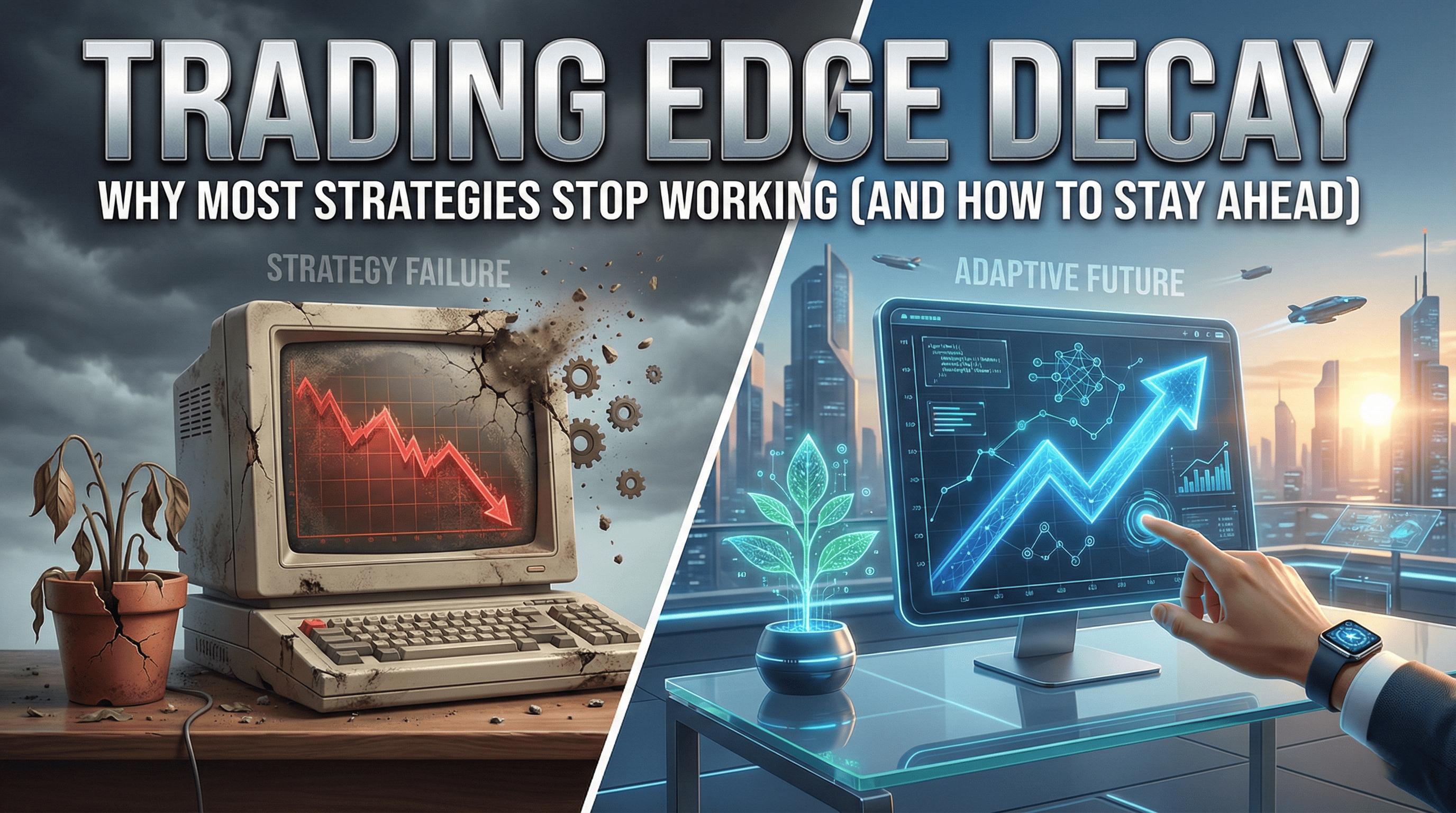
# Trading Edge Decay: Why Most Strategies Stop Working and How to Stay Ahead
Every successful trader has experienced it: a strategy that once generated consistent profits suddenly starts producing losses. What was once your reliable edge in the market seems to have vanished overnight. This phenomenon, known as "edge decay," is one of the most challenging aspects of trading that separates long-term winners from those who eventually give up.
Understanding why trading edges decay and learning how to adapt is crucial for sustained trading success. In this comprehensive guide, we'll explore the mechanisms behind edge decay, identify the warning signs, and provide actionable strategies to maintain and evolve your trading advantage in an ever-changing market environment.
Table of Contents
- [Understanding Edge Decay](#understanding-edge-decay)
- [Common Causes of Strategy Failure](#common-causes-of-strategy-failure)
- [Recognizing Early Warning Signs](#recognizing-early-warning-signs)
- [Market Evolution and Adaptation](#market-evolution-and-adaptation)
- [Maintaining Your Trading Edge](#maintaining-your-trading-edge)
- [Building Anti-Fragile Trading Systems](#building-anti-fragile-trading-systems)
- [Future-Proofing Your Strategy](#future-proofing-your-strategy)
- [Conclusion](#conclusion)
Understanding Edge Decay
Edge decay refers to the gradual or sudden deterioration of a trading strategy's effectiveness over time. What once provided a statistical advantage in the markets becomes less profitable or even unprofitable as market conditions change, competition increases, or inefficiencies are arbitraged away.
:::key-concept A trading edge is any systematic advantage that allows you to profit consistently from market inefficiencies. Edge decay occurs when these inefficiencies disappear or when market participants adapt to exploit the same opportunities. :::
The Lifecycle of a Trading Edge
Every trading strategy follows a predictable lifecycle:
1. Discovery Phase: A new inefficiency or pattern is identified 2. Exploitation Phase: Early adopters profit from the edge 3. Maturation Phase: More traders discover and use the strategy 4. Saturation Phase: The edge becomes crowded and less profitable 5. Decay Phase: The edge diminishes or disappears entirely
Types of Edge Decay
Gradual Decay: The most common form, where profitability slowly erodes over months or years as more participants discover and exploit the same opportunities.
Sudden Decay: Occurs when market structure changes dramatically, such as new regulations, technological advances, or major economic shifts that instantly invalidate certain strategies.
Cyclical Decay: Some edges work in specific market conditions but fail in others, creating periods of effectiveness followed by periods of underperformance.
:::example Consider the classic "January Effect" in stock markets, where small-cap stocks historically outperformed in January. As this anomaly became widely known and institutionalized, the effect largely disappeared due to increased competition and front-running. :::
Common Causes of Strategy Failure
Understanding why trading strategies fail is essential for preventing edge decay. Here are the primary factors that contribute to strategy deterioration:
Market Structure Changes
Markets are constantly evolving, and structural changes can render previously successful strategies ineffective:
- Regulatory Changes: New rules can eliminate certain trading opportunities
- Technological Advances: High-frequency trading and algorithmic systems can arbitrage away inefficiencies
- Market Participant Evolution: As retail traders become more sophisticated, simple strategies become less effective
- Liquidity Changes: Shifts in market liquidity can impact strategy performance
Information Diffusion
As trading strategies become more widely known, their effectiveness typically decreases:
- Educational Content: Books, courses, and online content spread strategy knowledge
- Social Media: Trading communities share successful approaches
- Institutional Adoption: Hedge funds and prop trading firms scale successful strategies
- Academic Research: Studies that identify anomalies often lead to their elimination
:::warning Be cautious of any trading strategy that's heavily promoted or widely discussed. The more popular a strategy becomes, the more likely it is to experience edge decay. :::
Overcrowding Effects
When too many traders attempt to exploit the same edge:
- Price Impact: Large combined positions move prices unfavorably
- Timing Competition: Traders compete to enter and exit positions first
- Risk Parameter Changes: Stop losses and profit targets become predictable
- Slippage Increases: Execution quality deteriorates due to competition
Data Mining and Curve Fitting
Some apparent edges never existed in the first place:
- Selection Bias: Choosing favorable time periods or instruments for backtesting
- Overfitting: Creating overly complex rules that work on historical data but fail in live markets
- Survivorship Bias: Ignoring failed strategies when evaluating performance
- Look-Ahead Bias: Using future information in historical testing
Recognizing Early Warning Signs
Successful traders monitor their strategies continuously for signs of deteriorating performance. Here are key indicators that your edge may be decaying:
Performance Metrics
Declining Win Rate: A gradual decrease in the percentage of profitable trades
Reduced Average Win Size: Smaller profits per winning trade
Increased Average Loss Size: Larger losses per losing trade
Lower Risk-Adjusted Returns: Decreasing Sharpe ratio or other risk-adjusted metrics
Extended Drawdown Periods: Longer periods of consecutive losses or flat performance
Market Behavior Changes
Decreased Volatility in Target Setups: The market moves you're trying to capture become smaller
Faster Price Discovery: Markets reach target levels more quickly, reducing profit potential
Increased False Signals: More setups that look valid but fail to follow through
Changed Order Flow Patterns: Different buying and selling behavior in your target scenarios
:::tip Maintain detailed trading records and review them regularly. Many edge decay warning signs become apparent only when analyzed over extended periods. :::
Systematic Monitoring Approach
1. Rolling Performance Analysis: Evaluate your strategy's performance using rolling windows (e.g., 30, 60, 90 days) 2. Benchmark Comparison: Compare your results to relevant market benchmarks 3. Setup Quality Assessment: Monitor the quality and frequency of your trading setups 4. Execution Analysis: Track slippage, fill rates, and timing issues 5. Market Regime Detection: Identify when market conditions change significantly
Market Evolution and Adaptation
Markets are dynamic systems that constantly evolve, driven by technological advancement, regulatory changes, and shifts in participant behavior. Understanding these evolutionary forces helps traders anticipate and adapt to change.
Technological Impact
Technology continues to reshape trading landscapes:
Algorithmic Trading Growth: Automated systems now dominate many markets, changing price action characteristics and reducing certain inefficiencies.
Data Accessibility: Previously exclusive data sources become widely available, democratizing information advantages.
Execution Speed: Faster execution capabilities compress profit windows for certain strategies.
Machine Learning Integration: AI-driven strategies adapt more quickly to market changes.
Regulatory Evolution
Regulatory changes can dramatically impact trading strategies:
- Circuit Breakers: Limit extreme price movements
- Position Limits: Restrict large speculative positions
- Transparency Requirements: Increase market information disclosure
- Tax Changes: Affect strategy profitability calculations
:::example The implementation of MiFID II in Europe significantly changed market structure, affecting everything from research distribution to execution quality. Traders who failed to adapt their strategies to these changes saw their performance suffer. :::
Participant Sophistication
As market participants become more sophisticated:
- Retail Education: Individual traders become better informed and educated
- Institutional Evolution: Hedge funds and prop firms develop more advanced strategies
- Cross-Market Arbitrage: Inefficiencies across different markets get arbitraged away faster
- Risk Management: Better risk management practices reduce extreme market moves
Maintaining Your Trading Edge
The key to long-term trading success lies not in finding a perfect strategy that works forever, but in continuously maintaining and evolving your edge. Here's how to stay ahead:
Continuous Strategy Development
Research and Development: Allocate time and resources to developing new approaches
Market Analysis: Regularly analyze market structure changes and their implications
Strategy Diversification: Maintain multiple uncorrelated edges to reduce dependency risk
Innovation Focus: Look for new inefficiencies before they become widely known
Adaptive Risk Management
Your risk management approach must evolve with your strategies:
- Dynamic Position Sizing: Adjust position sizes based on current edge strength
- Correlation Monitoring: Watch for increasing correlations between different strategies
- Volatility Adjustment: Adapt to changing market volatility regimes
- Drawdown Management: Implement systematic rules for reducing risk during poor performance periods
:::key-concept Effective traders don't just have good strategies; they have good processes for identifying when strategies need modification or replacement. :::
Performance Review Framework
Implement a systematic approach to strategy evaluation:
1. Monthly Performance Review: Analyze key metrics and identify trends 2. Quarterly Strategy Assessment: Deep dive into strategy effectiveness 3. Annual Portfolio Review: Evaluate overall edge portfolio and make strategic adjustments 4. Event-Driven Reviews: Conduct special reviews after significant market events
Edge Preservation Techniques
Selective Disclosure: Be careful about sharing successful strategies publicly
Scale Management: Avoid growing positions beyond the strategy's capacity
Timing Variation: Introduce slight variations in entry and exit timing
Parameter Evolution: Gradually adjust strategy parameters as markets change
Building Anti-Fragile Trading Systems
Anti-fragile trading systems don't just survive market changes—they improve from stress and volatility. Building such systems requires specific design principles:
Diversification Strategies
Temporal Diversification: Use strategies that work in different time frames
Market Diversification: Trade across multiple asset classes and markets
Method Diversification: Employ different analytical approaches (technical, fundamental, quantitative)
Risk Factor Diversification: Ensure strategies respond to different risk factors
Adaptive Mechanisms
Machine Learning Integration: Use AI to identify when market conditions change
Regime Detection: Build systems that recognize different market environments
Parameter Optimization: Implement dynamic parameter adjustment based on performance
Feedback Loops: Create systems that learn from both successes and failures
:::example A trend-following system might incorporate mean-reversion components that activate during ranging markets, creating a hybrid approach that adapts to different market conditions. :::
Stress Testing Framework
Historical Stress Tests: Test strategies across various historical periods
Monte Carlo Simulations: Generate thousands of potential future scenarios
Correlation Breakdown Tests: Evaluate performance when correlations change suddenly
Liquidity Stress Tests: Assess strategy performance during liquidity crunches
Modular Design Principles
Component Independence: Build strategies with independent, swappable components
Gradual Integration: Introduce new elements gradually rather than wholesale changes
Fallback Options: Include backup approaches for when primary methods fail
Kill Switches: Implement automatic shutoffs for severely underperforming strategies
Future-Proofing Your Strategy
While it's impossible to predict exactly how markets will evolve, certain principles can help future-proof your trading approach:
Focus on Fundamentals
Human Psychology: Strategies based on enduring psychological principles tend to last longer
Market Structure: Understanding underlying market mechanics helps identify durable edges
Economic Principles: Grounding strategies in sound economic theory increases longevity
Risk Premium Capture: Focus on capturing genuine risk premiums rather than pure inefficiencies
Technology Integration
Automation Capabilities: Build systems that can incorporate new technologies
Data Pipeline Flexibility: Design data systems that can handle new information sources
Execution Adaptability: Ensure execution systems can adapt to new market structures
Monitoring Systems: Implement comprehensive monitoring for early problem detection
:::warning Don't become overly dependent on any single technology or data source. Markets can change faster than technology, and what works today may not work tomorrow. :::
Knowledge Ecosystem Development
Continuous Learning: Stay updated on market developments, academic research, and industry trends
Network Building: Maintain connections with other traders, researchers, and market participants
Information Sources: Diversify your information sources to get multiple perspectives
Skill Development: Continuously develop new analytical and technical skills
Scenario Planning
Develop and regularly update scenarios for potential market changes:
- Regulatory Scenarios: How might new regulations affect your strategies?
- Technology Scenarios: What if execution speeds increase by 10x?
- Market Structure Scenarios: How would changes in market making affect your approach?
- Economic Scenarios: How do your strategies perform in different economic environments?
Innovation Pipeline
Research Allocation: Dedicate specific resources to exploring new opportunities
Experimentation Framework: Establish systematic processes for testing new ideas
Partnership Opportunities: Collaborate with others to accelerate innovation
Academic Monitoring: Stay aware of relevant academic research that might impact markets
Conclusion
Trading edge decay is an inevitable reality that every successful trader must confront. The strategies that work today may not work tomorrow, and the key to long-term success lies not in finding a perfect system, but in building the capability to continuously adapt and evolve.
The most successful traders understand that edge decay is not a problem to be solved once, but an ongoing challenge that requires constant attention. They build systems that are anti-fragile, diversified, and adaptive. They monitor their performance carefully, recognize warning signs early, and aren't afraid to modify or abandon strategies that are no longer effective.
Remember that edge decay often accelerates when strategies become widely known. The very act of sharing a successful approach contributes to its eventual demise. This doesn't mean you should never share knowledge, but it does mean you should be strategic about what you share and when.
The future belongs to traders who can adapt quickly, innovate continuously, and maintain multiple edges simultaneously. By understanding the principles outlined in this guide and applying them systematically, you can build a trading approach that not only survives in changing markets but thrives because of change.
:::tip Start by conducting a comprehensive review of your current strategies. Identify which ones might be vulnerable to edge decay and begin developing backup approaches. The best time to prepare for edge decay is before it happens. :::
Take action today by analyzing your trading performance for early signs of edge decay, and begin building the adaptive systems that will keep you ahead of the curve in tomorrow's markets.
Practical Implementation Checklist
To help you implement the concepts from this guide, here's a systematic checklist you can follow:
Immediate Actions (Next 30 Days)
Strategy Audit
- Document all current trading strategies with entry/exit rules
- Calculate key performance metrics for each strategy over the past 12 months
- Identify strategies showing declining performance or increasing volatility
- List the core assumptions underlying each strategy
Monitoring Setup
- Implement automated performance tracking for each strategy
- Set up alerts for key performance deterioration indicators
- Create a monthly review schedule for strategy assessment
- Establish benchmarks for when to investigate potential edge decay
Medium-term Goals (Next 90 Days)
Diversification Enhancement
- Identify gaps in your current strategy portfolio
- Research and paper trade 2-3 new potential strategies
- Develop strategies for different market conditions (trending, ranging, volatile)
- Create position sizing rules that account for strategy correlation
Adaptive Systems
- Implement dynamic position sizing based on recent performance
- Set up regime detection indicators for your primary markets
- Create decision trees for strategy modification triggers
- Establish protocols for strategy retirement
Long-term Development (Next 12 Months)
Innovation Framework
- Allocate 10-20% of trading capital to experimental strategies
- Set up systematic backtesting and forward testing processes
- Create relationships with other traders for idea exchange
- Establish a research budget for market data and tools
Continuous Learning
- Schedule monthly market structure analysis sessions
- Track regulatory changes that might affect your markets
- Monitor academic research relevant to your trading approach
- Attend industry conferences or join professional trading groups
:::warning Don't try to implement everything at once. Start with the immediate actions and gradually build your adaptive trading infrastructure over time. Rushing the process can lead to overcomplication and reduced focus on execution. :::
Common Pitfalls to Avoid
The Optimization Trap
Many traders respond to edge decay by over-optimizing their existing strategies. This typically makes the problem worse by:
- Creating overfitted systems that work only on historical data
- Reducing the strategy's robustness to market changes
- Adding complexity without adding genuine edge
:::key-concept When a strategy starts failing, the solution is rarely more optimization. Instead, consider whether the underlying market dynamic has changed permanently. :::
The Abandonment Reflex
Conversely, some traders abandon strategies too quickly at the first sign of underperformance. Before retiring a strategy:
- Ensure you have sufficient sample size to draw conclusions
- Consider whether poor performance is due to temporary market conditions
- Analyze whether the strategy can be modified rather than discarded
- Check if the issue is execution rather than the strategy itself
The New Strategy Addiction
Some traders constantly chase new strategies instead of properly developing and maintaining existing ones. This leads to:
- Never fully understanding any single approach
- Increased transaction costs from constant strategy switching
- Reduced compound learning from strategy mastery
- Higher likelihood of catching strategies at their peak rather than their beginning
Building Your Edge Decay Defense Network
Internal Resources
Trading Journal Evolution: Transform your trading journal from a simple record into an analytical tool that tracks:
- Strategy performance by market regime
- Changes in market microstructure affecting your trades
- Correlation between different strategies over time
- Early warning indicators of performance deterioration
Simulation Environment: Develop capabilities to:
- Test how strategies would perform under different market conditions
- Simulate the impact of increased competition in your trading approach
- Model how changes in transaction costs might affect profitability
- Evaluate new ideas without risking real capital
External Resources
Information Networks: Build relationships with:
- Other traders in complementary (not competing) markets
- Academic researchers studying market microstructure
- Technology providers who can offer insights into market evolution
- Regulatory experts who understand upcoming changes
Market Intelligence: Develop processes to monitor:
- New participants entering your markets
- Changes in market making and liquidity provision
- Regulatory proposals that might affect market structure
- Technological developments that could change execution dynamics
:::tip The best defense against edge decay is often a strong offense. While protecting existing strategies is important, continuously developing new approaches ensures you're not entirely dependent on any single edge. :::
Final Thoughts: Embracing Impermanence
The concept of edge decay can initially feel discouraging – after all, no trader wants to hear that their successful strategies have an expiration date. However, understanding and preparing for edge decay is ultimately liberating. It frees you from the false hope of finding a "holy grail" system and instead focuses your energy on building sustainable, adaptive trading capabilities.
The most successful traders in history haven't been those who found one perfect strategy, but those who continuously evolved their approach as markets changed around them. They understood that in trading, as in nature, it's not the strongest who survive, but those most adaptable to change.
Edge decay is not your enemy – it's simply a fact of market life. By acknowledging it, preparing for it, and building systems to address it, you transform a potential weakness into a significant competitive advantage. While other traders are caught off guard by changing markets, you'll be ready to adapt and thrive.
:::key-concept The goal isn't to prevent edge decay – it's to be so well-prepared for it that when your edges inevitably evolve, you're already several steps ahead with new ones ready to take their place. :::
Start today by honestly assessing your current strategies, implementing monitoring systems, and beginning the process of building your adaptive trading infrastructure. The markets of tomorrow will belong to those who prepare for change today.
Your journey toward becoming an anti-fragile trader begins with a single step: acknowledging that change is the only constant in trading, and positioning yourself to benefit from that reality rather than being harmed by it.