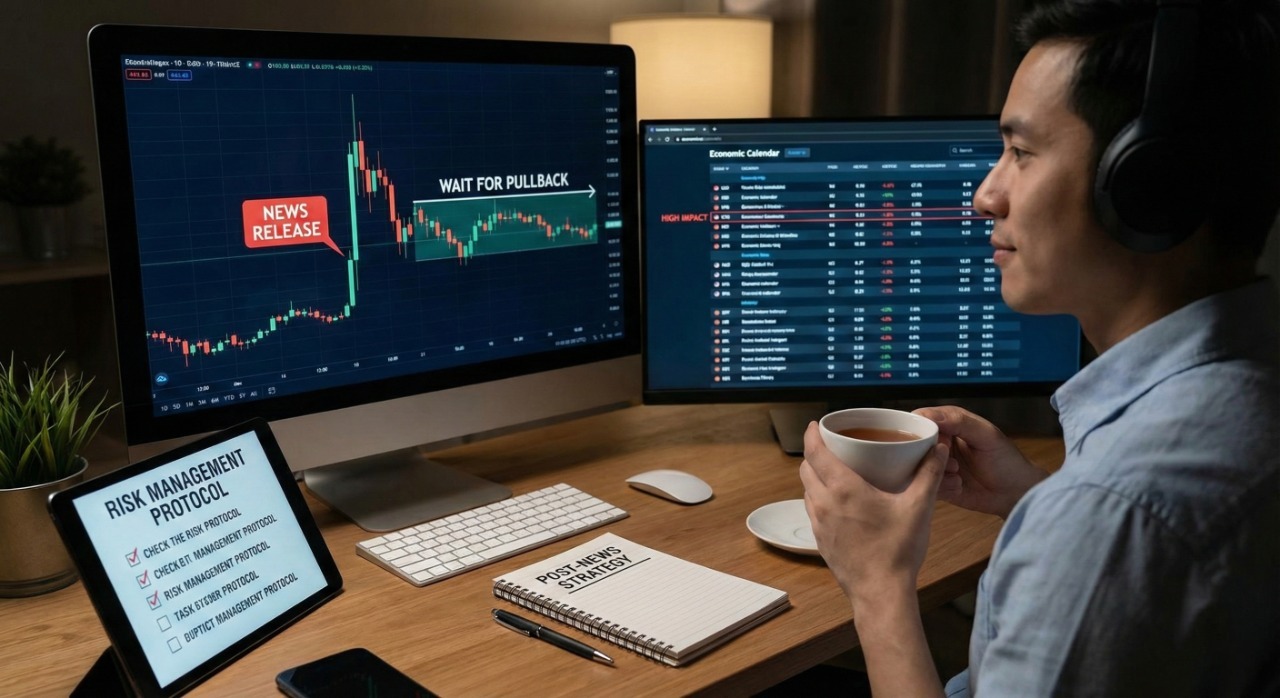
# Trading The News: Navigating High-Impact Events with Precision
Trading the news is a double-edged sword. It offers unparalleled opportunities for rapid profit due to sudden surges in volatility and liquidity, but it also carries significant risks. For experienced traders, understanding how to effectively anticipate, react to, and manage the aftermath of high-impact economic and geopolitical announcements is crucial for long-term success. This guide delves into advanced strategies, nuanced analysis, and critical risk management techniques to help you navigate these turbulent periods with precision.
While some advocate for avoiding news events altogether, dismissing them means missing out on some of the most lucrative trading opportunities. The key lies not in avoidance, but in intelligent engagement—developing a robust framework that transforms potential pitfalls into profitable ventures.
Table of Contents
- [The Nature of News-Driven Volatility](#the-nature-of-news-driven-volatility)
- [Anticipating and Preparing for High-Impact Events](#anticipating-and-preparing-for-high-impact-events)
- [Advanced Strategies for Trading News Events](#advanced-strategies-for-trading-news-events)
- [Risk Management and Post-Event Analysis](#risk-management-and-post-event-analysis)
- [Conclusion: Mastering News Trading for Sustained Edge](#conclusion-mastering-news-trading-for-sustained-edge)
The Nature of News-Driven Volatility
News events inject a unique form of volatility into the markets. Unlike technical corrections or trend continuations, news-driven moves are often characterized by extreme swiftness, significant price gaps, and reversals that can catch unprepared traders off guard. Understanding the underlying dynamics is the first step toward effective engagement.
:::key-concept Information Asymmetry and Price Discovery: News events are moments of intense information asymmetry. Participants react differently based on their access to information, interpretation, and pre-existing positions. Price discovery accelerates dramatically as new information is digested, leading to sharp directional moves and sometimes erratic behavior as market makers adjust their quotes. :::
Major economic releases (e.g., Non-Farm Payrolls, CPI, FOMC statements), geopolitical developments, and corporate earnings reports all trigger this phenomenon. The market's reaction is rarely simple; it's a complex interplay of immediate headlines, market expectations, and algorithmic trading responses.
- Initial Spike: Often a knee-jerk reaction based on the headline figure versus consensus. This move can be heavily influenced by algorithms front-running human reactions.
- Whipsaw/Reversal: If the market's initial interpretation changes, or if deeper components of the report contradict the headline, a rapid reversal can occur, trapping early entrants.
- Trend Continuation/Establishment: After the initial volatility subsides, the market often establishes a new short-term trend based on the overall implications of the news.
:::example Non-Farm Payrolls (NFP) Scenario:
Imagine consensus estimates for NFP are +200k jobs. The actual release comes in at +250k. Initially, USD pairs might spike sharply higher as it's a stronger-than-expected figure. However, if accompanying details show a significant drop in average hourly earnings or a rise in the unemployment rate, the USD strength might quickly reverse as traders factor in the broader implications for interest rate policy. :::
Anticipating and Preparing for High-Impact Events
Preparation is paramount when trading the news. This involves more than just knowing when the event occurs; it requires detailed analysis of market sentiment, potential outcomes, and predefined entry/exit criteria.
1. Economic Calendar & Event Impact Assessment:
- Utilize a reliable economic calendar (e.g., Forex Factory, Investing.com) and filter for high-impact events.
- Understand the historical impact of specific events on relevant currency pairs, indices, or commodities.
- Identify key figures (e.g., NFP, CPI, interest rate decisions) and their historical deviation from consensus.
2. Market Expectations & Consensus:
- Crucially, the market often reacts more to the deviation from consensus expectations than the absolute number itself.
- Monitor analyst reports, financial news outlets, and sentiment indicators to gauge market expectations leading up to the event.
:::tip Look beyond the headline: While the headline number is often the initial catalyst, the
underlying components and forward-looking statements often dictate the sustained market reaction. :::
3. Identify Key Support & Resistance Levels:
- Before the news release, mark out significant support and resistance levels on your charts. These levels act as potential turning points or areas where price might consolidate before making its next move.
- Strong levels can act as magnets or barriers during volatile news events.
4. Formulate "If-Then" Scenarios:
- Develop a plan for various outcomes. What will you do if the news is better than expected? Worse than expected? Exactly as expected?
- Pre-define your entry points, stop-loss levels, and take-profit targets for each scenario. This prevents emotional decision-making in the heat of the moment.
:::example FOMC Interest Rate Decision Scenario:
:::
- Expectation: 25 bps rate hike.
- Scenario 1: 50 bps hike (Hawkish Surprise): Plan to buy USD, target Resistance 1, stop loss below nearest support.
- Scenario 2: 25 bps hike (As Expected): Look for clues in the accompanying statement. If statement is hawkish, buy USD; if dovish, consider selling.
- Scenario 3: No hike (Dovish Surprise): Plan to sell USD, target Support 1, stop loss above nearest resistance.
Strategies for Trading the News
Trading the news is inherently risky, and it's not for every trader. For those who choose to engage, specific strategies can help manage risk and potentially capitalize on volatility.
1. The "Pre-News Breakout" Strategy (Risky):
- Some aggressive traders attempt to anticipate the direction of the move by entering a trade before the news. This often involves identifying strong technical patterns (e.g., pennants, flags) that suggest a directional bias.
- Risk: This strategy relies heavily on speculation and can lead to significant losses if the news goes against the anticipated direction, or if there's a whipsaw.
2. The "Fade the Spike" Strategy:
- This strategy involves trading against the initial knee-jerk reaction. If price spikes sharply in one direction (e.g., USD strengthens aggressively on seemingly good news), traders might look for signs of exhaustion and enter a position in the opposite direction, expecting a reversal or correction.
- This is based on the premise that initial reactions are often overdone and not fully reflective of the news's underlying implications.
- Requires: Quick execution and confirmation of reversal.
3. The "Post-News Confirmation" Strategy (Recommended for Beginners):
- This is generally the safest approach. Instead of trying to catch the initial spike, wait for the market to digest the news and establish a clearer direction.
- Look for a break of a key technical level after the news, or the establishment of a new trend on lower timeframes (e.g., 5-minute, 15-minute chart) once the initial volatility has subsided.
- Benefit: Reduces exposure to extreme volatility and whipsaws, allowing for more informed decisions.
- Drawback: May miss the largest initial move.
:::key-concept Risk Management is Paramount: No matter which strategy you employ, position sizing must be conservative. Volatility during news events can lead to wider-than-usual spreads, slippage, and rapid price movements that can hit stop losses surprisingly quickly. Never risk more than you can comfortably afford to lose. :::
Advanced Considerations and Tools
1. Algorithmic Trading & High-Frequency Trading (HFT):
- Be aware that a significant portion of initial news reactions are driven by algorithms designed to scan headlines and execute trades in milliseconds. Human traders are inherently at a disadvantage in this initial phase.
- This further supports the "Post-News Confirmation" strategy.
2. Order Flow & Volume Analysis:
- For more advanced traders, monitoring order flow and volume around news releases can provide insights into market conviction.
- Heavy buying/selling volume accompanying a direction move can indicate strong institutional interest, while weak volume might suggest a temporary move due to lack of conviction.
3. Volatility Indicators:
- Tools like Average True Range (ATR) or implied volatility from options markets can help gauge expected price swings. High implied volatility before an event suggests the market expects a large move, and stop-loss placements should account for this.
:::warning Avoid trading with tight stop losses during news events. Wider-than-normal spreads and increased volatility can easily trigger tight stops, even if the eventual price direction aligns with your analysis. Give your trades room to breathe within your risk tolerance. :::
Conclusion: Navigating the News with Discipline
Trading the news is a double-edged sword: it offers opportunities for significant profits due to heightened volatility, but it also carries increased risk. Success in this arena hinges on meticulous preparation, disciplined execution, and robust risk management.
Here are the key takeaways:
- Preparation is non-negotiable: Understand the event, gauge market expectations, and outline "if-then" scenarios.
- Volatile market conditions: Expect immediate spikes, potential whipsaws, and rapid reversals.
- Prioritize risk management: Use conservative position sizing, wider stop losses, and never over-leverage.
- Patience often pays: For most traders, waiting for post-news confirmation reduces risk and leads to more reliable setups.
- Not every event is a trading opportunity: Sometimes, the best trade is no trade, especially when uncertainty is high.
Developing the skill to navigate high-impact news events takes practice. We encourage you to start by observing how markets react to major announcements without placing live trades. Analyze the initial spike, the subsequent retracements, and the eventual trend establishment. With diligent practice and adherence to a strict trading plan, you can learn to harness the power of news events without getting burned.
:::tip Backtest your news trading strategies. While live news events are unique, you can analyze historical responses to similar economic data releases or earnings reports to refine your approach and understand typical market behaviors. :::
Advanced Strategies & Considerations
Beyond the foundational approaches, more seasoned traders might consider these advanced tactics when navigating news events:
1. Arbitrage Opportunities (Rare):
- In extremely fast-moving and inefficient markets (less common today due to HFT), slight price discrepancies across different exchanges might appear momentarily. These are usually exploited by automated systems.
2. Options Strategies:
- Using options can provide defined risk/reward profiles. For example, buying a straddle or strangle can profit from a large move in either direction, while selling one might generate income if volatility collapses post-news (though selling premium around news is often high-risk).
- Implied volatility (IV) crush after an event can erode the value of long options positions, even if the underlying moves in the desired direction.
:::key-concept Implied Volatility (IV) Crush: This occurs when the uncertainty surrounding a major event (and thus the demand for options contracts that profit from large moves) dissipates after the event has passed. As a result, the implied volatility component of an option's price can drop sharply, even if the underlying asset moves significantly, reducing the option's value. :::
3. Pattern Recognition on Lower Timeframes:
- After the initial chaos, professional traders often look for specific chart patterns (e.g., flags, pennants, accumulation/distribution phases) on 1-minute or 5-minute charts that indicate the market is consolidating before committing to a sustainable direction.
4. Correlation and Intermarket Analysis:
- Sometimes, a news event in one market (e.g., crude oil inventory) can have a ripple effect on correlated assets (e.g., CAD, energy stocks). Understanding these relationships can offer additional trading perspectives.
Essential Tools for News Traders
To effectively implement the strategies discussed, having the right tools is paramount:
1. Reliable Economic Calendar:
- A good calendar (e.g., from TradingView, ForexFactory, Investing.com) provides release times, previous data, consensus forecasts, and importantly, the "impact" level of the event.
2. Fast Data Feed & Trading Platform:
- Low latency is crucial. A fast data feed ensures you see price action as it happens, and a responsive trading platform allows for quick order execution.
3. Advanced Charting Software:
- Allows for multi-timeframe analysis, indicator overlays, and drawing tools to identify potential entry/exit points and chart patterns.
4. Volatility Tools:
- ATR (Average True Range) indicator to gauge historical volatility for stop-loss placement.
- Access to options chain data for implied volatility readings (if trading options).
5. Risk Management Calculator:
- Automate position sizing based on your account balance, desired risk per trade, and stop-loss distance. This is critical for preventing emotional over-leveraging.
:::example Imagine a Non-Farm Payroll (NFP) release.
:::
- Preparation: You know NFP is a high-impact event for USD pairs. You check expectations (e.g., 200k new jobs). You sketch scenarios: above 200k ( bullish USD), below 200k (bearish USD), inline (choppy).
- Post-News Confirmation: The NFP comes out at 250k. USD initially spikes up. Instead of chasing the spike, you wait. After 5-10 minutes, the market pulls back slightly to a previous resistance-turned-support level on a 5-minute chart, and then clear buying volume comes in. This confirms the initial move and offers a better, less risky entry point.
- Risk Management: You enter with a conservative position size, placing your stop loss below the confirmed support level, accounting for potential volatility.
Conclusion: Mastering the Art of News Trading
Trading the news demands a blend of analytical prowess, tactical execution, and unwavering discipline. It's a high-stakes environment where emotions can run wild, and only those with a clear plan and robust risk management succeed consistently.
Key Pointers to Remember:
- Be Prepared, Not Surprised: Know the news, its expected impact, and market consensus.
- Patience is a Virtue: The initial reaction is rarely the entire story. Wait for confirmation.
- Risk Management Above All: Protect your capital with strict position sizing and appropriate stop losses.
- Study & Observe: Dedicate time to watching how markets react to news events without live capital at risk. This builds intuition and confidence.
- Know Your Limitations: If an event is too unpredictable or your strategy isn't clear, staying on the sidelines is always an option.
By diligently practicing these principles, utilizing the right tools, and continuously learning from both your successes and failures, you can transform high-impact news events from formidable challenges into strategic opportunities. Embrace the volatility with a calm mind and a disciplined approach, and you'll be well on your way to navigating the news without getting burned. Start observing how the next major economic release unfolds – your analytical journey begins now.