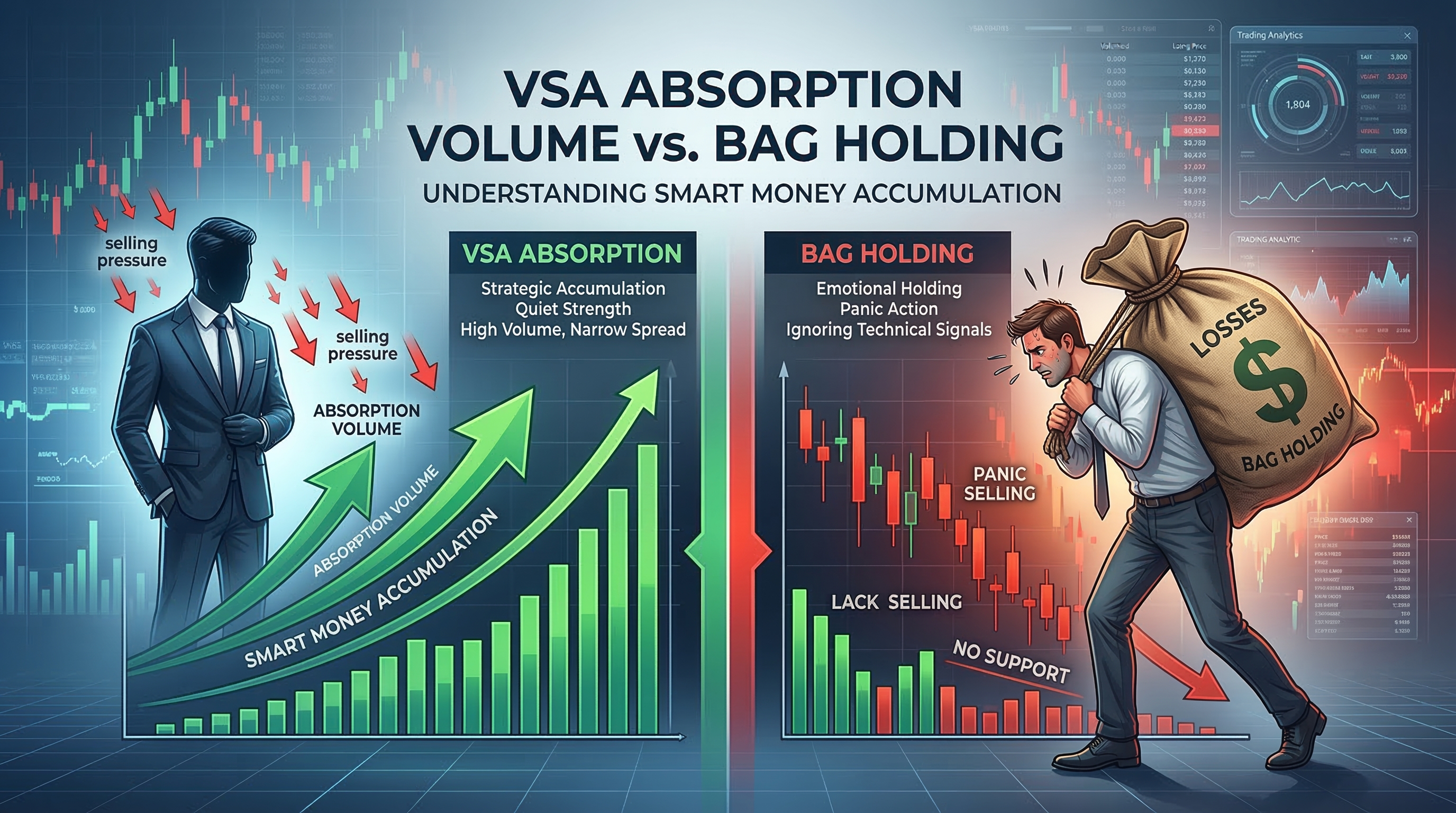
# VSA Absorption Volume vs. Bag Holding: Understanding Smart Money Accumulation
Volume Spread Analysis (VSA) provides traders with powerful insights into market behavior by examining the relationship between price movement, trading volume, and spread. One of the most critical distinctions in VSA is understanding the difference between vsa absorption volume and bag holding - a concept that separates smart money accumulation from emotional retail trading behavior.
This guide will help you recognize when professional money is quietly accumulating positions versus when retail traders are emotionally holding losing positions. Understanding this distinction is crucial for reading market intent and positioning yourself alongside smart money rather than against it.
Table of Contents
- [Understanding VSA Absorption Volume](#understanding-vsa-absorption-volume)
- [What is Bag Holding in Trading](#what-is-bag-holding-in-trading)
- [Key Differences Between Absorption and Bag Holding](#key-differences-between-absorption-and-bag-holding)
- [Identifying Absorption Volume Patterns](#identifying-absorption-volume-patterns)
- [Trading Strategies Using VSA Absorption Concepts](#trading-strategies-using-vsa-absorption-concepts)
- [Conclusion](#conclusion)
Understanding VSA Absorption Volume
VSA absorption volume represents the quiet accumulation or distribution by professional traders who absorb retail selling or buying pressure without significantly moving the market. This concept is fundamental to understanding how smart money operates in financial markets.
:::key-concept Absorption occurs when professional money quietly takes the opposite side of emotional retail trades, accumulating positions while the market appears weak or distributing while the market appears strong. :::
Characteristics of Absorption Volume
Absorption volume typically exhibits several key characteristics:
- High volume with narrow spreads: Large amounts of stock change hands with minimal price movement
- Price holds key support levels: Despite selling pressure, prices remain above critical support zones
- Volume increases on down moves: Higher volume accompanies price weakness, indicating absorption
- Minimal follow-through: Selling pressure fails to create sustained downward momentum
The Psychology Behind Absorption
Smart money understands market psychology and uses retail emotions to their advantage. When retail traders panic and sell, professional traders step in to absorb this selling at favorable prices. The key is recognizing when this absorption is occurring versus when genuine weakness exists in the market.
:::example Consider a stock that has fallen 20% over several weeks. On a particular day, the stock opens lower with high volume but closes near its highs with an unusually narrow spread. This pattern suggests that while retail investors were selling in panic, smart money was absorbing these shares, preventing further decline. :::
What is Bag Holding in Trading
Bag holding refers to the practice of continuing to hold a losing position in the hope that it will eventually recover, often due to emotional attachment or inability to accept a loss. This behavior is typically exhibited by retail traders who lack proper risk management strategies.
Characteristics of Bag Holding Behavior
Bag holding typically involves:
- Emotional attachment to positions: Refusing to cut losses due to hope or pride
- Averaging down repeatedly: Adding to losing positions without proper analysis
- Ignoring technical signals: Dismissing clear exit signals in favor of wishful thinking
- Lack of exit strategy: No predetermined stop-loss or risk management plan
The Danger of Bag Holding
While bag holding might occasionally work out if the market eventually recovers, it represents poor risk management and can lead to significant losses. Professional traders avoid this behavior by:
- Setting clear stop-losses before entering trades
- Having predetermined exit criteria
- Managing position sizes appropriately
- Treating each trade as part of a larger system
:::warning Bag holding often leads to opportunity cost, where capital is tied up in losing positions instead of being deployed in better opportunities. This can significantly impact long-term trading performance. :::
Key Differences Between Absorption and Bag Holding
Understanding the fundamental differences between absorption volume and bag holding is crucial for developing a professional trading mindset.
Intent and Strategy
VSA Absorption Volume:
- Deliberate accumulation based on analysis
- Strategic positioning at key levels
- Part of a larger distribution/accumulation plan
- Backed by institutional resources and research
Bag Holding:
- Emotional reaction to losses
- Hope-based rather than analysis-based
- No clear exit strategy
- Often involves retail-sized positions
Volume Characteristics
Absorption Volume Patterns:
- High volume with narrow spreads
- Volume spikes on weakness with price holding
- Professional accumulation signatures
- Volume precedes price movement
Bag Holding Volume Patterns:
- Declining volume as positions move against holder
- No institutional support evident
- Volume patterns show retail capitulation
- Limited buying power to support position
Market Context
:::tip Absorption typically occurs at key technical levels (support, resistance, previous highs/lows) while bag holding can occur at any price level based on where the trader initially entered. :::
Absorption Context:
- Occurs at strategic price levels
- Timing aligned with market cycles
- Supported by fundamental analysis
- Part of larger market campaign
Bag Holding Context:
- Random entry points
- No consideration of market cycles
- Ignores fundamental changes
- Isolated individual decision
Identifying Absorption Volume Patterns
Recognizing vsa absorption volume patterns requires understanding specific visual cues and volume characteristics that indicate professional activity.
The Classic Absorption Pattern
1. Setup Phase: Market shows weakness with increased selling pressure 2. Absorption Phase: High volume appears but price holds key levels 3. Testing Phase: Market retests lows with reduced volume 4. Markup Phase: Price begins advancing with professional support
Volume Analysis Techniques
When analyzing volume for absorption patterns, focus on:
Volume-Price Relationships:
- High volume + narrow spread = potential absorption
- High volume + wide down spread = likely selling
- Low volume + narrow spread = lack of interest
- Low volume + wide spread = potential manipulation
Comparative Volume Analysis:
- Compare current volume to recent average
- Look for volume spikes during price weakness
- Monitor volume expansion patterns
- Track volume dry-ups after absorption
:::example A cryptocurrency experiences a 15% decline over three days with increasing volume. On the fourth day, volume increases 300% above average, but the price only declines 2% and closes in the upper half of its range. This pattern suggests strong absorption of selling pressure by smart money. :::
Support Level Analysis
Absorption often occurs at key technical levels:
- Previous resistance becoming support
- Major moving averages
- Fibonacci retracement levels
- Round psychological numbers
- Previous swing lows
Time Frame Considerations
Absorption patterns can occur across multiple time frames:
- Intraday: Short-term absorption during volatile sessions
- Daily: Multi-day accumulation campaigns
- Weekly: Long-term institutional positioning
- Monthly: Major trend reversals and cycle changes
Trading Strategies Using VSA Absorption Concepts
Successfully trading vsa absorption volume patterns requires specific strategies that align with professional money movement.
The Absorption Entry Strategy
Step 1: Identify Potential Absorption
- Look for high volume with narrow spreads
- Confirm price holding at key support levels
- Verify volume increase during weakness
Step 2: Wait for Confirmation
- Monitor for volume dry-up on subsequent weakness
- Look for signs of demand returning
- Watch for break above recent resistance
Step 3: Execute Entry
- Enter on break above absorption day high
- Use absorption low as stop-loss reference
- Target previous resistance levels
:::tip The best absorption plays often occur after extended selling pressure when retail traders have given up hope, but smart money sees value. :::
Risk Management in Absorption Trading
Position Sizing:
- Limit risk to 1-2% of capital per trade
- Use absorption low as natural stop-loss level
- Scale into positions if absorption continues
Stop-Loss Placement:
- Place stops below absorption low
- Allow for normal market volatility
- Adjust stops as position moves favorably
Profit Targeting:
- First target: Previous resistance level
- Second target: Measured move projection
- Trail stops to lock in profits
Avoiding Bag Holding Behavior
To avoid falling into bag holding patterns:
1. Set Clear Rules: Establish entry and exit criteria before trading 2. Use Stop Losses: Always have a predetermined exit point for losses 3. Monitor Volume: Watch for changes in volume patterns 4. Stay Objective: Base decisions on analysis, not emotions 5. Review Regularly: Constantly reassess position validity
Multi-Timeframe Analysis
Combine absorption analysis across different timeframes:
Higher Timeframe: Identify major support/resistance zones Entry Timeframe: Spot absorption patterns and entry signals Execution Timeframe: Fine-tune entries and manage positions
:::warning Never ignore higher timeframe trends when trading absorption patterns. Absorption against the major trend is more likely to fail than absorption that aligns with longer-term direction. :::
Advanced VSA Techniques
Volume Spread Analysis Indicators:
- Volume-weighted average price (VWAP)
- Volume oscillators
- Accumulation/distribution indicators
- On-balance volume (OBV)
Professional Money Tracking:
- Monitor institutional flow data
- Track large block transactions
- Analyze options flow for clues
- Watch for insider activity
Conclusion
Understanding the distinction between vsa absorption volume and bag holding is fundamental to developing a professional trading approach. While bag holding represents emotional, hope-based position management, absorption volume indicates strategic accumulation by smart money at key market levels.
Successful traders learn to identify absorption patterns and position themselves alongside professional money rather than fighting against it. This requires patience, discipline, and the ability to read volume patterns correctly within the context of overall market structure.
Key takeaways for traders:
- Absorption occurs at strategic levels with high volume and narrow spreads
- Bag holding is emotional behavior that ignores proper risk management
- Professional money uses retail emotions to accumulate positions advantageously
- Volume analysis combined with price action provides the clearest signals
- Proper risk management prevents bag holding behavior
By mastering these concepts, you can improve your ability to read market intent and make more informed trading decisions. Remember that successful trading is about following the smart money, not fighting against it.
Ready to improve your VSA skills? Start by analyzing charts for absorption patterns and practice identifying the difference between professional accumulation and retail bag holding. Focus on volume-price relationships and always maintain proper risk management to avoid emotional trading mistakes.