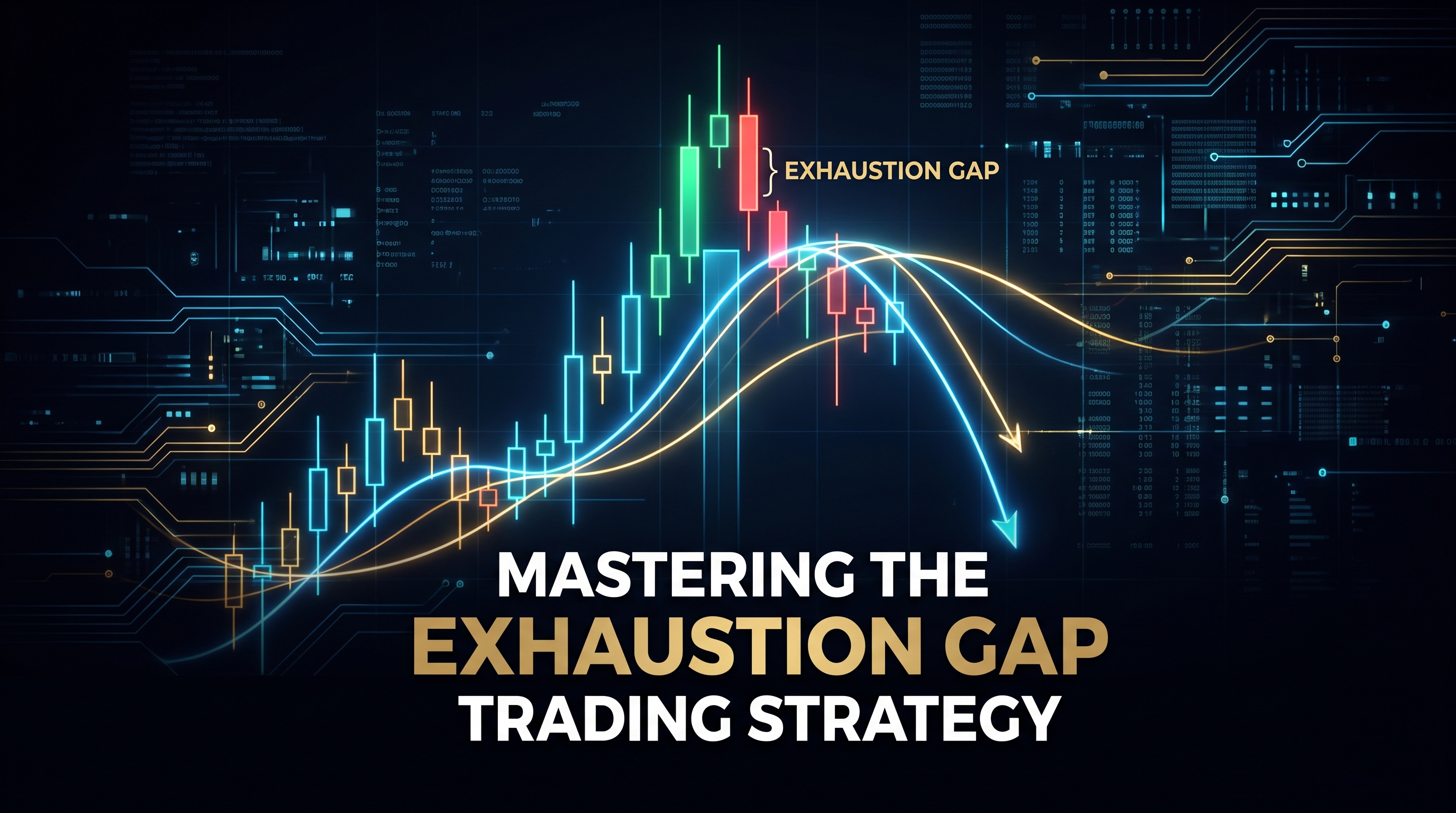
# Mastering the Exhaustion Gap Trading Strategy: A Complete Guide to Profitable Gap Trading
Exhaustion gaps represent one of the most reliable reversal signals in technical analysis, offering traders high-probability opportunities to profit from trend changes. Unlike other types of gaps that signal continuation, an exhaustion gap trading strategy focuses on identifying the final push of a trending move before a significant reversal occurs.
Understanding how to properly identify and trade exhaustion gaps can dramatically improve your trading performance, especially when combined with proper risk management and volume analysis. This comprehensive guide will walk you through everything you need to know about implementing a successful exhaustion gap trading strategy in your market approach.
Table of Contents
- [Understanding Exhaustion Gaps](#understanding-exhaustion-gaps)
- [Key Characteristics of Exhaustion Gaps](#key-characteristics-of-exhaustion-gaps)
- [How to Identify Exhaustion Gap Setups](#how-to-identify-exhaustion-gap-setups)
- [Implementing Your Exhaustion Gap Trading Strategy](#implementing-your-exhaustion-gap-trading-strategy)
- [Risk Management and Position Sizing](#risk-management-and-position-sizing)
- [Common Mistakes and How to Avoid Them](#common-mistakes-and-how-to-avoid-them)
- [Conclusion and Next Steps](#conclusion-and-next-steps)
Understanding Exhaustion Gaps
An exhaustion gap occurs at the end of a strong trending move when the price gaps in the direction of the prevailing trend but quickly reverses. This gap represents the final effort of buyers (in an uptrend) or sellers (in a downtrend) to push the price further before exhaustion sets in and the trend reverses.
:::key-concept Exhaustion gaps are characterized by high volume on the gap day, followed by an immediate reversal that often fills the gap within a few trading sessions. This makes them distinct from breakaway or continuation gaps. :::
The psychology behind exhaustion gaps is fascinating. They typically occur when market sentiment reaches an extreme level. In an uptrend, buyers become increasingly aggressive, pushing prices higher with such force that a gap forms. However, this aggressive buying represents the last gasp of bullish momentum. Once this buying pressure is exhausted, sellers step in, often with significant force, causing the rapid reversal.
Types of Market Gaps
To effectively implement an exhaustion gap trading strategy, it's crucial to distinguish between different types of gaps:
- Breakaway Gaps: Occur at the beginning of a new trend
- Continuation Gaps: Happen in the middle of a trend
- Exhaustion Gaps: Mark the end of a trend
- Common Gaps: Regular gaps with no significant meaning
Exhaustion gaps are the most reliable for reversal trading because they signal a fundamental shift in market dynamics from trending behavior to reversal behavior.
Key Characteristics of Exhaustion Gaps
Successful identification of exhaustion gaps requires understanding their distinctive characteristics. These features separate true exhaustion gaps from other types of price gaps that might mislead traders.
Volume Patterns
Volume plays a crucial role in confirming exhaustion gaps. A legitimate exhaustion gap typically exhibits:
- High volume on the gap day: This represents the final surge of buying or selling pressure
- Declining volume after the gap: As the trend exhausts, participation decreases
- Increased volume on reversal: When the price begins moving against the gap direction
:::example Consider a stock that has been trending upward for several weeks. On Monday, it gaps up 3% on volume that's 200% above average. However, by Wednesday, the stock has reversed and filled the gap, with volume increasing each day of the decline. This pattern strongly suggests an exhaustion gap. :::
Price Action Signals
Effective exhaustion gap identification also relies on specific price action characteristics:
1. Gap size: Exhaustion gaps are often larger than typical gaps in the same security 2. Immediate reversal: Price begins moving against the gap direction within 1-3 trading sessions 3. Gap fill: The gap gets filled relatively quickly, usually within a week 4. Extended trend preceding the gap: The gap occurs after a significant trending move
Market Context Indicators
The broader market context provides additional confirmation for exhaustion gap setups:
- Overbought/oversold conditions: Technical indicators showing extreme readings
- News catalyst: Often coincides with earnings announcements or significant news
- Market sentiment extremes: High levels of bullishness or bearishness
- Previous support/resistance levels: Gaps often occur near significant technical levels
:::warning Never trade an exhaustion gap based solely on the gap itself. Always wait for confirmation through price action and volume before entering a position. :::
How to Identify Exhaustion Gap Setups
Developing a systematic approach to identifying exhaustion gap opportunities is essential for consistent success with this trading strategy. The identification process involves both technical analysis and market awareness.
Step-by-Step Identification Process
1. Scan for Recent Gaps Begin each trading day by scanning your watchlist for securities that have gapped significantly (typically 2% or more) in either direction. Focus on stocks, indices, or other instruments that have been trending strongly in recent weeks.
2. Analyze the Preceding Trend Examine the trend leading up to the gap:
- Has the security been trending for at least 2-3 weeks?
- Is the trend showing signs of acceleration or exhaustion?
- Are there any technical indicators suggesting overbought/oversold conditions?
3. Evaluate Volume Characteristics Analyze volume patterns both on the gap day and in the preceding sessions:
- Is gap-day volume significantly above average?
- Has volume been increasing throughout the trend?
- Are there signs of distribution (high volume on down days) or accumulation?
4. Check Technical Indicators Look for confirmation from various technical indicators:
- RSI readings above 70 (for uptrend exhaustion) or below 30 (for downtrend exhaustion)
- MACD showing divergence with price
- Bollinger Bands indicating extreme price extension
Chart Pattern Recognition
Exhaustion gaps often occur in conjunction with specific chart patterns that can enhance the probability of a successful trade:
- Shooting star or doji candles: On the gap day or immediately following
- Reversal candlestick patterns: Hammer, hanging man, or engulfing patterns
- Volume spikes: Accompanied by reversal price action
:::tip Use multiple timeframes when analyzing potential exhaustion gap setups. What appears as an exhaustion gap on a daily chart might just be a minor pullback on a weekly chart. :::
Confirmation Signals
Before implementing your exhaustion gap trading strategy, wait for these confirmation signals:
1. Price action confirmation: The security begins trading back toward the gap within 1-2 days 2. Volume confirmation: Volume increases as price moves against the gap direction 3. Technical indicator confirmation: Momentum indicators begin showing divergence or reversal signals 4. Market structure confirmation: Break of recent support (in uptrend exhaustion) or resistance (in downtrend exhaustion)
Implementing Your Exhaustion Gap Trading Strategy
Once you've identified a potential exhaustion gap setup and received confirmation signals, it's time to execute your trade plan. A systematic approach to entry, management, and exit is crucial for long-term success.
Entry Strategies
Conservative Entry Approach Wait for the gap to be completely filled before entering a position. This approach offers:
- Higher probability setups
- Clear risk/reward parameters
- Reduced false signal risk
Aggressive Entry Approach Enter positions as soon as confirmation signals appear, even before gap fill:
- Earlier entry with potentially better risk/reward
- Higher risk of false signals
- Requires tighter stop-loss management
:::example A stock gaps up from $50 to $52 on high volume after a strong uptrend. Using the conservative approach, you would wait for the price to decline back to $50 (filling the gap) before entering a short position. The aggressive approach might involve entering a short position at $51.50 once reversal candlestick patterns confirm. :::
Position Sizing Considerations
Your exhaustion gap trading strategy should include specific position sizing rules:
- Risk per trade: Limit risk to 1-2% of total capital per trade
- Gap size consideration: Smaller positions for larger gaps due to increased volatility
- Market conditions: Reduce position sizes during high-volatility market periods
- Confirmation strength: Larger positions when multiple confirmation signals align
Stop-Loss Placement
Effective stop-loss placement is critical for exhaustion gap trades:
For Gap-Fill Trades (Conservative Entry)
- Place stop-loss slightly beyond the gap high (for shorts) or gap low (for longs)
- Allow for normal market fluctuation while protecting against trend resumption
For Early Entry Trades (Aggressive Entry)
- Tighter stop-losses due to earlier entry
- Place stops beyond recent swing highs/lows
- Consider using trailing stops as the trade moves in your favor
Profit Target Setting
Establishing clear profit targets helps maximize the effectiveness of your exhaustion gap trading strategy:
1. Technical targets: Previous support/resistance levels, moving averages 2. Measured moves: Calculate targets based on the size of the preceding trend 3. Fibonacci retracements: Common reversal levels at 38.2%, 50%, and 61.8% 4. Multiple target approach: Take partial profits at different levels
:::tip Consider scaling out of positions as they move in your favor. Take 50% profits at the first target, 25% at the second target, and let the remaining 25% run with a trailing stop. :::
Risk Management and Position Sizing
Risk management forms the foundation of any successful exhaustion gap trading strategy. Without proper risk controls, even the most accurate gap identification skills won't lead to long-term profitability.
Capital Allocation Rules
Establish clear rules for how much capital to risk on exhaustion gap trades:
- Maximum risk per trade: Never risk more than 2% of total capital on a single trade
- Maximum portfolio exposure: Limit total exposure to gap trades to 10% of portfolio
- Correlation considerations: Avoid taking multiple positions in highly correlated securities
- Market condition adjustments: Reduce position sizes during volatile market periods
Portfolio Management Strategies
Diversification Across Markets Implement your exhaustion gap trading strategy across different asset classes:
- Stocks and ETFs
- Forex pairs
- Cryptocurrency markets
- Commodity futures
Time Diversification Avoid concentrating all gap trades in the same time period:
- Spread trades across different market sessions
- Consider seasonal patterns in gap frequency
- Monitor overall market volatility levels
Dynamic Risk Adjustment
Adjust risk parameters based on current market conditions:
High Volatility Periods
- Reduce position sizes by 25-50%
- Widen stop-loss levels to account for increased noise
- Require stronger confirmation signals
Low Volatility Periods
- Maintain standard position sizes
- Use tighter stop-loss levels
- Accept trades with moderate confirmation
:::warning Never increase position sizes to "make up" for previous losses. Stick to your predetermined risk management rules regardless of recent trading performance. :::
Trade Management Techniques
Active trade management can significantly improve the performance of your exhaustion gap trading strategy:
1. Partial profit taking: Reduce position size as targets are reached 2. Stop-loss adjustment: Move stops to breakeven once the trade shows profit 3. Trailing stops: Use dynamic stops to capture extended moves 4. Time-based exits: Close positions if they don't develop as expected within a specific timeframe
Common Mistakes and How to Avoid Them
Even experienced traders can fall into common traps when implementing an exhaustion gap trading strategy. Understanding these pitfalls and how to avoid them is essential for long-term success.
Mistake #1: Trading Every Gap
The Problem: Attempting to trade every price gap without proper analysis leads to poor trade selection and reduced profitability.
The Solution: Develop strict criteria for gap selection:
- Minimum gap size requirements
- Volume confirmation requirements
- Trend duration minimums
- Technical indicator confirmation
Mistake #2: Ignoring Market Context
The Problem: Trading exhaustion gaps without considering broader market conditions can lead to poorly timed entries.
The Solution: Always analyze:
- Overall market trend and sentiment
- Economic calendar events
- Sector-specific news and developments
- Correlation with major indices
Mistake #3: Poor Risk Management
The Problem: Inadequate stop-loss placement or position sizing can turn winning strategies into losing ones.
The Solution: Implement systematic risk controls:
- Predetermined stop-loss levels
- Position sizing based on risk, not profit potential
- Maximum daily/weekly loss limits
- Regular strategy performance reviews
:::example A trader identifies what appears to be a perfect exhaustion gap setup but risks 5% of their capital on the trade instead of the planned 1%. Even though the setup is valid, the oversized risk creates unnecessary pressure and potential for significant losses. :::
Mistake #4: Emotional Trading Decisions
The Problem: Allowing emotions to override systematic analysis leads to inconsistent results.
The Solution: Develop and follow a detailed trading plan:
- Written entry and exit criteria
- Predetermined position sizes
- Regular strategy reviews and adjustments
- Emotional state monitoring
Mistake #5: Insufficient Backtesting
The Problem: Implementing strategies without proper historical testing can lead to unrealistic expectations.
The Solution: Conduct thorough backtesting:
- Test across different market conditions
- Analyze win rates and risk/reward ratios
- Identify optimal market environments
- Continuously refine entry and exit criteria
:::tip Keep a detailed trading journal documenting each exhaustion gap trade, including setup quality, market conditions, and lessons learned. This data becomes invaluable for strategy refinement. :::
Conclusion and Next Steps
Mastering the exhaustion gap trading strategy requires patience, discipline, and continuous learning. The key to success lies in developing a systematic approach to gap identification, implementing proper risk management, and maintaining emotional discipline throughout the trading process.
Remember that exhaustion gaps represent just one tool in your trading toolkit. They work best when combined with other technical analysis techniques and used within a comprehensive trading plan. The most successful traders using this strategy focus on high-probability setups rather than trying to trade every gap that appears.
To improve your exhaustion gap trading skills, start by paper trading these setups until you develop confidence in your identification and execution abilities. Keep detailed records of each trade, analyzing both winners and losers to identify patterns and areas for improvement.
As you gain experience with the exhaustion gap trading strategy, consider incorporating additional confirmation signals such as volume profile analysis, market breadth indicators, or sentiment measures. The goal is to continuously refine your approach while maintaining the core principles of proper risk management and systematic execution.
Ready to Master Gap Trading? Start practicing your exhaustion gap identification skills by analyzing historical charts and paper trading setups. Focus on developing your eye for the key characteristics discussed in this guide, and remember that consistency in application is more important than finding the "perfect" trade. Begin building your expertise today with systematic chart analysis and disciplined trade planning.