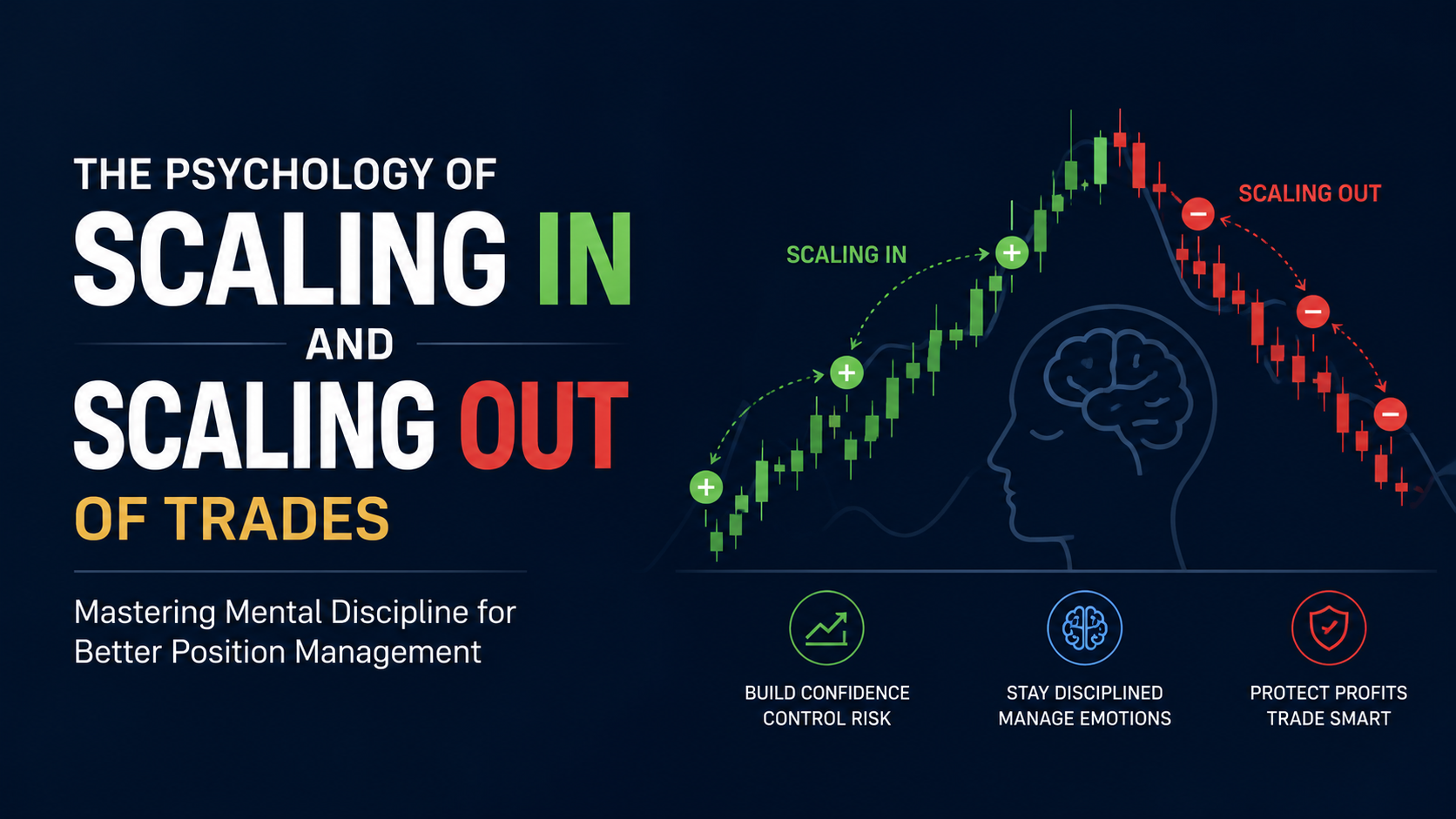
# The Psychology of Scaling In and Scaling Out of Trades: Mastering Mental Discipline for Better Position Management
Scaling in and out of trades represents one of the most sophisticated yet psychologically challenging aspects of trading. While the technical mechanics of adding to winning positions or gradually exiting trades may seem straightforward, the psychological barriers traders face when implementing these strategies can significantly impact performance. Understanding the psychology of scaling trades is essential for developing the mental discipline required to execute these advanced position management techniques effectively.
This comprehensive guide explores the psychological dynamics underlying scaling strategies, examining the cognitive biases, emotional triggers, and mental frameworks that influence how traders build and exit positions. Whether you're struggling with premature exits, hesitating to add to winners, or experiencing regret after scaling decisions, mastering the psychological aspects of scaling can transform your trading approach.
Table of Contents
- [Understanding the Mental Framework of Scaling Strategies](#understanding-the-mental-framework-of-scaling-strategies)
- [The Psychological Challenges of Scaling Into Positions](#the-psychological-challenges-of-scaling-into-positions)
- [The Emotional Complexity of Scaling Out of Trades](#the-emotional-complexity-of-scaling-out-of-trades)
- [Cognitive Biases That Sabotage Scaling Decisions](#cognitive-biases-that-sabotage-scaling-decisions)
- [Building Mental Discipline for Consistent Scaling Execution](#building-mental-discipline-for-consistent-scaling-execution)
- [Practical Psychological Strategies for Scaling Success](#practical-psychological-strategies-for-scaling-success)
- [Conclusion: Integrating Psychology and Strategy](#conclusion-integrating-psychology-and-strategy)
Understanding the Mental Framework of Scaling Strategies
The psychology of scaling trades begins with understanding why these strategies feel counterintuitive to our natural instincts. Human psychology evolved to seek certainty and avoid risk, yet scaling strategies require embracing uncertainty and managing risk dynamically.
Why Scaling Feels Unnatural
When you scale into a position, you're adding to a trade that's already showing profit—effectively increasing your exposure when you could simply bank your gains. This conflicts with our natural risk-aversion tendencies. Conversely, scaling out requires you to leave potential profits on the table by exiting portions of your position, triggering the fear of missing out on larger gains.
:::key-concept The Scaling Paradox: The most psychologically difficult trading decisions—adding to winners and partially exiting—are often the most strategically sound. Success requires training your mind to act against natural instincts. :::
The Core Psychological Shift Required
Successful scaling demands a fundamental shift from binary thinking to probabilistic thinking. Instead of viewing trades as all-or-nothing propositions, you must embrace graduated approaches that acknowledge uncertainty:
- Position building isn't about being "right"—it's about maximizing opportunity when conditions favor your thesis
- Partial exits aren't about being "wrong"—they're about managing risk and securing profits across different scenarios
- Market behavior exists on a spectrum—your position sizing should reflect this reality
:::example Real-World Scenario: A trader identifies a strong uptrend in a currency pair. Instead of entering with full size immediately, they enter 30% of their intended position. As the trend confirms with a higher high and volume expansion, they add another 30%. At a key resistance level, they scale out 40% to secure profits while maintaining exposure for a potential breakout.
This approach acknowledges that the trend might continue or reverse—the trader positions themselves to benefit either way rather than betting everything on one outcome. :::
The Psychological Challenges of Scaling Into Positions
Scaling into trades—the practice of building a position gradually as your thesis develops—presents unique psychological hurdles that can paralyze even experienced traders.
The Fear of Averaging Into Losers
The most significant psychological barrier to scaling in is the deep-seated fear of "averaging down" on a losing trade. This fear stems from legitimate concerns—many traders have blown accounts by repeatedly adding to positions that move against them, refusing to admit they were wrong.
:::warning Critical Distinction: Scaling into winners based on confirming price action is fundamentally different from averaging down on losers out of stubbornness. The former is strategic position building; the latter is emotional avoidance of accepting losses. :::
Overcoming this fear requires:
1. Clear entry rules: Define specific conditions that must be met before each additional entry 2. Invalidation levels: Know exactly when your thesis is wrong and no more entries should occur 3. Historical evidence: Review past trades where scaling in would have improved results 4. Risk parameters: Calculate maximum risk before the first entry, ensuring all scaled entries fit within your risk tolerance
The Regret of Missing Initial Entries
When scaling in, you intentionally enter with a smaller position than your maximum size. If the trade immediately moves in your favor, you may experience regret that you didn't commit fully from the start. This "opportunity cost regret" can lead to impulsive decision-making on future trades.
Managing regret psychology:
- Accept that hindsight always reveals the "perfect" entry—you can't trade with future knowledge
- Track your overall results from scaling strategies, not individual trade outcomes
- Recognize that the trades where you're grateful you scaled (avoiding large losses) balance the ones where full commitment would have been better
- Focus on process over individual outcomes
The Pressure of Timing Additional Entries
Deciding when to add to a position creates ongoing psychological pressure. Should you add now? Wait for a pullback? What if it runs without you? This continuous decision-making can create mental fatigue and analysis paralysis.
:::tip Solution: Develop predetermined scaling plans before entering trades. Define specific technical conditions, time intervals, or percentage moves that trigger additional entries. This removes real-time emotional decision-making from the equation. :::
The Overconfidence Trap
When your initial position shows immediate profit, overconfidence can set in, tempting you to add too aggressively or abandon your risk management plan. The psychology of scaling trades includes recognizing when early success clouds judgment.
Indicators of overconfidence affecting scaling:
- Adding larger sizes than planned after initial profits
- Skipping predefined confirmation signals because "you know" the trade will work
- Scaling in more times than your plan allows
- Reducing stop-loss distances to accommodate larger positions
The Emotional Complexity of Scaling Out of Trades
Scaling out of positions—gradually exiting a trade rather than closing it entirely—brings a different set of psychological challenges centered around profit-taking, loss aversion, and the fear of missing extended moves.
The Pain of Leaving Money on the Table
Every time you scale out of a portion of your position and the price continues moving favorably, you experience the acute pain of "missing out" on what could have been larger profits. This pain often feels more intense than the pleasure of securing profits, leading traders to abandon scaling-out strategies.
:::key-concept The Profit Paradox: The psychological pain of watching your scaled-out portion miss further gains typically exceeds the psychological pleasure of locking in guaranteed profits—even when the profits secured are substantial. Understanding this bias is crucial for maintaining discipline. :::
Reframing your mental approach:
- View scaled exits as "guaranteed wins" rather than "missed opportunities"
- Recognize that the portion remaining captures any extended move
- Track cumulative profits from scaling out over months, not individual trades
- Remember that you can't know in advance which trades will extend significantly
The Temptation to Hold Everything
When a trade moves strongly in your favor, greed can override your scaling plan. The voice in your head says, "Why take partial profits when this could become a massive winner?" This temptation to hold your entire position often results in giving back profits when the move reverses.
The psychological reality: Large, extended moves feel inevitable when you're in them, but they're statistically rare. Most profitable moves retrace significantly. Scaling out ensures you capture profits across the more common scenarios while maintaining exposure for the exceptional ones.
:::example Case Study: A swing trader enters a stock position at $50, planning to scale out one-third at $55, one-third at $60, and hold the final third for potential extended gains. The stock quickly hits $55, but the trader holds everything, thinking "this is going to $70." The stock reaches $58 before reversing to $52. The trader exits at $53, making a small profit instead of the planned substantial gain.
The psychology of scaling trades requires accepting "good enough" profits rather than gambling on "perfect" outcomes. :::
The Fear of Exiting Too Early
Counterbalancing greed is the fear that scaling out will cause you to miss "the big one"—the career-making trade that could have transformed your account. This fear can create hesitation, causing traders to delay scaling exits and potentially miss planned profit targets entirely.
Managing this fear effectively:
1. Partial position retention: Always keep a portion for extended moves, addressing the fear directly 2. Documented trailing strategies: Define how you'll manage the remaining portion with trailing stops or technical levels 3. Probability-based thinking: Remind yourself that most trades don't become massive winners 4. Historical review: Study your past trades to see how often holding everything would have actually improved results versus scaling out
The Regret of Different Scaling Choices
After the trade concludes, you'll often second-guess your scaling decisions. "I should have held more," or "I should have exited more earlier." This hindsight regret can erode confidence in your scaling strategy and lead to inconsistent execution.
:::tip Mental Framework: Judge your scaling decisions by whether you followed your plan and the information available at the time—not by the unknowable outcome. Perfect exits only exist in hindsight. :::
Cognitive Biases That Sabotage Scaling Decisions
Understanding the specific cognitive biases that affect the psychology of scaling trades helps you recognize when your thinking becomes distorted and course-correct before making impulsive decisions.
Recency Bias in Scaling Execution
Recency bias causes traders to overweight recent experiences when making scaling decisions. If your last few scaled trades missed significant moves, you'll be tempted to hold everything on the next trade. Conversely, if holding full positions recently led to giving back profits, you might scale out too aggressively.
Overcoming recency bias:
- Maintain a trading journal tracking scaling decisions across many trades
- Review your complete scaling history, not just recent trades
- Base scaling strategies on statistical analysis, not emotional memory
- Recognize when recent experiences are influencing current decisions
Loss Aversion and Scaling Decisions
Loss aversion—the tendency to feel losses more acutely than equivalent gains—heavily influences scaling psychology. This bias makes the "loss" of potential profits from scaling out feel worse than the actual gain of secured profits.
When scaling in, loss aversion can prevent you from adding to winning positions because you fear turning a winner into a loser if the additional entry is poorly timed.
Strategies to counter loss aversion:
- Frame scaled profits as absolute gains, not relative to maximum possible
- Calculate your realized gains from scaling strategies to reinforce positive outcomes
- Use mental accounting to separate your initial position from scaled portions
- Focus on total account growth rather than individual trade maximization
Anchoring to Initial Entry Prices
Anchoring bias causes traders to fixate on their initial entry price when making scaling decisions. When adding to positions, you might hesitate because the current price seems "too high" compared to your first entry. When scaling out, you might hold positions too long because you're anchored to an earlier peak price.
:::warning Anchoring Danger: Your initial entry price is financially irrelevant to whether current market conditions warrant adding or exiting. The market doesn't "know" or "care" where you entered. Base decisions on current market structure, not historical personal entry points. :::
Confirmation Bias in Position Building
When scaling into positions, confirmation bias leads traders to seek information supporting their thesis while ignoring contradictory signals. This can result in continuing to add to positions even when the evidence suggests the trade is failing.
Maintaining objectivity:
- Establish specific invalidation criteria before any entries
- Actively seek information that contradicts your thesis
- Use checklists requiring objective criteria before each scaled entry
- Review trades with a mindset of "what could prove me wrong?"
The Disposition Effect
The disposition effect describes the tendency to sell winners too quickly while holding losers too long. In scaling contexts, this manifests as aggressively scaling out of profitable positions at the first sign of profit while refusing to reduce losing positions until losses become painful.
Addressing the disposition effect:
- Create symmetrical rules for scaling out of winners and losers
- Use price-based or time-based exit triggers that remove emotion
- Calculate opportunity cost of held positions objectively
- Review whether your scaling behavior differs between winners and losers
Building Mental Discipline for Consistent Scaling Execution
The psychology of scaling trades ultimately requires developing mental discipline—the ability to execute your strategy consistently regardless of emotional impulses or cognitive biases.
Creating a Pre-Trade Scaling Plan
Mental discipline begins before you enter any position. A comprehensive pre-trade plan removes most emotional decisions from the heat of the moment.
Essential elements of a scaling plan:
1. Initial position size: Specific percentage of total intended position 2. Scaling-in triggers: Exact conditions for additional entries (technical levels, time frames, confirmations) 3. Maximum position size: Total exposure limit across all scaled entries 4. Scaling-out levels: Predetermined price targets or technical conditions for partial exits 5. Portion sizes: How much to exit at each level (e.g., 1/3, 1/2, 25%) 6. Final exit strategy: How to manage the remaining portion (trailing stop, target, time-based) 7. Invalidation points: When to exit everything immediately
:::example Sample Scaling Plan:
:::
- Enter 25% position at breakout above resistance
- Add 25% if price retests breakout level and holds
- Add final 50% if volume expansion confirms trend continuation
- Scale out 40% at 2:1 reward-risk ratio
- Scale out 30% at previous swing high
- Trail final 30% with 20-period EMA
- Exit everything if price closes below breakout level
Developing Emotional Awareness
Mental discipline requires recognizing emotional states as they occur and preventing them from driving decisions. Emotional awareness is a skill developed through practice.
Building emotional awareness:
- Pre-trade check-ins: Before making any scaling decision, pause and identify your current emotional state
- Emotion labeling: Name what you're feeling ("I'm experiencing greed," "I'm feeling fear of missing out")
- Physical awareness: Notice physical sensations associated with emotions (tension, elevated heart rate, restlessness)
- Pattern recognition: Track which emotions precede impulsive scaling decisions
The Power of Trading Journals for Scaling Psychology
A trading journal focused on scaling psychology provides invaluable feedback for developing discipline. Beyond recording entries and exits, document your emotional and mental states.
Critical journal elements for scaling:
- Pre-scaling emotions: How you felt before making each scaling decision
- Thought processes: What reasoning led to each scaled entry or exit
- Plan adherence: Did you follow your predetermined plan or deviate?
- Deviation analysis: When you didn't follow the plan, what emotions or thoughts drove the change?
- Outcome separation: Rate the quality of your decision-making separately from the financial outcome
- Pattern identification: Regular reviews to identify recurring psychological patterns
Implementing Systematic Rules
Systematic, rule-based approaches reduce the psychological burden of scaling decisions. When you follow predetermined rules, you eliminate much of the emotional decision-making.
:::tip Systematic Approach Example: Scale out 25% of any position that reaches 1.5:1 reward-risk, another 25% at 2.5:1, and 25% at 4:1, regardless of your emotional state or market conditions. Trail the final 25% with a technical indicator. No exceptions.
This systematic approach removes the question "should I take profits now?" and replaces it with "has my rule trigger occurred?" :::
Building Gradual Confidence Through Small Steps
If scaling strategies feel psychologically overwhelming, build confidence gradually. Start with minimal scaling (just two positions: initial and final) and simple rules before progressing to more sophisticated approaches.
Progressive scaling development:
1. Phase 1: Practice scaling out only—enter full size, exit in two portions 2. Phase 2: Add scaling in—enter half size, add half size on one trigger 3. Phase 3: Increase complexity—three-part entries, three-part exits 4. Phase 4: Dynamic scaling based on multiple technical factors
Practical Psychological Strategies for Scaling Success
Beyond general mental discipline, specific psychological strategies help traders execute scaling approaches more consistently.
Mental Accounting for Scaled Positions
Mental accounting—treating different portions of your position as separate "buckets"—can reduce the psychological pain of partial exits and facilitate better scaling decisions.
Example mental accounting framework:
- Conservative bucket: The portion you'll exit at the first reasonable profit target ("business profits")
- Moderate bucket: The portion held for your planned target ("expected returns")
- Aggressive bucket: The portion held for extended moves ("lottery ticket")
By mentally categorizing your position this way, scaling out the conservative bucket feels like taking business profits rather than leaving money on the table.
Reframing Scaling Decisions
How you frame scaling decisions psychologically impacts your ability to execute them. Reframe partial exits and entries using language that reduces emotional resistance.
Reframing examples:
- Instead of "giving up potential profits," think "guaranteeing partial success"
- Instead of "missing the extended move," think "still participating with remaining position"
- Instead of "adding to a position that might reverse," think "increasing exposure to confirmed opportunity"
- Instead of "being wrong about position size," think "adapting to developing information"
Visualization and Mental Rehearsal
Visualization techniques help prepare your mind for the emotional challenges of scaling execution. Mental rehearsal builds neural pathways that make disciplined behavior more automatic.
Visualization exercise for scaling:
1. Imagine entering a position with your first scaled entry 2. Visualize the price moving in your favor and reaching your next entry trigger 3. Feel the hesitation and fear that might arise ("what if it reverses after I add?") 4. See yourself calmly executing your second entry according to plan 5. Visualize reaching your first exit target and the temptation to hold everything 6. See yourself confidently executing your planned partial exit 7. Experience the price continuing higher after your exit and manage the emotional response 8. Feel satisfaction with your disciplined execution regardless of the outcome
Practice this visualization regularly, especially before trading sessions.
Creating Environmental Supports
Your trading environment can support or sabotage your scaling psychology. Create environmental structures that reinforce disciplined behavior.
Environmental supports:
- Written scaling plan: Keep your plan visible on your screen during trading
- Automated alerts: Set price alerts at scaling levels to trigger decisions
- Trading checklists: Require checking boxes before any scaled entry or exit
- Accountability partners: Share scaling plans with other traders who can provide objective feedback
- Cooling-off periods: Implement mandatory waiting periods between recognizing a trigger and executing
Celebrating Process Over Outcomes
The psychology of scaling trades improves when you celebrate disciplined execution rather than perfect results. A well-executed scaling plan that yields modest profits deserves more recognition than an undisciplined full-position hold that accidentally catches a large move.
:::key-concept Success Redefined: Measure success by plan adherence and disciplined execution, not by whether you captured the maximum possible profit. Consistent execution of sound strategies produces long-term success even when individual trades aren't optimized perfectly. :::
Managing Self-Talk and Internal Dialogue
Your internal dialogue during scaling decisions significantly impacts execution. Negative or pressuring self-talk increases emotional resistance, while constructive self-talk supports disciplined behavior.
Negative self-talk examples:
- "I'm such an idiot for scaling out before that huge move"
- "I'm going to miss out if I don't add more right now"
- "Everyone else would have held the whole position"
Constructive self-talk alternatives:
- "I followed my plan, which gives me the best probability of long-term success"
- "My plan accounts for multiple scenarios—adding only occurs when triggers confirm"
- "My strategy is designed for my risk tolerance and goals, not comparison to others"
Stress Management and Scaling Psychology
Elevated stress impairs decision-making and makes emotional impulses harder to resist. Managing overall stress levels improves your ability to execute scaling strategies consistently.
Stress management for better scaling execution:
- Position sizing: Ensure total position size doesn't create excessive anxiety
- Regular breaks: Step away from screens between scaling decisions
- Physical exercise: Regular exercise improves emotional regulation
- Adequate sleep: Sleep deprivation significantly impairs discipline
- Mindfulness practices: Meditation or breathing exercises enhance emotional control
Learning from Scaling Regret
Regret is inevitable in scaling—you'll sometimes wish you'd scaled differently. Rather than allowing regret to undermine your strategy, use it as a learning tool.
Productive regret analysis:
1. Identify the regret: Specifically what decision do you regret? 2. Examine the information available: Based on what you knew at the decision point, was it reasonable? 3. Review your plan: Did you follow your predetermined strategy? 4. Assess outcome vs. process: Separate the quality of decision-making from the unpredictable outcome 5. Extract lessons: What genuine improvements could enhance your scaling approach? 6. Release hindsight bias: Acknowledge that the "obvious" best choice is only clear in retrospect
:::warning Regret Trap: Constantly adjusting your scaling strategy based on recent regrets leads to inconsistency and poor long-term results. Only modify your approach based on statistical analysis across many trades, not emotional reactions to individual outcomes. :::
Conclusion: Integrating Psychology and Strategy
The psychology of scaling trades represents one of the most challenging yet rewarding aspects of trading development. While the technical mechanics of scaling in and out of positions can be learned quickly, mastering the psychological elements requires ongoing practice, self-awareness, and mental discipline.
Successful scaling isn't about eliminating emotional responses to building and exiting positions—fear, greed, regret, and temptation are natural human reactions to uncertainty and risk. Instead, success comes from recognizing these emotional and cognitive patterns, understanding how they influence your decisions, and developing the mental frameworks and disciplines to act in accordance with your strategic plan rather than your emotional impulses.
The traders who excel at scaling strategies share common psychological characteristics:
- They've accepted that perfect entries and exits only exist in hindsight
- They've developed detailed pre-trade plans that remove real-time emotional decisions
- They measure success by plan adherence and process quality, not outcome optimization
- They've trained themselves to think probabilistically rather than seeking certainty
- They've built emotional awareness that allows them to recognize bias and impulse
- They've developed mental accounting frameworks that reduce the pain of partial actions
- They've committed to continuous learning from both successful and unsuccessful scaling experiences
As you develop your own scaling psychology, remember that consistency matters more than perfection. A simple scaling strategy executed with unwavering discipline will outperform a sophisticated approach that you abandon whenever emotions run high. Start with straightforward scaling rules, practice executing them consistently across many trades, and gradually increase complexity as your mental discipline strengthens.
The journey to mastering the psychology of scaling trades is ongoing. Each trade provides an opportunity to observe your emotional responses, test your discipline, and refine your mental approaches. Over time, what initially feels counterintuitive—adding to winners, taking partial profits, leaving potential gains on the table—becomes second nature. The emotional turbulence diminishes, replaced by calm confidence in your systematic approach.
Your trading results will improve not because you've learned to predict the market perfectly, but because you've learned to manage your positions and your psychology with equal skill. This integration of strategic thinking and psychological mastery separates consistently profitable traders from those who struggle despite having sound technical knowledge.
Take Action: Begin developing your scaling psychology today by creating a detailed scaling plan for your next trade. Define specific entry and exit points, predetermine your position sizes, and commit to executing the plan regardless of your emotional state. After the trade concludes, journal about the psychological challenges you faced and how you managed them. This practice, repeated across many trades, builds the mental discipline that transforms scaling from a theoretical concept into a practical edge in your trading.
Start with your charts, identify an opportunity, create your scaling plan, and experience the psychological dynamics firsthand. The understanding you gain from actual execution will deepen your mastery far more than theoretical knowledge alone.